Funnel
Learn how a funnel maps the customer journey and how to create targeted content for each phase with TOFU, MOFU, and BOFU.
What is a Funnel?
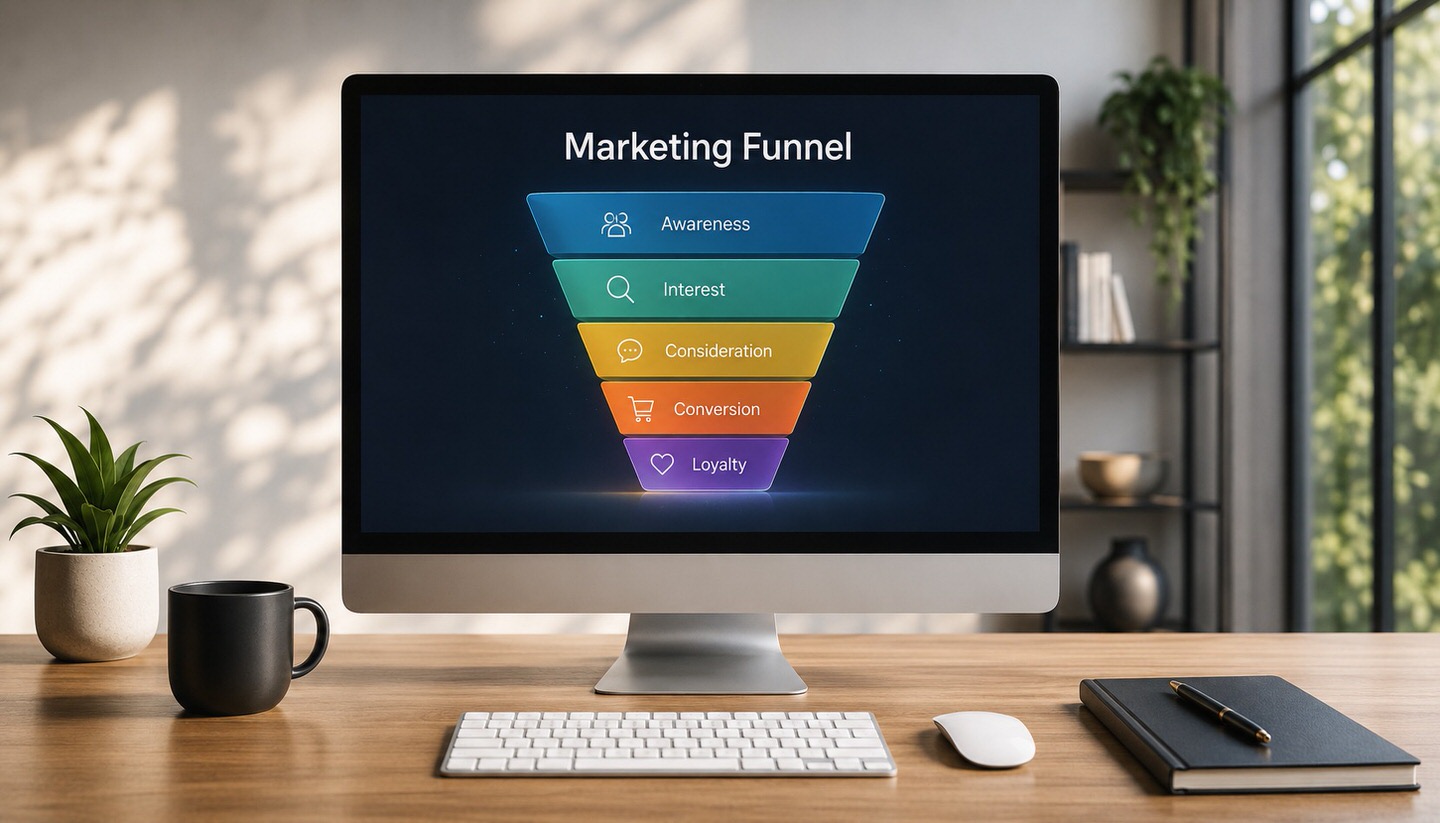
A funnel (known as a "Trichter" in German) is a marketing model that maps the journey of a potential customer from the first awareness of a brand to the desired action and beyond. The image of the funnel is deliberately chosen: at the top, the wide opening, many prospects enter. With each subsequent stage, the number decreases as some drop out. At the bottom, the narrow end, only those who actually convert arrive—meaning they make a purchase, sign up, or make an enquiry.
The funnel is therefore one of the most fundamental conceptual models in all of online marketing. It helps businesses understand at which stage a prospect is, where people are lost, and which measures make sense at which point.
The Three Broad Funnel Levels: TOFU, MOFU, BOFU
A widely used classification in marketing divides the funnel into three levels, often referred to by their English abbreviations:
- TOFU (Top of the Funnel): The top, broadest level. The focus here is on awareness and reach. People have a problem or interest but do not yet know the solution or brand. Suitable content includes informative materials such as guides and blog articles.
- MOFU (Middle of the Funnel): The middle level. Prospects are comparing options and seriously considering a solution. Suitable content includes in-depth materials such as comparisons, case studies, or webinars.
- BOFU (Bottom of the Funnel): The lowest, narrowest level. The decision is imminent here. Suitable content includes concrete, conversion-focused materials such as product pages, offers, demos, or testimonials.
This classification is particularly helpful in creating content tailored to each phase, rather than offering the same content to all prospects regardless of their stage.
Different Funnel Terms and How They Relate
Several terms circulate around the funnel, which can easily become confusing. They essentially describe the same funnel model from different perspectives:
- Marketing Funnel: Emphasises the marketing perspective, i.e., how awareness is generated and interest is built (primarily the upper levels).
- Sales Funnel: Emphasises the sales perspective, i.e., how prospects become paying customers (primarily the lower levels).
- Conversion Funnel: Emphasises the concrete sequence of phases leading to conversion and is closely linked to web analytics.
In practice, these terms are often used synonymously. What matters less is the exact distinction and more the shared underlying principle: the step-by-step progression from first contact to conversion.
Content Along the Funnel
Perhaps the greatest practical benefit of funnel thinking lies in content alignment. A person at the top of the funnel needs different content than someone close to making a purchase. By taking this into account, you can address prospects appropriately at every stage: inform and build trust at the top, convince and compare in the middle, and facilitate the conversion at the bottom. This approach directly ties into search intent (User Intent), as the phase in the funnel often reflects the type of search query.
Criticism of the Classic Funnel: The Flywheel Model
An important modern consideration: the classic funnel model has a weakness. It ends with the purchase and does not further address the customer. However, existing customers are particularly valuable as they can make repeat purchases and refer others. As a further development, the image of the flywheel has therefore become established. Unlike the linear funnel, it is circular: satisfied customers drive new prospects into the system through referrals. Customer retention here is not an endpoint but part of a self-reinforcing cycle. Many modern strategies therefore extend the funnel to include a post-purchase phase.
Why Is the Funnel Model Important?
- Identify Weak Points: The funnel shows at which stage many prospects drop out, revealing potential for optimisation.
- Targeted Communication: Measures and content can be tailored to the respective phase.
- Efficient Resource Allocation: Budget and effort are directed where they have the greatest impact.
- Shared Understanding: Marketing and sales discuss the same phases and collaborate more effectively.
Conclusion
A funnel is the fundamental marketing model that maps the journey from first contact to conversion in phases. The division into TOFU, MOFU, and BOFU helps address prospects appropriately at every stage, particularly with the right content. Whether it’s a Marketing Funnel, Sales Funnel, or Conversion Funnel: the core principle is always the same step-by-step progression. What’s important is the modern awareness that the funnel should not end with the purchase—the flywheel model consciously includes the valuable phase of customer retention. Those who use funnel thinking to understand where prospects stand and where they are lost can improve their measures in a targeted way and guide more people to the goal.