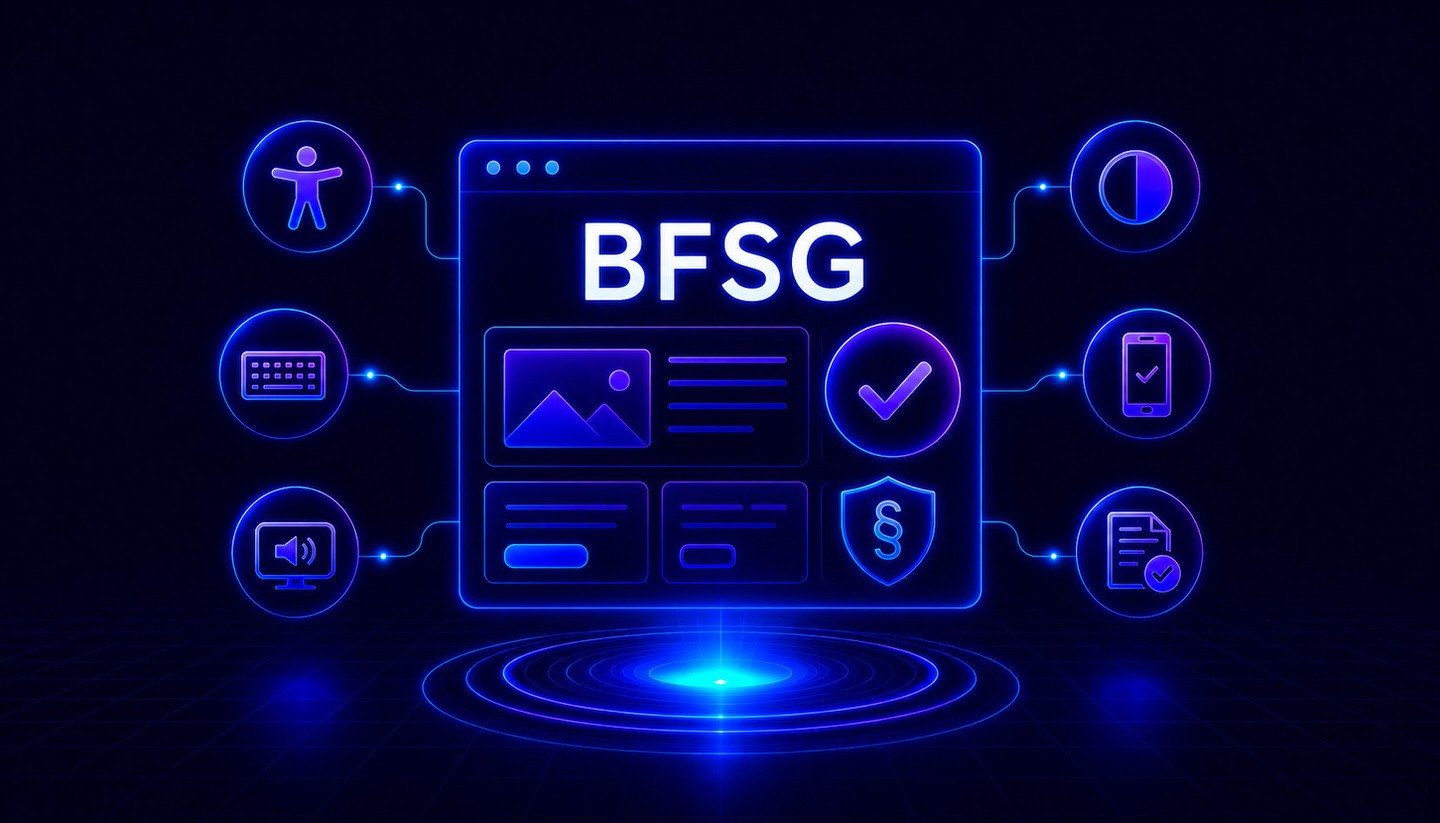
EAA - BFSG (Accessibility Reinforcement Act)
The Accessibility Reinforcement Act (EAA / BFSG) mandates accessibility for digital products and services from 2025 under the EU directive.
What is the BFSG?
The Barrier-Free Strengthening Act (BFSG) is a German law that mandates accessibility for certain digital products and services. It transposes the European Accessibility Act (EAA, Directive EU 2019/882) into German law and has been in effect since 28 June 2025. The aim is to enable people with disabilities to participate equally and without discrimination in digital life.
For website operators, this means: websites, online shops, and apps covered by the law must be designed so that they are perceivable, operable, and understandable for people with disabilities.
Who is affected by the BFSG?
The BFSG primarily targets companies that offer digital services to end consumers (B2C). These include in particular:
- Online shops and e-commerce providers
- Websites through which services are booked or contracts concluded
- Banking, telecommunications, and passenger transport services
- Apps with corresponding functions
Important: Even initial contact to initiate a business transaction, such as via a contact form, can already be considered an electronic service and may trigger the law.
Who is exempt?
- Micro-enterprises for services: Service providers with fewer than 10 employees and an annual turnover or annual balance sheet total of no more than 2 million euros are exempt from the obligations. However, this exemption does not apply to companies that manufacture or distribute products covered by the law.
- Pure B2B offerings: Services that are exclusively aimed at business customers are not subject to the BFSG.
- Archive content: Content published before 28 June 2025 that has not been updated since is considered archived and is exempt.
Note: Even those who are not legally obliged benefit from accessibility, as it improves usability for everyone and opens up additional target groups.
What are the specific requirements?
The law itself does not specify technical details but refers to the European standard EN 301 549. This, in turn, is based on the internationally recognised Web Content Accessibility Guidelines (WCAG) version 2.1, conformance level AA. In practice, this means, among other things:
- Perceivability: Alt text for images, sufficient colour contrast, and scalable fonts.
- Operability: The entire website must be operable without a mouse, using only the keyboard.
- Understandability: Clear language, logical navigation, and understandable forms with unambiguous error messages.
- Robustness: The website must function reliably with assistive technologies such as screen readers, which requires clean, semantic HTML code.
The Accessibility Statement
Affected providers must also provide a so-called accessibility statement. This explains, among other things, how the requirements are met and how users can report barriers. This statement should be easily accessible on the website, similar to the imprint and privacy policy.
What are the consequences of non-compliance?
Compliance is monitored by the market surveillance authorities of the federal states. Non-compliance may result in orders for rectification and fines. Additionally, there is a risk of warnings under competition law. Unlike some other regulations, there is no general transition period for affected websites and online shops; the obligation has applied directly since the deadline.
What advantages does accessibility offer beyond the legal obligation?
- Greater reach: A significant portion of the population lives with permanent or temporary disabilities. Accessibility opens up these target groups.
- Better user experience for all: Clear structures, good contrasts, and understandable navigation benefit every visitor.
- SEO benefits: Many accessibility requirements overlap with good search engine optimisation, such as clean HTML code, meaningful heading structure, alt text, and descriptive link texts. What helps screen readers also helps search engine crawlers.
Conclusion
The BFSG makes digital accessibility a legal obligation for many companies and has been in effect since 28 June 2025. Primarily affected are B2C providers, while micro-enterprises for services and pure B2B offerings are exempt. The technical guidance is provided by WCAG 2.1 at level AA. Website operators should check their sites early, as accessibility is not only a legal necessity but also improves user experience and search engine optimisation.
Note: This text is for general information and does not replace legal advice. For specific questions regarding applicability and implementation, expert legal counsel should be sought.