On-Page Optimization
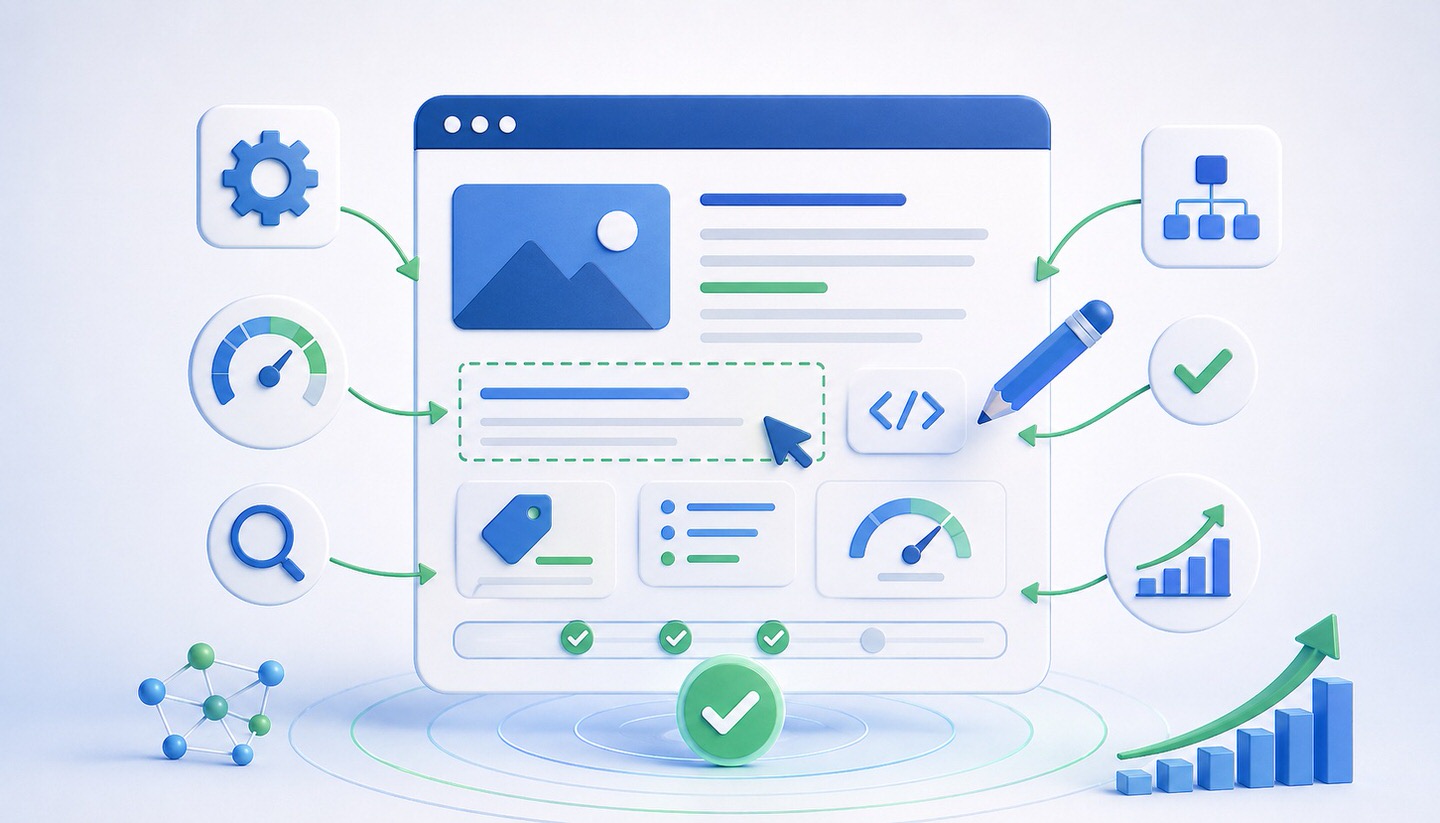
On-page optimization includes all SEO measures on your own website, from content and technology to structure, forming the foundation of every SEO strategy.
What is On-Page Optimisation?
On-page optimisation (also known as on-page SEO) includes all search engine optimisation measures that take place directly on your own website. This encompasses content, technical design, and the structure of a page. It thus forms the counterpart to off-page optimisation, which focuses on factors outside your own website. Simply put: with on-page optimisation, you have everything under your own control.
This is precisely what makes it the foundation of every SEO strategy. The best external signals are of little use if your own site does not convince in terms of content or technical aspects. On-page optimisation can be broadly divided into three areas: content, technology, and structure.
1. Content Optimisation
Content is the heart of every website and the most important on-page factor. The key is that it meets the search intent of users and covers a topic comprehensively and understandably. Key points include:
- High-quality, relevant texts: Content that provides real added value and answers the questions of the target audience.
- Meaningful keyword usage: The main topic should appear naturally in the text without resorting to keyword stuffing.
- Heading structure: A clear structure with a single H1 and logically subordinate H2 and H3 headings helps both readers and search engines.
- Up-to-dateness: Regularly maintained content is favoured by Google.
2. Technical Optimisation
Technical on-page optimisation ensures that a website can be easily crawled by search engines and provides a pleasant user experience. Important aspects include:
- Loading speed: Fast pages improve user experience and Core Web Vitals.
- Mobile optimisation: Since Google uses mobile-first indexing, the site must function flawlessly on smartphones.
- Clean URLs: Short, descriptive addresses that clearly indicate the page topic.
- Structured data: Markup using JSON-LD helps Google better understand content and enables rich snippets.
- Indexability: Ensuring that important pages can be crawled and indexed, for example, via a correct robots.txt and an XML sitemap.
3. Structural Optimisation
The structure of a website determines how well users and search engines can navigate it:
- Internal linking: Meaningful links between your own pages distribute link equity and guide visitors to further content.
- Flat hierarchy: Important content should be accessible with as few clicks as possible.
- Breadcrumb navigation: This improves orientation and helps search engines understand the page structure.
The Most Important On-Page Elements at a Glance
Some specific elements deserve special attention as they are crucial for both ranking and click-through rate:
- Title tag: The page title that appears in search results. One of the most important on-page elements overall.
- Meta description: The preview text in search results. Not a direct ranking factor but influences the click-through rate.
- Headings (H1 to H6): Structure the content and signal the thematic hierarchy.
- Alt texts: Describe images for search engines and improve accessibility.
- Descriptive URLs: Clear, understandable addresses.
On-Page and Off-Page: The Interaction
On-page optimisation is the foundation on which all further SEO measures are built. Only when your own site convinces in terms of content and technical aspects do external signals like backlinks develop their full effect. The great advantage of on-page optimisation: it is entirely within your own sphere of influence and can be specifically improved at any time, unlike off-page factors, which depend on the rest of the web.
Conclusion
On-page optimisation encompasses all SEO measures on your own website, from high-quality content to technical performance and a well-thought-out structure. It is the controllable and thus fundamental pillar of search engine optimisation. Those who work meticulously here create the conditions for a website to be well understood by search engines, frequently visited by users, and effectively complemented by off-page measures.