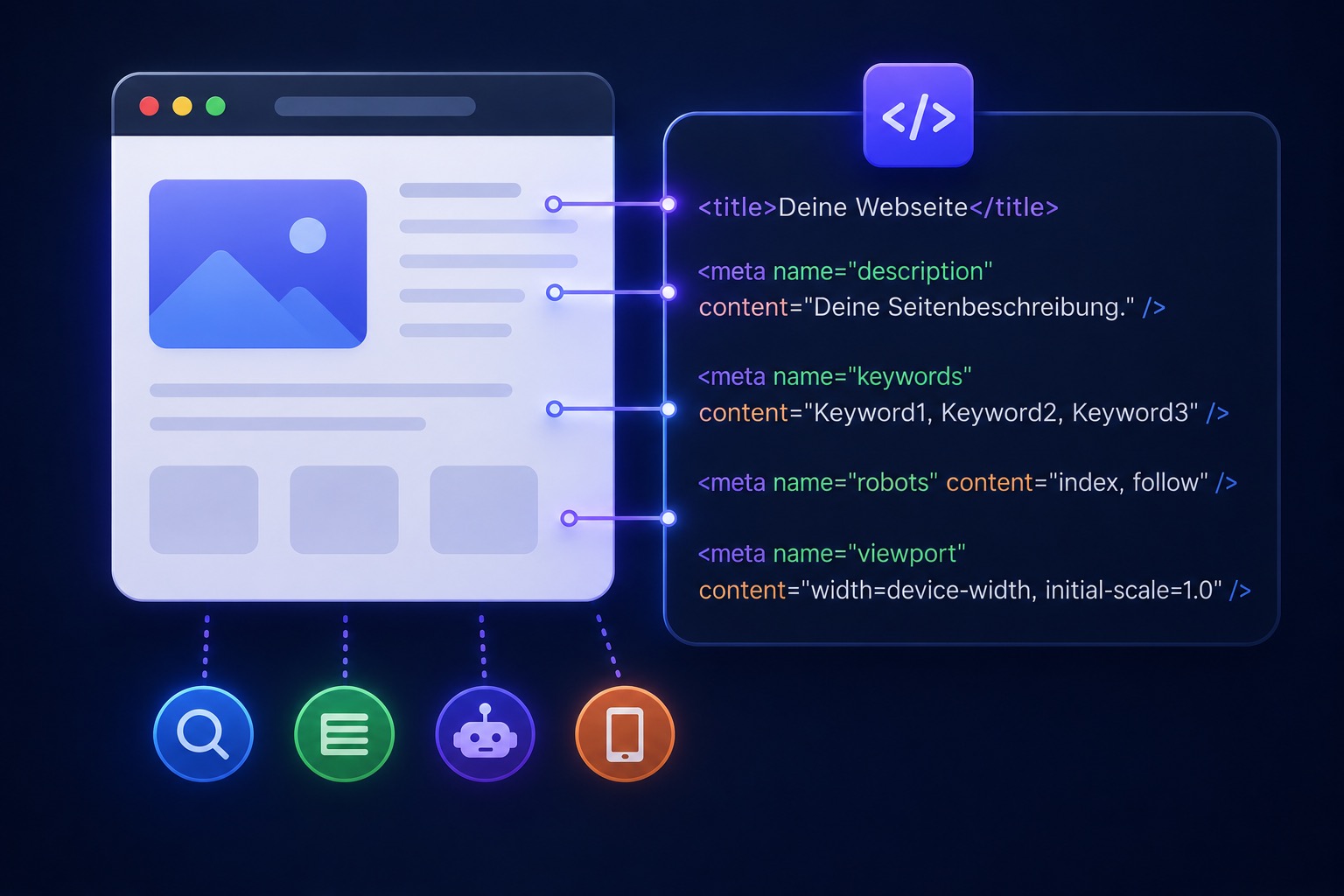
Meta Tags
Meta tags provide invisible information for search engines - we explain which ones matter today and which you can ignore.
What Are Meta Tags?
Meta tags are HTML elements located in the head section of a webpage (within the <head>) that provide information about the page, known as metadata. They are not visible to visitors on the page itself but are intended for browsers, search engines, and other systems, such as social networks. In simple terms, meta tags are additional pieces of information that communicate in the background what a page is about and how it should be handled.
For search engine optimization (SEO), meta tags are a classic topic. It’s important to consider them carefully, as not all meta tags are still relevant today. Some influence how a page appears in search results or how it is crawled, while others have long been ignored by Google.
Where Are Meta Tags Located?
All meta tags are found in the <head> section of the HTML document, before the visible content. A typical head section might look like this:
<head>
  <meta charset="utf-8">
  <meta name="viewport" content="width=device-width, initial-scale=1.0">
  <title>Example Page</title>
  <meta name="description" content="A brief description of the page.">
</head>
An Overview of the Most Important Meta Tags
- Meta Description: A brief description of the page content, often displayed as a preview text in search results. While it is not a direct ranking factor, it influences the click-through rate (CTR) and has its own glossary entry.
- Meta Robots: Controls how search engines handle the page, such as whether it should be indexed (
index) or not (noindex) and whether links should be followed (followornofollow). One of the most important meta tags for technical SEO. - Meta Charset: Defines the character encoding (usually
utf-8) to ensure that umlauts and special characters are displayed correctly. - Meta Viewport: Ensures that the page adapts to the screen size, forming the basis for responsive design and mobile display.
A Closer Look at the Meta Robots Tag
The meta robots tag deserves special attention as it directly controls indexing. For example:
<meta name="robots" content="noindex, follow">This instruction tells search engines: Do not include this page in the index, but follow the links on it. It’s important to note the relationship with robots.txt: For Google to read a noindex directive, the page must be crawlable. If the page is blocked via robots.txt, the instruction cannot be read. For non-HTML files like PDFs, the X-Robots-Tag serves the same purpose.
The Biggest Misconception: The Meta Keywords Tag Is Dead
A persistent myth concerns the meta keywords tag, which was once used to list the target keywords of a page. Here’s a clear clarification: Google has completely ignored this tag for many years. It has no influence on rankings. In the past, it was heavily abused for spam, which is why it has long been irrelevant. Filling out the meta keywords tag is therefore a waste of time and can even reveal your keyword strategy to competitors. If you come across old guides recommending this tag, you should ignore that advice.
Meta Tags for Social Networks: Open Graph
A special group of meta tags controls how a link appears when shared on social networks. The best-known are Open Graph tags (recognizable by the og: prefix), originally introduced by Facebook and now widely used. They determine which title, description, and preview image appear when sharing:
<meta property="og:title" content="Title when sharing">
<meta property="og:description" content="Description when sharing">
<meta property="og:image" content="https://www.example.com/image.jpg">
While these tags are not a direct ranking factor, they influence how appealing a shared link appears and, consequently, how often it is clicked. They are therefore very valuable for social media marketing.
Which Meta Tags Are Truly Important Today?
- Important and relevant: Meta Description (for CTR), Meta Robots (for indexing control), Meta Charset and Meta Viewport (technical foundations), and Open Graph tags (for sharing).
- Irrelevant: The Meta Keywords tag.
An important side note: The page title (<title>) is technically not a meta tag but a separate HTML element. Since it is also located in the <head> and is very important for SEO, it is often mentioned in the same context.
Conclusion
Meta tags are invisible pieces of information in the head section of a webpage that tell browsers, search engines, and social networks what the page is about and how it should be handled. The key is to distinguish between relevant and outdated tags: Meta Description, Meta Robots, Charset, and Viewport, as well as Open Graph tags, are important today, while the Meta Keywords tag is completely irrelevant. When used correctly, meta tags ensure that a page is displayed correctly from a technical standpoint, indexed properly, presented attractively in search results, and shared effectively on social networks. They are therefore part of the foundation of a technically well-optimized website.