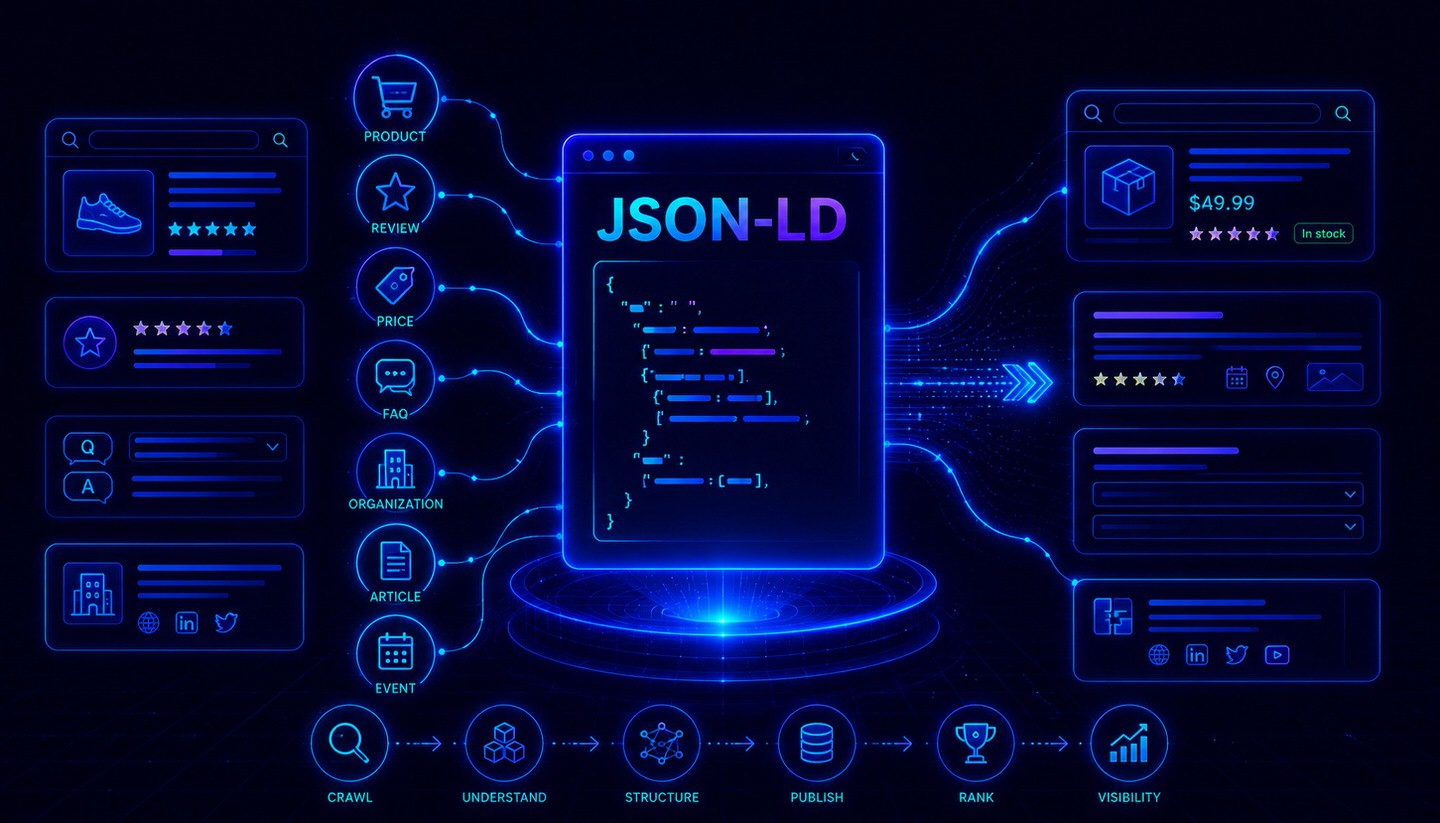
JSON-LD
JSON-LD is the structured data format recommended by Google, helping search engines accurately understand and display content.
What is JSON-LD?
JSON-LD stands for "JavaScript Object Notation for Linked Data" and is a format used to embed structured data into a website. Structured data refers to additional information in the source code that explains to a search engine what a page is specifically about. For example, it can indicate that a certain number is a price, that a text represents a review, or that a piece of information shows a company's opening hours.
While humans intuitively grasp the context of a page, search engines need clear hints. JSON-LD provides these hints in a machine-readable format without altering the visible content of the page.
JSON-LD and Schema.org
JSON-LD is merely the format, i.e., the technical notation. The actual vocabulary that defines which terms and properties exist comes from Schema.org. This is a shared standard supported by Google, Microsoft (Bing), Yahoo, and Yandex, among others.
The combination is as follows: Schema.org provides the terms (e.g., "Product," "Recipe," "Organization," or "FAQPage"), and JSON-LD is the format in which these terms are written into the page. Google explicitly recommends JSON-LD as the preferred format over older alternatives like Microdata and RDFa.
What does JSON-LD look like?
JSON-LD is embedded in a <script> block, usually in the <head> of the page. Here’s a simple example for a local business:
<script type="application/ld+json">
{
  "@context": "https://schema.org",
  "@type": "LocalBusiness",
  "name": "Example GmbH",
  "address": {
    "@type": "PostalAddress",
    "streetAddress": "Musterstraße 1",
    "addressLocality": "Berlin",
    "postalCode": "10115",
    "addressCountry": "DE"
  },
  "telephone": "+49-30-1234567",
  "openingHours": "Mo-Fr 09:00-18:00"
}
</script>
The entry @context refers to the Schema.org vocabulary, @type specifies the type of object, and the additional fields describe the specific properties.
Why is JSON-LD important for SEO?
Structured data with JSON-LD does not directly improve rankings, but it significantly influences how a page is displayed in search results. This makes it valuable for SEO and online marketing:
- Rich Snippets (Rich Results): These are enhanced search results that go beyond the basic title and description. Examples include star ratings for products, price information, cooking times for recipes, or expandable FAQ sections. Such results stand out visually and often increase the click-through rate (CTR).
- Knowledge Panels: These are the info boxes that appear on the right side of search results for companies, people, or brands. Structured data helps Google collect and correctly assign the information for these panels.
- Better content classification: Google understands more clearly which entities (people, places, products, organizations) are covered on a page through structured data. This supports the thematic classification in the so-called Knowledge Graph.
Important Schema types for website owners
- Organization / LocalBusiness: Basic information about companies, especially important for local providers with addresses and opening hours.
- Product: For online shops, including price, availability, and reviews.
- Article / BlogPosting: For editorial content and blog articles.
- FAQPage: For pages with questions and answers that can appear as expandable elements in search results.
- BreadcrumbList: Displays the breadcrumb navigation so that Google can show the path directly in the search result.
- Review / AggregateRating: For reviews and star ratings.
Relation to GEO and AI search
Structured data is gaining importance beyond traditional search. AI-powered response systems in the context of Generative Engine Optimization (GEO) also benefit from clearly marked-up content. When it is machine-readable which facts, entities, and relationships a page contains, the likelihood increases that the content will be correctly captured by AI systems and used as a source.
Implementation and testing
There are several ways to implement this in practice:
- WordPress users: SEO plugins like Yoast SEO or Rank Math automatically generate appropriate JSON-LD for many page types without requiring any coding.
- Manual creation: Those who want to embed the code themselves can use tools like the Schema Markup Generator.
- Testing: After implementation, the markup should be checked using the Google Rich Results Test and the Schema Markup Validator from Schema.org. These tools indicate errors and whether the data qualifies for Rich Results.
Important: Structured data must reflect the actual visible content of the page. If reviews or information are marked up that are not visible to users, Google may consider this a violation of guidelines and remove the Rich Results.
Conclusion
JSON-LD is the format preferred by Google for embedding structured data into a website. While it does not directly improve rankings, it leads to more eye-catching search results, supports Knowledge Panels, and helps search engines and AI systems correctly understand content. The effort is manageable, especially since common CMS and plugins largely automate the work. For anyone looking to increase visibility in search results, clean Schema markup with JSON-LD is one of the most rewarding technical SEO measures.