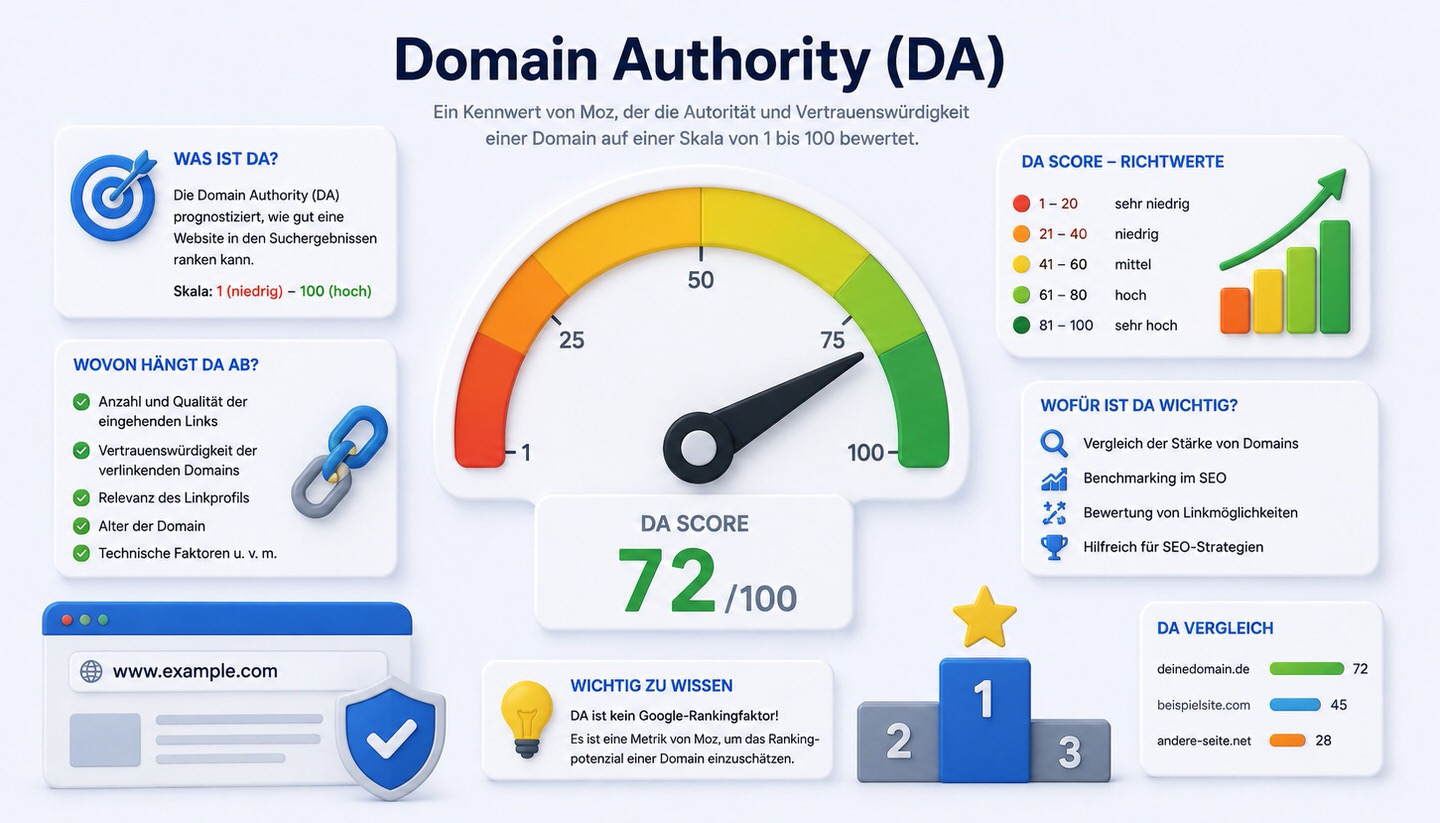
Domain Authority (DA)
Domain Authority (DA) is a metric developed by Moz that evaluates the predicted ranking strength of a website on a scale from 1 to 100.
What is Domain Authority (DA)?
Domain Authority (DA), roughly translated as "domain authority," is a metric that predicts how well a website is likely to rank in search results. The value is given on a scale from 1 to 100, with a higher value indicating a stronger ability to rank. Domain Authority is primarily based on a website's backlink profile, meaning the number and quality of links pointing to it from other websites.
A crucial point and the most common misconception: Domain Authority is not an official Google ranking factor. It was developed by the SEO company Moz and is purely a third-party metric. Google itself has repeatedly confirmed that it does not use such a value.
Who Invented Domain Authority?
Domain Authority was created by the software provider Moz and is an estimated comparative metric, not a value provided by Google. The concept is inspired, among other things, by the PageRank principle, which evaluates the importance of a page based on its links. Important to note: Other providers have developed their own, very similar metrics:
- Domain Authority (DA): by Moz
- Domain Rating (DR): by Ahrefs
- Authority Score (AS): by Semrush
These values all measure a similar concept but are calculated differently. Therefore, the same website can have significantly different values across various tools. A direct comparison between the metrics of different providers is thus not meaningful.
How is Domain Authority Calculated?
Moz calculates Domain Authority using a machine learning process that evaluates numerous signals related to the backlink profile. The most important influencing factors are:
- Referring Domains: The number of different, high-quality websites linking to your own site.
- Quality of Backlinks: Links from trustworthy, topic-relevant sites count significantly more than many low-quality links.
- Total Number of Links: The entire link profile is also taken into account.
- Spam Detection: Modern versions of the metric attempt to identify and devalue manipulative or low-quality links.
Since DA is based on a logarithmic scale, it becomes increasingly difficult to gain further points as the value rises. Increasing the score from 20 to 30 is significantly easier than from 70 to 80.
What is Domain Authority Useful For, and What is It Not?
Despite its popularity, DA must be correctly interpreted. It is a useful tool but not an end in itself:
- Useful as a Comparative Value: DA is well-suited for comparing your own site with competitors and roughly assessing the strength of your backlink profile.
- Useful for Monitoring Trends: The development of your own value over time can indicate whether SEO efforts are moving in the right direction.
- Not Useful as an Optimization Goal: Trying to "optimize" DA in isolation is misleading. Since Google does not use this value, a higher DA does not directly improve rankings.
- No Guarantee for Good Rankings: Sites with lower DA regularly rank above sites with higher DA if they are more thematically relevant or better fulfill the search intent.
An Important Warning: DA Can Be Manipulated
Because many mistakenly treat Domain Authority as a reliable quality seal, it is deliberately manipulated. A common method is to purchase expired domains with existing backlink profiles and redirect them to a target page to artificially inflate its value. This is particularly relevant in the trade of backlinks and guest posts: A high DA alone, therefore, says nothing about the actual quality of a site. When evaluating links or collaborations, DA should never be considered in isolation but should be supplemented by attention to real organic traffic and thematic relevance.
How to Improve Domain Authority Effectively
Since DA reflects the backlink profile, it improves through the same measures that also benefit real SEO:
- Build High-Quality Backlinks: Organically acquired links from trustworthy, topic-relevant sites.
- Clean Up Harmful Links: Identify and remove low-quality or manipulative links.
- Create Excellent Content: Content so valuable that others link to it voluntarily.
- Solid SEO Foundations: A technically sound site with a good user experience as the foundation.
In other words: Those who practice genuine, sustainable SEO will improve their Domain Authority naturally, without ever needing to target it directly.
Conclusion
Domain Authority is a metric developed by Moz that estimates the ranking strength of a website on a scale from 1 to 100 based on its backlink profile. While it is useful as a comparative and reference value, proper interpretation is crucial: It is not a Google ranking factor, not a quality guarantee, and can even be manipulated. It should therefore be understood as a rough guideline, not a goal. The most sustainable way to achieve a high Domain Authority is the same as for good rankings in general: high-quality content, a cleanly developed backlink profile, and a solid SEO foundation.