API (Application Programming Interface)
An API is a programming interface for structured data exchange between programs - central to automation in online marketing.
What is an API?
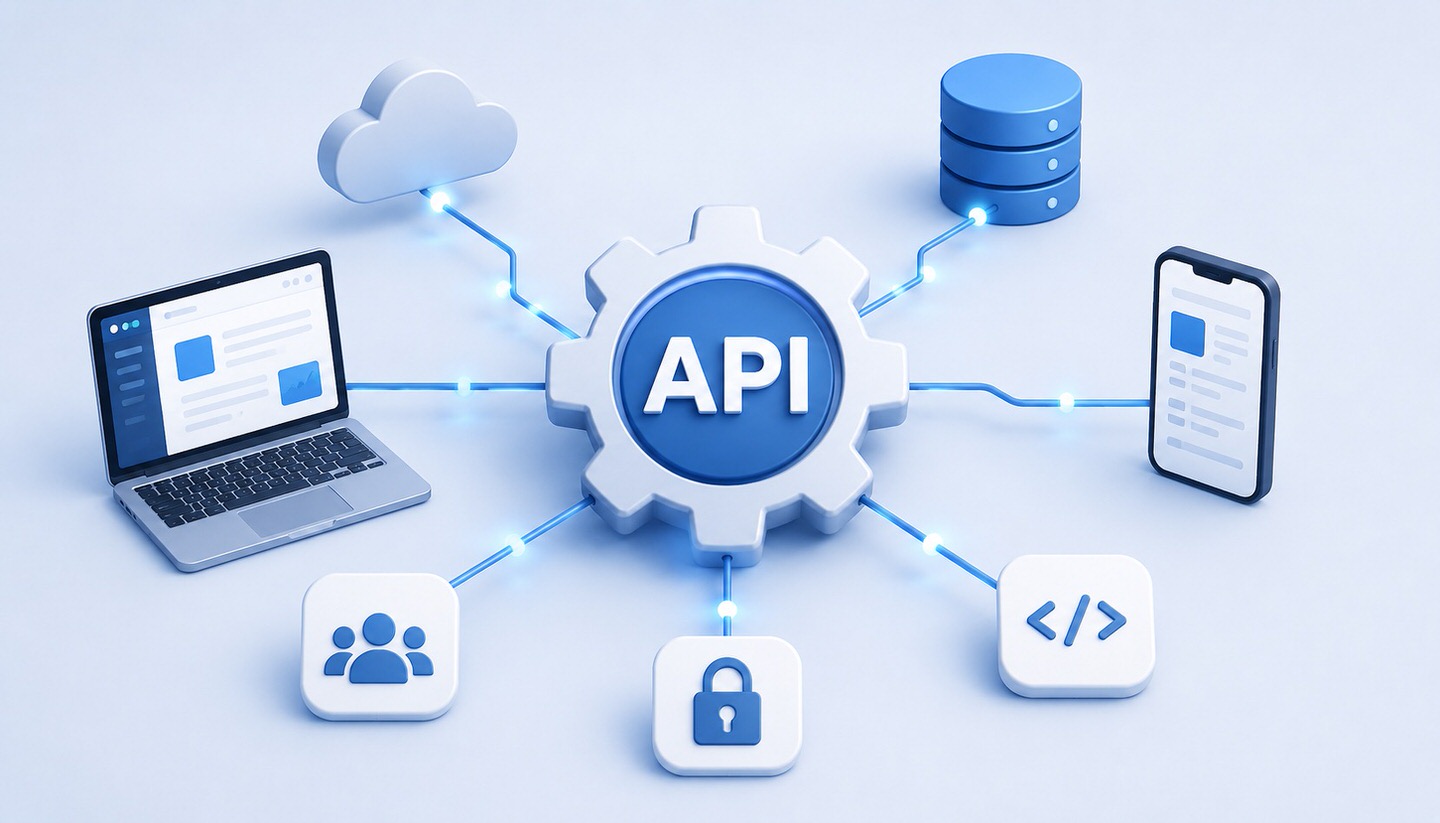
API stands for "Application Programming Interface". An API is a defined interface through which two programs can communicate and exchange data without one service needing to know the internal processes of the other. Simply put, an API is an agreed-upon way for one software to request something from another and receive a response.
A common illustration is the waiter in a restaurant: The guest (a program) places their order with the waiter (the API), who forwards it to the kitchen (the other system) and brings back the finished dish. The guest doesn’t need to know how the kitchen works; they simply use the agreed-upon interface. Similarly, programs exchange data via APIs without revealing their internal details.
How does an API work?
On the web, communication via an API usually follows a simple request-and-response principle:
- Request: A program sends a request to the API, such as "Give me the visitor numbers from last week."
- Processing: The requested system processes the request in the background.
- Response: The API returns the requested data, usually in a structured format like JSON.
The returned data is structured in a way that allows a program to process it automatically. This is where data formats like JSON and XML come into play, which you can already find in your glossary: They serve as the common "language" in which APIs transmit their responses.
Where do you encounter APIs in online marketing?
Even though APIs work in the background, they are used in many areas relevant to marketing:
- Google Search Console API: Enables automated retrieval of SEO data such as search queries and click numbers for integration into custom reports.
- Google Analytics API: Delivers web analytics data automatically to other tools or dashboards.
- Google Ads and Microsoft Ads API: Allow automated management and evaluation of advertising campaigns.
- AI and LLM services: Large language models are usually accessed via an API, for example, to generate texts or analyze data.
- Interfaces between systems: For instance, when an online shop automatically transfers its product data to a comparison portal or a newsletter tool.
- Social media APIs: Enable automated publishing of posts or retrieval of metrics.
What advantages do APIs offer?
- Automation: Recurring tasks like retrieving reports can be automated instead of being done manually.
- Data integration: Data from different sources can be consolidated in a central dashboard.
- Efficiency: APIs save time and reduce errors that occur with manual data transfer.
- Extensibility: APIs allow different tools and services to be connected and combined into larger workflows.
Key terms related to APIs
- API key: An individual access key that identifies an application to the API and secures access. It should be kept confidential.
- Endpoint: The specific address through which a particular function or dataset of an API can be accessed.
- Quota and rate limit: Usage limits that define how many requests are allowed within a certain period. You can find more details in the glossary under the term "Quota".
- REST and JSON: A widely used standard for web APIs (REST), which typically transmits data in the lightweight JSON format.
What does this mean for beginners?
For most website operators, it is not necessary to program with APIs themselves. However, it is important to understand the concept, as APIs often work unnoticed in the background. Many common tools use them automatically: An SEO plugin displaying data from the Search Console, a dashboard consolidating multiple sources, or an AI feature in a content tool all rely on APIs. Understanding what an API is allows you to choose such tools more consciously and better assess their capabilities.
Conclusion
An API is a programming interface through which different programs can exchange data in a structured way and collaborate. In online marketing, it forms the invisible foundation for automation and data integration, such as when retrieving SEO and analytics data, managing advertising campaigns, or using AI services. Even if beginners don’t need to program with APIs themselves, understanding this concept helps in grasping modern marketing tools and their possibilities. APIs are thus a central, albeit often invisible, building block of digital marketing.