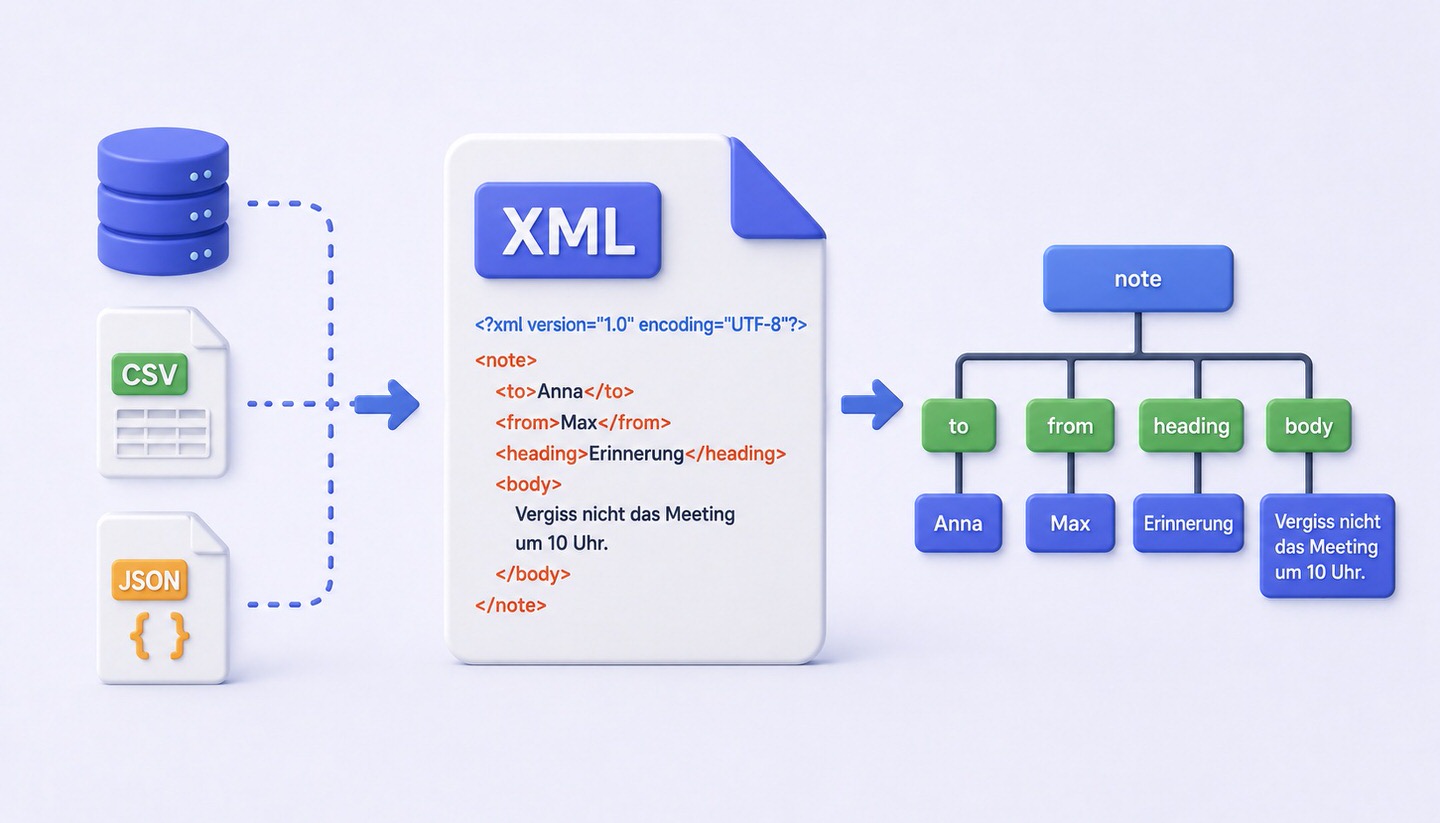
XML (Extensible Markup Language)
XML is an extensible markup language for structured data, essential for SEO (e.g., XML sitemaps) and platform-independent data exchange.
What is XML?
XML stands for Extensible Markup Language. It is a format for storing and exchanging data in a structured way that is readable for both humans and machines. XML does not define how data is displayed but instead describes what the individual data components mean. Information is marked using so-called tags that enclose the content and give it meaning.
Simply put, XML is a kind of universal language that allows different programs and systems to exchange structured data with each other, regardless of the software or platform they use.
How is XML structured?
XML works with tags, similar to HTML. Each piece of content is enclosed by an opening and a closing tag. A simple example:
<book>
  <title>SEO for Beginners</title>
  <author>Max Mustermann</author>
  <year>2026</year>
</book>
Here, it is clearly defined that "SEO for Beginners" is the title, "Max Mustermann" is the author, and "2026" is the year. The tags can be freely chosen, which is where the "Extensible" in the name comes from. Unlike HTML, there are no fixed, predefined tags; instead, you can define them according to the specific purpose.
The difference between XML and HTML
At first glance, XML and HTML look similar, but they serve different purposes:
- HTML is used to display content in a browser. Its tags are predefined (e.g., for headings or paragraphs) and describe how something is displayed.
- XML is used for structuring and exchanging data. Its tags can be freely chosen and describe what a piece of content means, not how it looks.
In simple terms: HTML displays data, while XML transports and describes data.
Where is XML used in online marketing and SEO?
Even though XML works in the background, it is used in several SEO-relevant areas:
- XML Sitemap: The most well-known use case in SEO. The list of all important pages of a website that makes crawling easier for search engines is built in XML format.
- RSS Feeds: Feeds that allow new content (such as blog posts) to be automatically retrieved and distributed are also based on XML.
- Data exchange and interfaces: Many systems exchange data via XML, such as product data between an online shop and a comparison portal.
- Configuration files: Numerous programs and systems use XML to store settings.
XML and JSON: an important comparison
In modern applications, XML is increasingly being supplemented or replaced by the JSON format, especially for data exchange between web services. Both serve the same purpose—structured data transmission—but differ in their syntax:
- XML is more verbose and uses enclosing tags. It is considered very robust and well-suited for complex, deeply nested data.
- JSON is more compact and lightweight, making it particularly popular for web applications and programming interfaces (APIs).
In the SEO context, this comparison is particularly relevant for structured data: While sitemaps use XML, the JSON-based format JSON-LD is now commonly used for schema markup and recommended by Google.
Advantages of XML
- Platform-independent: XML can be processed by almost any software and on any system.
- Structured and clear: The clear markup makes data easily machine-readable and understandable.
- Flexible: Due to the freely definable tags, XML can be adapted to almost any use case.
- Human-readable: Unlike purely binary formats, an XML file can be opened and understood directly.
Conclusion
XML is an extensible markup language that structures data in a platform-independent way, making it readable for both humans and machines. Unlike HTML, it does not describe how data is displayed but rather its meaning and structure. In online marketing, XML is primarily encountered in the form of XML sitemaps and RSS feeds. Although the more lightweight JSON format has gained importance in many modern applications, XML remains an important and widely used standard for structured data exchange.