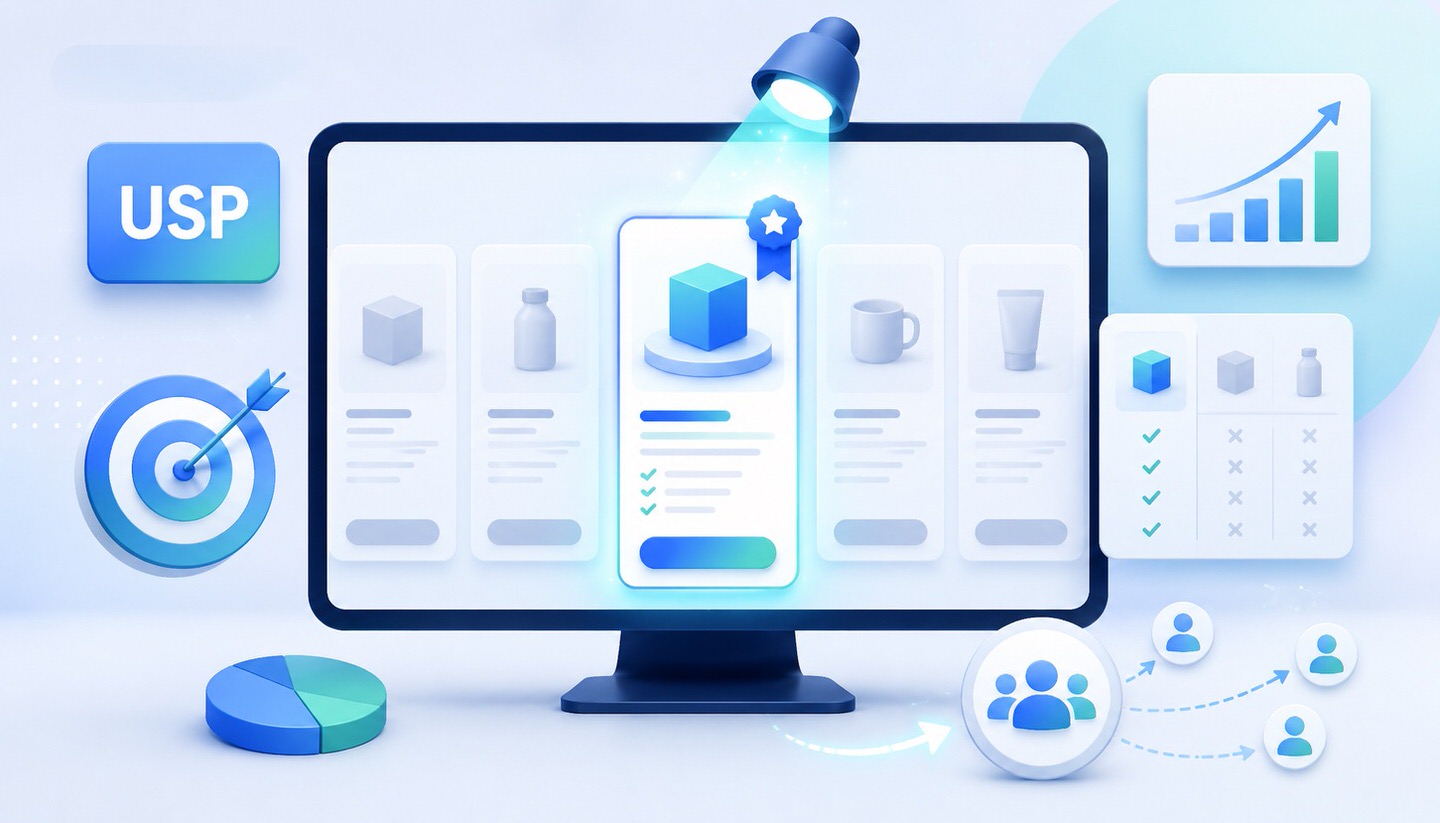
USP (Unique Selling Proposition)
USP (Unique Selling Proposition) is the unique feature that sets your offering apart from the competition and convinces customers.
What is a USP?
USP stands for Unique Selling Proposition, often translated into German as "Alleinstellungsmerkmal" (unique selling point) or "einzigartiges Verkaufsversprechen" (unique sales promise). It refers to the one clearly highlighted feature that sets a product, service, or brand apart from the competition. The USP answers the central question every customer asks: "Why should I choose this particular offer and not that of a competitor?"
In a market where many offerings may seem interchangeable at first glance, a clear USP is crucial. It gives potential customers a concrete reason to choose a brand and forms the foundation of a compelling positioning strategy.
What makes a good USP?
Not every feature qualifies as a unique selling point. An effective USP ideally meets several criteria:
- Unique: It stands out from competitors. A feature that everyone offers is not a USP.
- Relevant: It addresses a real need or problem of the target audience. Uniqueness alone is useless if it doesn’t interest anyone.
- Clear and understandable: It can be summed up in one sentence.
- Credible: It must be deliverable. An empty promise does more harm than good.
Important to note: A USP doesn’t have to be an objectively unique product feature. Even a special service, a clear brand promise, or a particular style of communication can form an effective USP.
Examples of USP Types
- Quality: Particularly high-quality materials or craftsmanship.
- Price: The most affordable offer in the market (often difficult to maintain long-term).
- Service: For example, an exceptionally long warranty, fast shipping, or outstanding support.
- Specialisation: Focus on a specific niche or target group.
- Values and attitude: Such as sustainability, regional production, or fair manufacturing.
The USP in Online Marketing
In digital marketing, the USP is omnipresent, as it runs through almost all channels and content:
- Website: The USP should be prominently communicated on the homepage, ideally in the visible area, so visitors immediately understand what makes the offer special.
- Advertising: In SEA and social ad campaigns, a clear USP helps stand out from competing ads and increases the click-through rate.
- Meta Description and Title: A USP in the search result snippet can significantly boost the click-through rate.
- Conversion Optimisation: A clearly formulated USP removes doubts for visitors and supports the decision-making process, which can directly impact the conversion rate.
USP and Related Terms
The USP is occasionally confused with similar concepts:
- USP vs. Slogan: The USP is the substantive unique selling point, while the slogan is a catchy linguistic packaging. Both can coincide but don’t have to.
- USP vs. Value Proposition: The Value Proposition (value promise) is more comprehensive and describes the overall value of an offer, whereas the USP specifically highlights the one differentiating feature.
How to Find Your Own USP?
- Understand your target audience: What are their real needs and problems?
- Analyse the competition: What do competitors offer, and where is there a gap?
- Identify your own strengths: What can your offer do better or differently than others?
- Find the intersection: The ideal USP lies where your own strength meets a real customer need that the competition does not cover.
Conclusion
The USP is the central unique selling point that distinguishes a brand or offer from the competition and answers the crucial question of why a customer should choose it. A good USP is unique, relevant, clear, and credible. In online marketing, it runs through all channels—from the website to ads to search result snippets—and influences click-through rates and conversions. Those who find their USP at the intersection of their own strengths and real customer needs and communicate it consistently create the foundation to stand out clearly in a crowded market.