User Engagement
User engagement reveals how actively users interact with websites - a key indicator of quality and relevance in online marketing.
What is User Engagement?
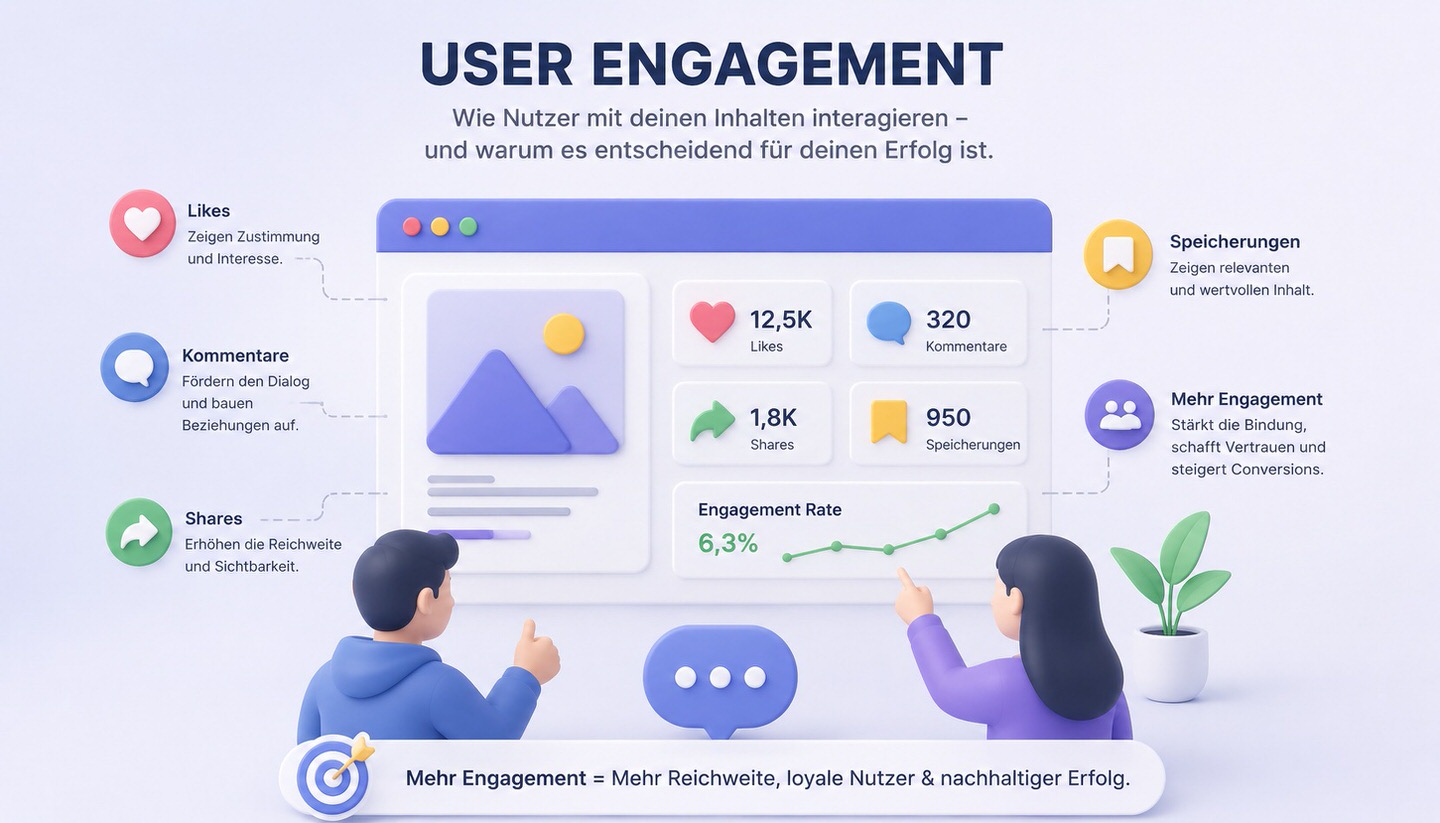
User Engagement (known in German as Nutzerinteraktion or Nutzerengagement) describes how actively and intensively visitors interact with a website, app, or content. It’s not just about how many people visit a page, but what they do there: Do they keep reading, click through, comment, share, or return? User Engagement thus measures the quality of the relationship between the user and the offering, not just the pure reach.
In online marketing, User Engagement is an important indicator of whether content is truly relevant and appealing. High visitor numbers alone mean little if users leave immediately. Only engagement shows whether an offering actually sparks and retains interest.
How Can User Engagement Be Measured?
Engagement is reflected in numerous measurable signals. The most important ones are:
- Time on Page: How long do visitors stay on a page?
- Pages per Session: How many pages does a user view per visit?
- Bounce Rate: How many visitors leave the page without further interaction?
- Interactions: Clicks, scroll depth, video plays, or form completions.
- Social Signals: Likes, comments, and shares of content on social media.
- Returning Visitors: How many users come back again?
User Engagement and the Engagement Rate
Closely related to the term is the Engagement Rate, which summarizes engagement in a concrete metric. In Google Analytics 4 (GA4), this value has a fixed definition: A session is considered "engaged" if it lasts longer than 10 seconds, triggers at least one key event, or includes at least two page views. The Engagement Rate has thus become the central measure of user interaction in GA4 and has largely replaced the former bounce rate.
Why Is User Engagement Important for SEO?
User Engagement and search engine optimization are closely linked, as engagement signals provide clues about the quality and relevance of a page:
- Positive User Signals: If visitors stay long and interact, Google interprets this as a sign that the page fulfills the search intent.
- Low Bounce Rate: If users don’t immediately return to the search results, this signals satisfaction with the content.
- Indirect Impact: High engagement often leads to more shares and backlinks, which in turn strengthens visibility.
It’s important to have a realistic perspective: Engagement signals are not a simple, direct ranking factor that can be "optimized" in isolation. Rather, they reflect whether content is good. Those who provide high-quality, relevant content automatically generate more engagement, which has a positive effect.
How Can You Increase User Engagement?
- Relevant, High-Quality Content: The foundation of any engagement. Content must meet the needs of the target audience and match the search intent.
- Good Readability and Structure: Clear texts with subheadings, short paragraphs, and a logical structure encourage further reading.
- Fast Loading Times: Long wait times are one of the most common reasons for immediate bounces.
- Internal Linking: Further links keep visitors on the site longer and encourage them to explore more content.
- Interactive Elements: Videos, surveys, or calculators increase participation.
- Clear Calls-to-Action: Explicit CTAs guide users to the next meaningful action.
Conclusion
User Engagement describes how actively users interact with a website or content and is an important benchmark for its quality and relevance. It reveals what lies behind mere visitor numbers: whether an offering truly convinces and retains users. For SEO, engagement is particularly significant because it reflects whether content meets user expectations. The most sustainable way to increase engagement is not through tricks, but by providing real value: relevant content, a good user experience, and a clear structure. Those who create content for their users automatically generate the engagement that convinces both visitors and search engines.