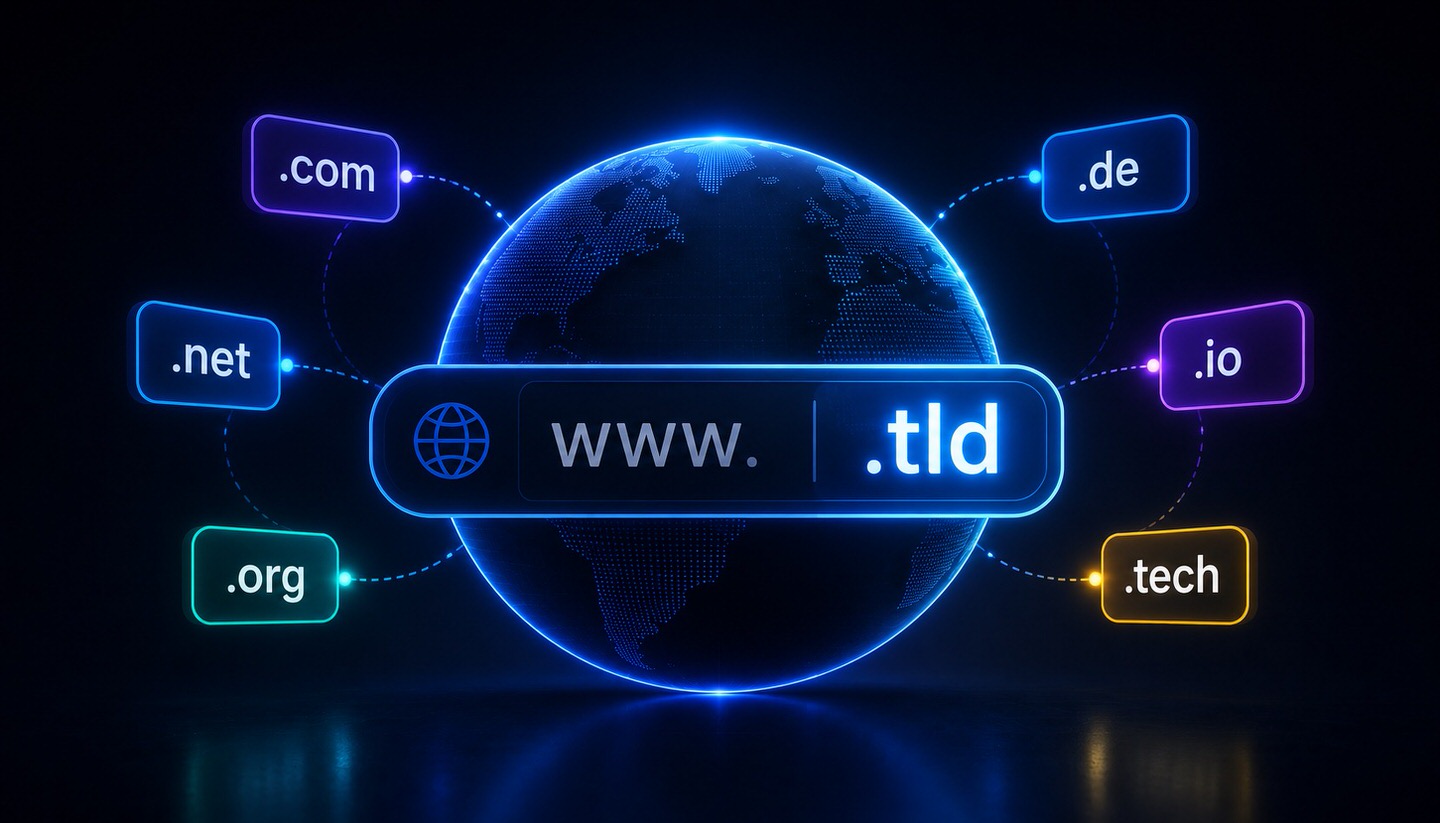
Top-Level Domain (TLD)
A top-level domain (TLD) is the last part of a domain (e.g., .de, .com) and impacts SEO as well as a website's geographic targeting.
What is a Top-Level Domain (TLD)?
The Top-Level Domain (TLD), known in German as the "top-level domain," is the last part of a domain, i.e., the section after the final dot. In "example.de," ".de" is the Top-Level Domain, while in "example.com," it is ".com." The TLD holds the highest position in the hierarchical structure of the Domain Name System and assigns a web address to a specific category or country.
To clarify, let’s look at the structure of a domain: In "www.example.de," "de" is the Top-Level Domain, "example" is the actual domain (also called the Second-Level Domain), and "www" is a subdomain. The TLD is thus the rearmost, overarching component of any web address. For a more detailed explanation of how a domain is structured overall, refer to the dedicated glossary entry on domains.
What types of Top-Level Domains are there?
Top-Level Domains can be divided into several groups:
- Generic TLDs (gTLD): General extensions without a country reference, such as ".com," ".org," ".net," or ".info." The most well-known is ".com."
- Country-specific TLDs (ccTLD): Extensions assigned to a specific country, such as ".de" for Germany, ".at" for Austria, ".ch" for Switzerland, or ".fr" for France.
- New generic TLDs: In recent years, numerous new extensions have been introduced, such as ".shop," ".blog," ".online," ".app," or even city extensions like ".berlin." These significantly expand the available options.
- Special TLDs: Extensions with restricted usage, such as ".gov" for U.S. government agencies or ".edu" for U.S. educational institutions.
The entire system of Top-Level Domains is managed by a central organization called ICANN, which is responsible for the global coordination of domain names.
What role does the TLD play in SEO?
Several nuanced considerations are important here, as there are many misconceptions surrounding TLDs:
- Country TLDs and geographic targeting: A country-specific TLD like ".de" sends a strong signal that a website is targeting that country. This is relevant for geographic targeting and Local SEO. A ".de" domain is therefore advantageous for a German audience but may complicate an international focus.
- Generic TLDs are global: Extensions like ".com" are considered country-neutral and are suitable for an international focus.
- New TLDs do not rank worse: A persistent myth claims that new extensions like ".shop" or ".online" rank worse. Google has clarified that the choice of TLD (aside from the geographic signal of country TLDs) has no direct impact on ranking. All extensions are fundamentally treated equally.
- Keyword in the TLD provides no bonus: An extension like ".shop" does not offer a ranking advantage simply because it thematically fits.
TLD and User Trust
Beyond the technical aspects, user perception plays a role. Established extensions like ".de" or ".com" appear more trustworthy and professional to many people because they are familiar. A few extensions, however, have gained a poor reputation due to widespread misuse for spam, which can trigger distrust among some users. While this is not a direct ranking factor, the choice of TLD can indirectly influence how credible a website appears at first glance.
Which TLD should you choose?
- For a German audience: The ".de" extension is usually the best choice, as it builds trust and clearly signals a focus on Germany.
- For an international focus: A generic extension like ".com" is suitable because it is country-neutral.
- Availability and clarity: The desired domain is often already taken under established extensions. New TLDs can then be an alternative but should fit the brand and remain understandable.
- Targeting multiple countries: If you want to address different countries specifically, you can use country-specific domains and correctly assign them using the hreflang attribute.
Conclusion
The Top-Level Domain is the last part of a domain after the final dot and assigns a web address to a category or country. One distinguishes between generic extensions like ".com," country-specific ones like ".de," and numerous new extensions. For SEO, the key point is: Country TLDs send a strong geographic signal and are thus important for regional targeting, while the choice of TLD otherwise has no direct impact on ranking. New or thematic extensions do not rank worse or better. Beyond the technical aspects, user perception matters: Familiar extensions build trust. For a German audience, ".de" is usually the best choice, while ".com" is suitable for an international focus. Thus, the right TLD supports both the findability and credibility of a website.