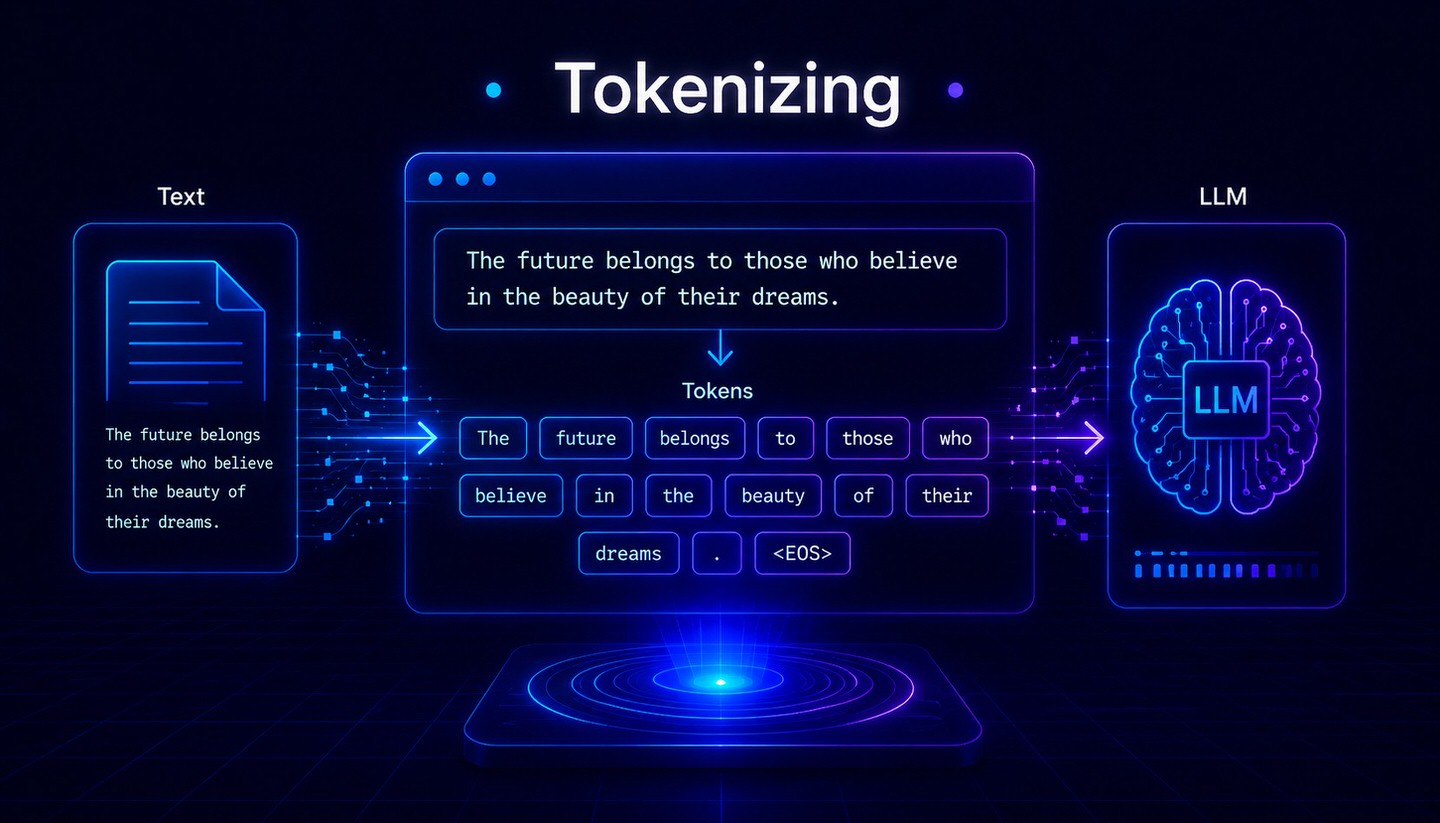
Tokenizing (Tokenization)
Tokenization is the process of breaking down text into tokens so that AI models like GPT can process it—essential for costs and SEO.
What is Tokenization?
Tokenization (tokenizing) is the process of breaking down a text into smaller units called tokens. These tokens are the smallest building blocks that a large language model (LLM) such as GPT or Gemini works with. Before an AI model can process a text, it must first convert it into these tokens, as models do not compute with letters or entire words but with these standardized units.
Simply put, tokenization is the translation of human language into a form that an AI model can further process.
A Token Is Not the Same as a Word
A common misconception is that a token simply corresponds to a word. Modern language models typically use a method called subword tokenization, where words are broken down into meaningful parts. This has a practical reason: it allows the model to process unknown or compound words without needing a separate symbol for every possible word.
A few examples to illustrate:
- Common short words like "and" or "the" are often exactly one token.
- Longer or rarer words are broken down, such as "Suchmaschinenoptimierung" into multiple tokens like "Such", "maschinen", "optimierung".
- Spaces and punctuation can also be separate tokens.
As a rough rule of thumb in English: one token corresponds to about four characters or roughly 0.75 words.
How Does Tokenization Work Technically?
The breakdown follows fixed methods that have been trained on large text corpora. The most common ones are:
- Byte-Pair Encoding (BPE): Starts with individual characters and gradually combines the most frequent character pairs into larger units. Used, among others, in the GPT series.
- WordPiece: A similar method used, for example, in BERT.
- SentencePiece / Unigram: Methods that work language-independently and do not require prior word separation.
After the breakdown, each token is converted into a number and then transformed into a vector (a so-called embedding), which is a mathematical representation of its meaning. Only with these vectors can the model's neural network actually perform computations.
Why Is Tokenization Practically Relevant?
Even those who are not developers benefit from understanding tokenization when working with AI tools:
- Costs: The use of AI models via an API is typically billed per token, both for input and output. Knowing the token count helps to better estimate costs.
- Context Window: Each model can only process a limited number of tokens at once, known as the context window. If a text is longer, it is truncated or must be split. The size is always specified in tokens, not words.
- Efficiency in Prompts: Formulating inputs (prompts) concisely and clearly saves tokens and thus costs and computing time.
Special Consideration for the German Language
An important point for German-speaking regions: German texts usually require more tokens than equivalent English texts. This is due, among other things, to long compound words (composita) as well as umlauts and special characters, which are often broken down into multiple tokens. As a result, a German text can consume noticeably more tokens for the same meaning, which affects both costs and the utilization of the context window.
Relevance to SEO, Content, and GEO
With the rise of AI-powered search (GEO, Generative Engine Optimization), the topic is gaining importance. AI systems do not process content as a whole but break it down into tokens and then evaluate their meaning in context. In practice, this means: clearly structured, unambiguously formulated, and self-contained text sections can be better captured by language models and used for responses. Tokenization itself is not a lever for optimization, but understanding how AI systems "break down" and read text helps to prepare content in an AI-friendly way.
Conclusion
Tokenization is the fundamental first step by which every large language model processes texts. Tokens are not simply words but often smaller parts. For practical work with AI tools, understanding this unit is important because it determines costs, text lengths, and the efficiency of inputs. Especially in German, it is worth handling this consciously, as our language tends to consume more tokens than others. Those who understand how AI systems process text can both work more effectively with these tools and tailor their content more precisely for AI search.