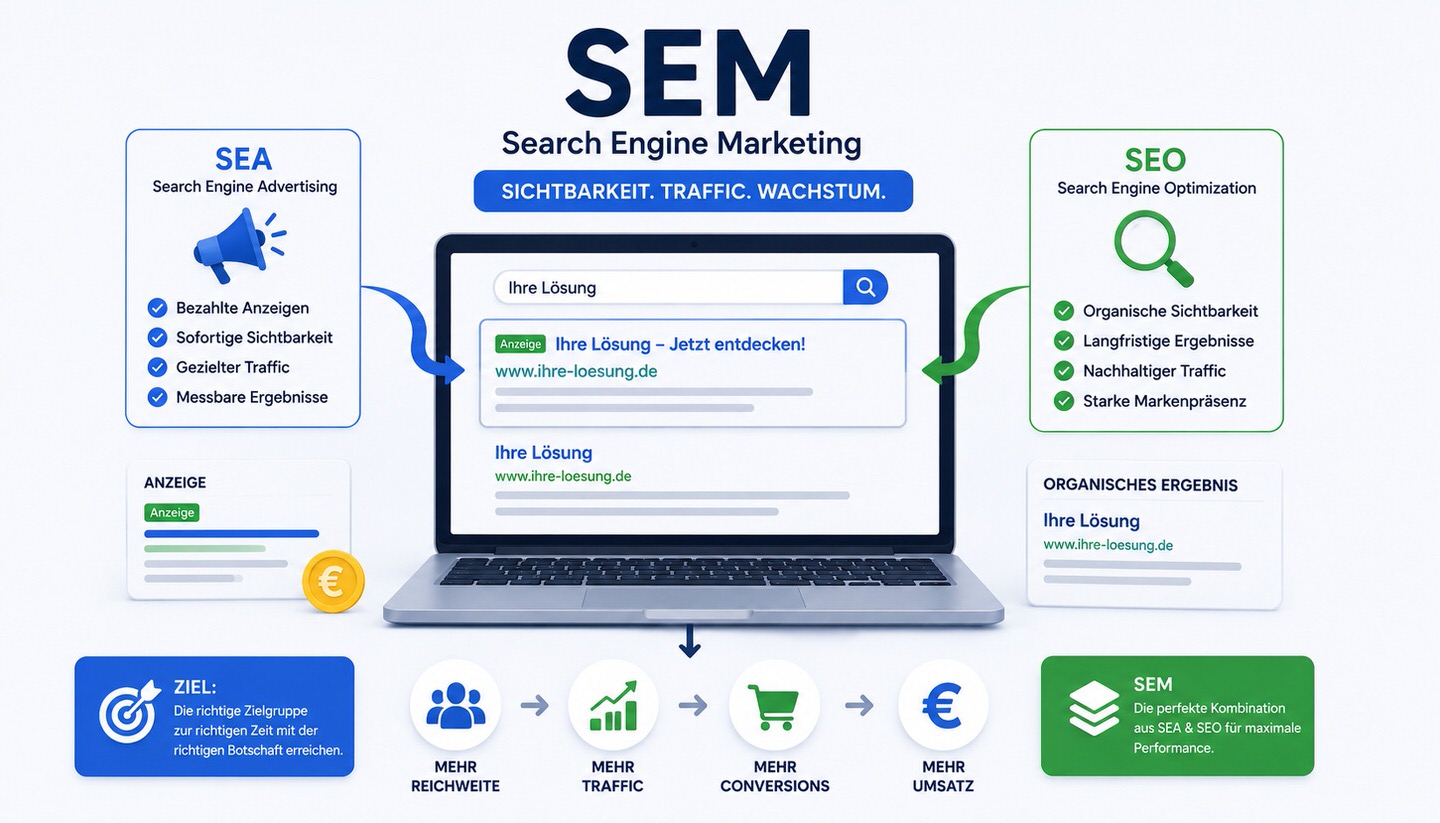
SEM (Search Engine Marketing)
SEM (Search Engine Marketing) is the umbrella term for SEO and SEA to increase visibility in search engines and target customers effectively.
What is SEM?
SEM stands for Search Engine Marketing. It is the umbrella term for all marketing measures aimed at increasing the visibility of a website in search engines. SEM encompasses both unpaid and paid visibility, thus combining two central disciplines under one roof.
The core idea: Search engines like Google are the starting point for most people when they search for information, products, or services. Those who are visible there reach potential customers precisely at the moment they have a specific interest. SEM bundles all strategies to achieve this visibility.
The Two Components of SEM
SEM is divided into two major sub-areas that together make up the entire search engine marketing:
- SEO (Search Engine Optimization): Search engine optimization that targets organic, unpaid results. It builds sustainable visibility through high-quality content, technology, and authority.
- SEA (Search Engine Advertising): Search engine advertising, i.e., paid ads that are immediately visible but incur ongoing costs.
Simplified, the relationship can be represented as follows: SEM is the roof, SEO and SEA are the two pillars beneath it.
An Important Note on Terminology
In practice, the term SEM is not always used consistently. Some use SEM as a pure umbrella term for SEO and SEA together, as described here. Others, especially in the English-speaking world, equate SEM with paid search engine advertising and thus effectively mean only SEA. If you hear or read the term, it is therefore advisable to ask or deduce from the context which meaning is intended. However, the clean, original definition is as an umbrella term.
Why is SEM Important?
- Visibility where people search: SEM reaches users exactly where they are actively searching, which increases relevance and the likelihood of conversion.
- Combination of short- and long-term: SEA can generate visitors immediately, while SEO builds sustainable visibility in parallel.
- Measurability: Both areas can be precisely evaluated and optimized using tools like Google Analytics and the Google Search Console.
- Holistic strategy: SEM considers search engine visibility as a whole, rather than treating SEO and SEA in isolation.
The Interaction of SEO and SEA in SEM
The real strength of SEM lies in the smart interplay of its two pillars. They complement each other on several levels:
- Temporal complementarity: SEA provides immediate visibility, while SEO takes weeks or months to develop its effect. Together, they cover both short-term and long-term needs.
- Mutual learning: SEA campaigns quickly show which keywords and ad texts convert well. These insights can be directly transferred to the SEO strategy.
- Double presence: If you appear for an important keyword both organically and with an ad, you occupy more space on the search results page and appear more prominent.
- Security: If organic visibility fluctuates, for example after a Google update, SEA can temporarily fill the gap.
SEM in Transition Through AI Search
Like all search engine marketing, SEM is also changing due to the increasing use of AI-powered search. AI summaries and answer systems alter how users interact with search results and often lead to queries being answered directly without a click. For SEM, this means that mere placement is losing importance, and it is increasingly important to be present in the various formats of the search results page—organically, paid, and increasingly in AI-generated answers (keyword GEO).
Conclusion
SEM is the umbrella term for all search engine marketing and combines the two pillars SEO and SEA. While SEO builds sustainable, unpaid visibility, SEA ensures immediate, paid presence. The greatest impact is not achieved by one of the two disciplines alone, but through their well-thought-out interplay. Those who understand SEM as a holistic strategy and sensibly combine short-term and long-term measures utilize the full potential of search engines as the most important channel to be visible precisely when potential customers are actively searching.