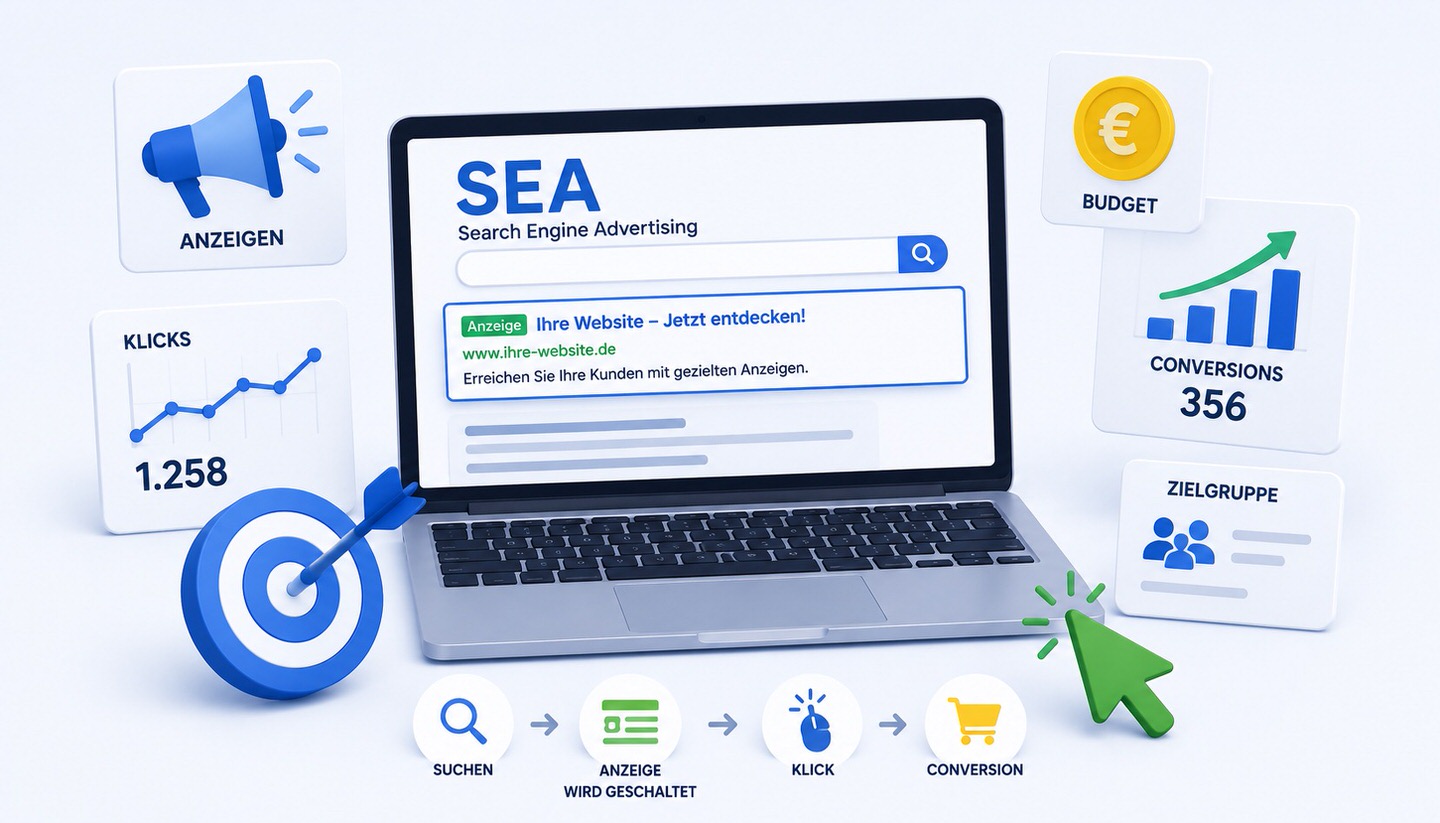
SEA (Search Engine Advertising)
SEA (Search Engine Advertising), or search engine advertising, enables immediate visibility through paid ads on search engines like Google - ideal for fast results.
What is SEA?
SEA stands for Search Engine Advertising. It refers to placing paid ads in the search results of search engines like Google or Bing. These ads usually appear above and below the organic (unpaid) results and are marked as "Ad" or "Sponsored." When a user searches for a specific term, an advertiser can appear with a relevant ad at that exact moment.
The biggest advantage of SEA: visibility is available immediately. While SEO can take weeks or months, an SEA campaign can drive visitors to a website within a very short time. The best-known platform for this is Google Ads.
SEA, SEO, and SEM: How the Terms Relate
These three abbreviations are often confused. Here’s how they connect:
- SEM (Search Engine Marketing): The umbrella term for all search engine marketing.
- SEO (Search Engine Optimization): The area that focuses on organic, unpaid results.
- SEA (Search Engine Advertising): The area that relies on paid ads.
Simply put: SEM is the roof, while SEO and SEA are the two pillars beneath it.
How Does SEA Work?
SEA is typically based on an auction principle combined with keywords. The process looks like this in simplified terms:
- Define keywords: The advertiser determines for which search terms their ad should appear.
- Place a bid: A maximum bid is set for each click (Cost per Click, CPC).
- Create the ad: A relevant ad text is written to match the search query.
- Auction: With every search query, the search engine decides in a fraction of a second which ads appear and in what order.
Important: The highest bid doesn’t always win. In Google Ads, the so-called Ad Rank, which combines bid and Quality Score, determines the outcome. A relevant, high-quality ad with a good landing page can therefore achieve a better position with a lower bid than a poorer ad with a higher bid.
The Most Important Billing Models
- CPC (Cost per Click): The most common model. Costs are only incurred when someone clicks on the ad. This principle is also called Pay per Click (PPC).
- CPM (Cost per Mille): Billing per thousand impressions, more suitable for reach-oriented campaigns.
- CPA (Cost per Acquisition): Billing per completed action, such as a purchase.
Advantages and Limitations of SEA
Advantages:
- Immediate visibility: Ads can drive visitors almost at the push of a button.
- Precise control: Budget, target audience, region, time, and keywords can be defined exactly.
- Full measurability: Every click and conversion can be tracked.
- Easy to test: Ads and landing pages can be quickly optimized through A/B testing.
Limitations:
- Ongoing costs: Once the budget runs out, visibility ends. The effect is rented, not built.
- High competition: In competitive industries, click prices can be very high.
- Ad blindness: Some users consciously ignore paid ads.
SEA and SEO: Not an Either-Or
SEA and SEO are often seen as opposites, but they complement each other perfectly. SEA delivers fast, predictable results and is well-suited for product launches, promotions, or testing which keywords work. SEO builds long-term, cost-free visibility. A well-thought-out strategy combines both: SEA for short-term reach, SEO for a sustainable foundation. Insights from SEA campaigns—such as which search terms and ad texts convert best—can also be valuable for SEO strategy.
Conclusion
SEA covers paid advertising in search engines and, alongside SEO, is the second pillar of search engine marketing. Its biggest advantage is immediate, precisely controllable, and fully measurable visibility, while its biggest drawback is dependence on an ongoing budget. The key to success lies not in the highest bid but in relevant ads, a good Quality Score, and suitable landing pages. SEA is most effective as part of a balanced mix that combines the quick impact of paid ads with the sustainable growth of SEO.