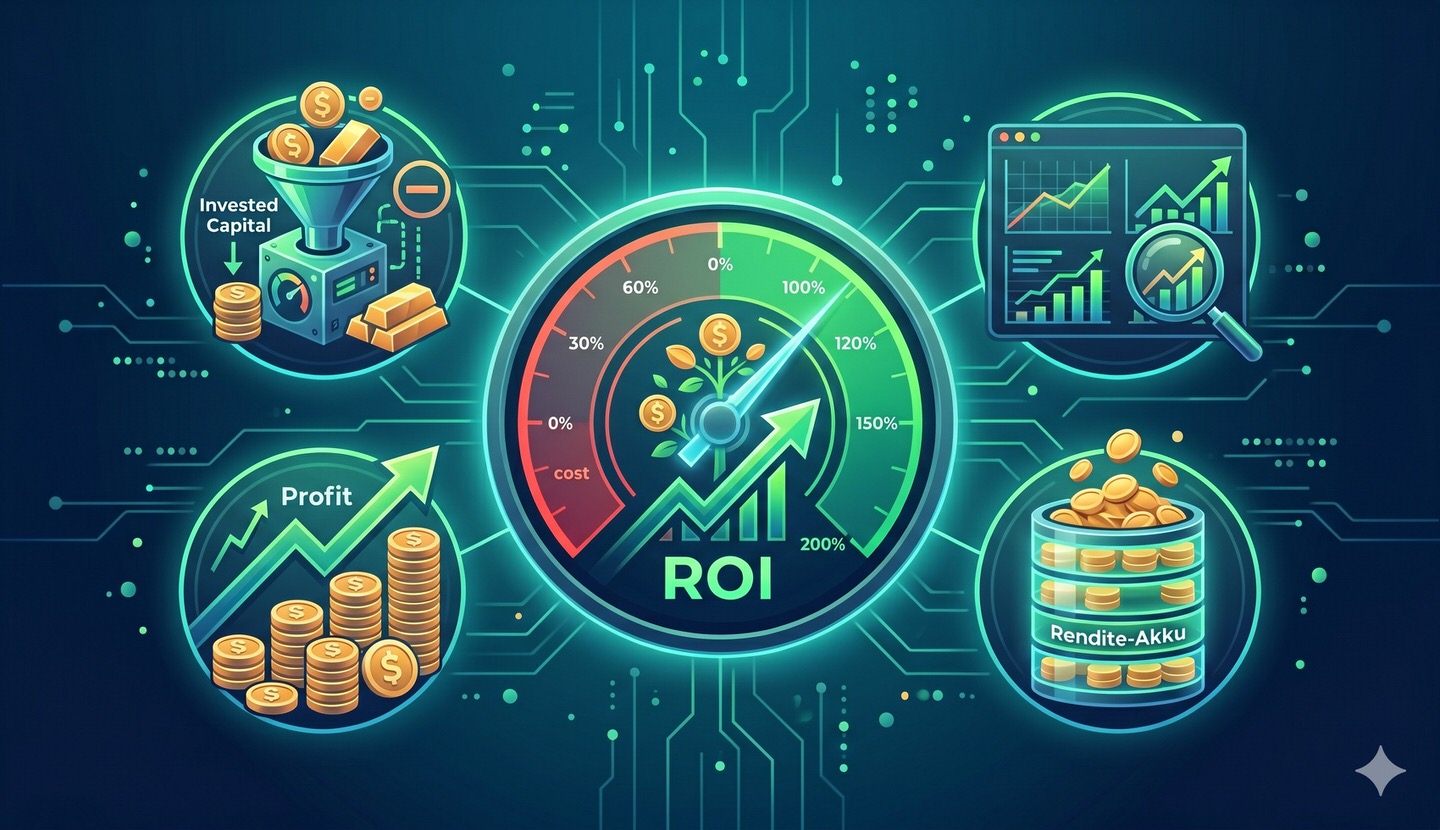
ROI (Return on Investment)
ROI measures the ratio of profit to investment costs and is a key metric for marketing success.
What is ROI?
ROI (Return on Investment) is a key metric that measures the ratio between the profit generated and the costs incurred. Simply put, ROI answers the question: What is the outcome when I invest a certain amount? It shows whether and to what extent an investment has paid off.
In online marketing, ROI is one of the most important metrics because it makes the financial success of measures and campaigns measurable. Instead of just looking at clicks or reach, it focuses on the crucial question: Does a measure actually generate more revenue than it costs?
How is ROI calculated?
ROI is expressed as a percentage and calculated using the following formula:
ROI = (Profit / Investment Costs) x 100
Profit is derived from the revenue generated minus the costs. For example: A company invests €1,000 in an advertising campaign and generates €1,500 in revenue from it. The profit is therefore €500. The calculation is: 500 divided by 1,000, multiplied by 100. This results in an ROI of 50%.
A positive ROI means the investment was worthwhile. An ROI of 0% corresponds to the break-even point (the investment exactly covers its costs), while a negative ROI indicates a loss.
Why is ROI so important in marketing?
- Success becomes measurable: ROI clearly shows whether a marketing measure was financially successful.
- Better budget decisions: Knowing the ROI of individual channels allows you to allocate your budget specifically to where it generates the highest return.
- Comparability: Different measures and channels can be directly compared based on ROI.
- Justification of investments: ROI is the strongest argument for internally justifying marketing budgets.
ROI and related metrics
In marketing, you encounter several similar terms that are easily confused:
- ROI: The overarching value that relates profit to the total investment.
- ROAS (Return on Ad Spend): Specifically refers to advertising spend and looks at revenue per euro spent on advertising, not profit. ROAS is therefore more narrowly focused than ROI.
- ROMI (Return on Marketing Investment): Specifically refers to the profitability of overall marketing spend.
The key difference: ROI takes into account the actual profit (after deducting all costs), whereas ROAS only considers revenue in relation to pure advertising costs.
The pitfalls of ROI in online marketing
While ROI is extremely useful, its calculation in marketing is not always straightforward:
- Attribution: Often, multiple channels contribute to a sale. Which channel the success is attributed to significantly affects the calculated ROI.
- Long-term effects: Some measures, such as SEO or brand building, only pay off after months. A short-term ROI measurement can underestimate their true value.
- Indirect values: Brand awareness, trust, or customer loyalty are difficult to capture in a direct ROI but are economically valuable.
- Complete cost capture: For a realistic ROI, all costs must be included—not just the advertising budget, but also working hours, tools, and other expenses.
Conclusion
ROI is the central metric for evaluating the financial success of investments and marketing measures. It relates profit to costs, making it measurable whether a measure has truly paid off. In online marketing, it is indispensable for well-founded budget decisions but should be used with care: Attribution, long-term effects, and hard-to-measure values like brand building require a nuanced approach. Those who use ROI in conjunction with other metrics such as ROAS and Customer Lifetime Value gain a realistic picture of the actual success of their measures.