RAG (Retrieval-Augmented Generation)
RAG combines language models with search systems for more precise, up-to-date AI responses - essential for SEO and GEO.
What is RAG (Retrieval-Augmented Generation)?
RAG stands for Retrieval-Augmented Generation. It refers to a technique that combines a large language model (LLM) with a search system. Instead of relying solely on the knowledge a language model has learned during training, a RAG system first retrieves relevant, up-to-date information from an external source when a query is made and only then generates its response based on this information. RAG thus combines the retrieval of information (Retrieval) with the generation of text (Generation).
This technique is particularly relevant for your glossary because it is the core of modern AI search systems. AI answers, AI summaries, and many chatbots operate on this exact principle. Anyone who wants to understand how to become visible in AI-powered search (keyword GEO) cannot do without understanding RAG.
What Problem Does RAG Solve?
Large language models on their own have some fundamental weaknesses that RAG specifically addresses:
- Outdated Knowledge: A language model only knows the data up to the end of its training (the knowledge cutoff). Current events are unknown to it. RAG provides up-to-date information.
- Hallucinations: Language models tend to invent plausible-sounding but incorrect answers. By basing the response on retrieved, real sources, RAG significantly reduces this risk.
- Lack of Access to Specific Data: A general model does not know company-internal or highly specific content. RAG can integrate precisely these sources.
- Lack of Verifiability: Since RAG systems access concrete sources, they can cite these as references, making the answer verifiable.
How Does RAG Work?
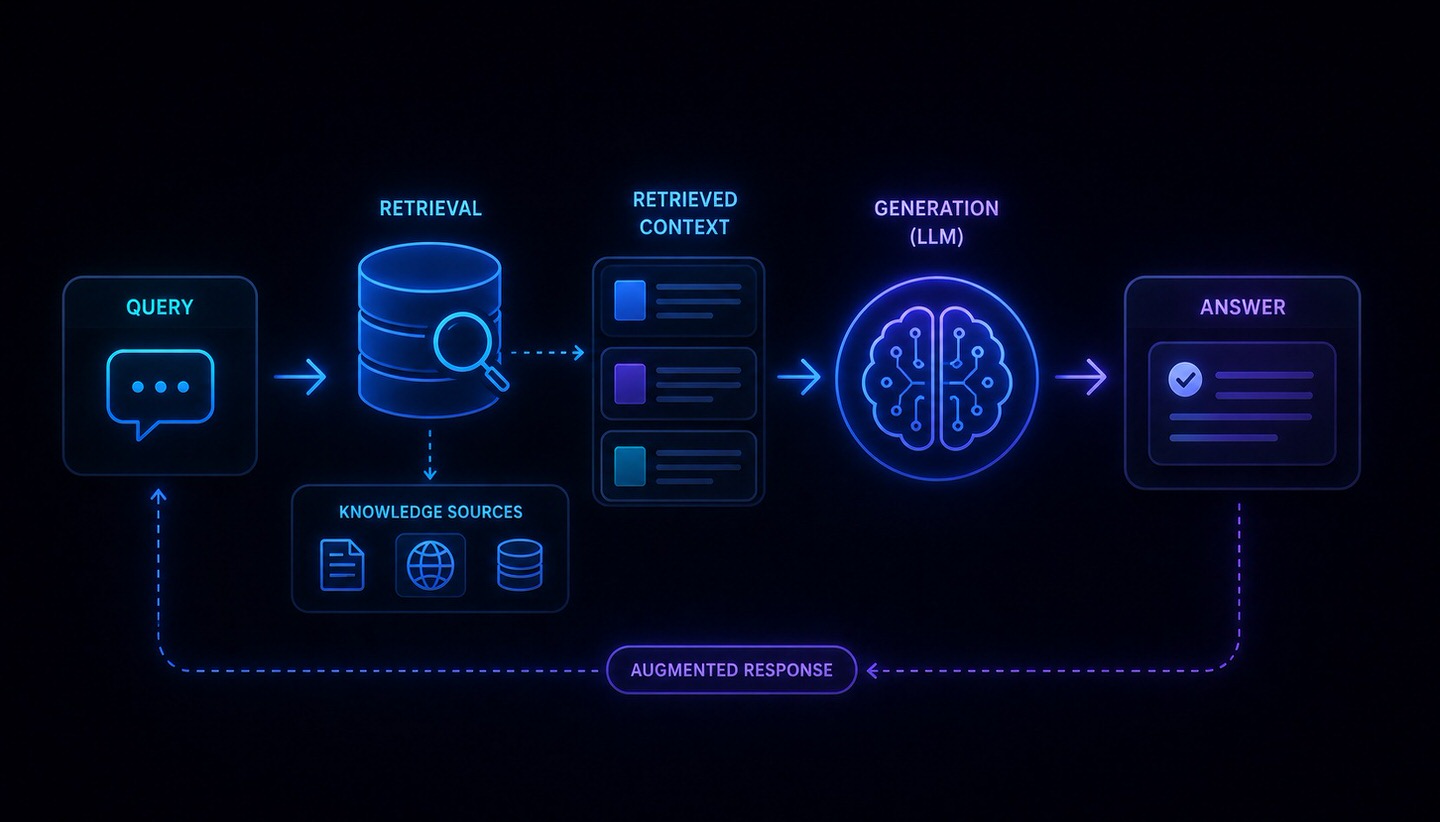
The process essentially consists of two steps:
- 1. Retrieval: When a query is made, the system first searches a knowledge base, such as a document collection, a database, or the web, and retrieves the most relevant content. This is often done via semantic search, which matches not just exact words but the meaning.
- 2. Augmented Generation: The retrieved content is passed to the language model along with the question. The model then formulates its answer based on this provided information, often including the sources.
A clear comparison: A language model alone is like a closed-book exam where only memorized knowledge counts. RAG turns this into an open-book exam where the model can first look up the relevant pages before answering. The result is usually more accurate and up-to-date.
Why Is RAG Crucial for SEO and GEO?
This is the most important point for your target audience. Since AI search systems operate on the RAG principle—retrieving content and generating an answer with sources—there are clear consequences for how to become visible in AI search:
- Findability Is a Prerequisite: Only content that is found during the retrieval step can end up in an AI response. Content must therefore be easily crawlable and available in HTML, which explains why JavaScript-heavy sites are problematic here.
- Clear Structure Helps: Well-structured content that directly and clearly answers a question is more likely to be retrieved as a relevant source.
- Trustworthiness Counts: RAG systems prefer reliable, competent sources, which underscores the importance of E-E-A-T.
- Being Cited Is the Goal: As with AI Overviews, being mentioned as a source in the AI answer is the new visibility goal. GEO is ultimately the optimization to be selected and cited in the retrieval step of a RAG system.
Where Is RAG Used?
RAG is used in many areas today, such as in the AI answers of search engines, in AI assistants and chatbots, in internal corporate knowledge systems (which access company-owned documents), and in customer support tools that draw answers from a knowledge database. Wherever an AI needs to provide reliable, up-to-date, or specific answers, RAG is often employed.
Conclusion
RAG (Retrieval-Augmented Generation) combines a language model with a search system: Instead of answering purely from memory, it first retrieves relevant, up-to-date information from external sources and generates the answer based on this. This addresses key weaknesses of pure language models, namely outdated knowledge, hallucinations, and lack of verifiability. For online marketing, RAG is of great importance as it is the operating principle of modern AI search systems. To be visible and cited in these systems, you must ensure that your content is findable, clearly structured, and trustworthy. Thus, RAG is the technical core that explains why GEO works and what really matters in optimizing for AI search.