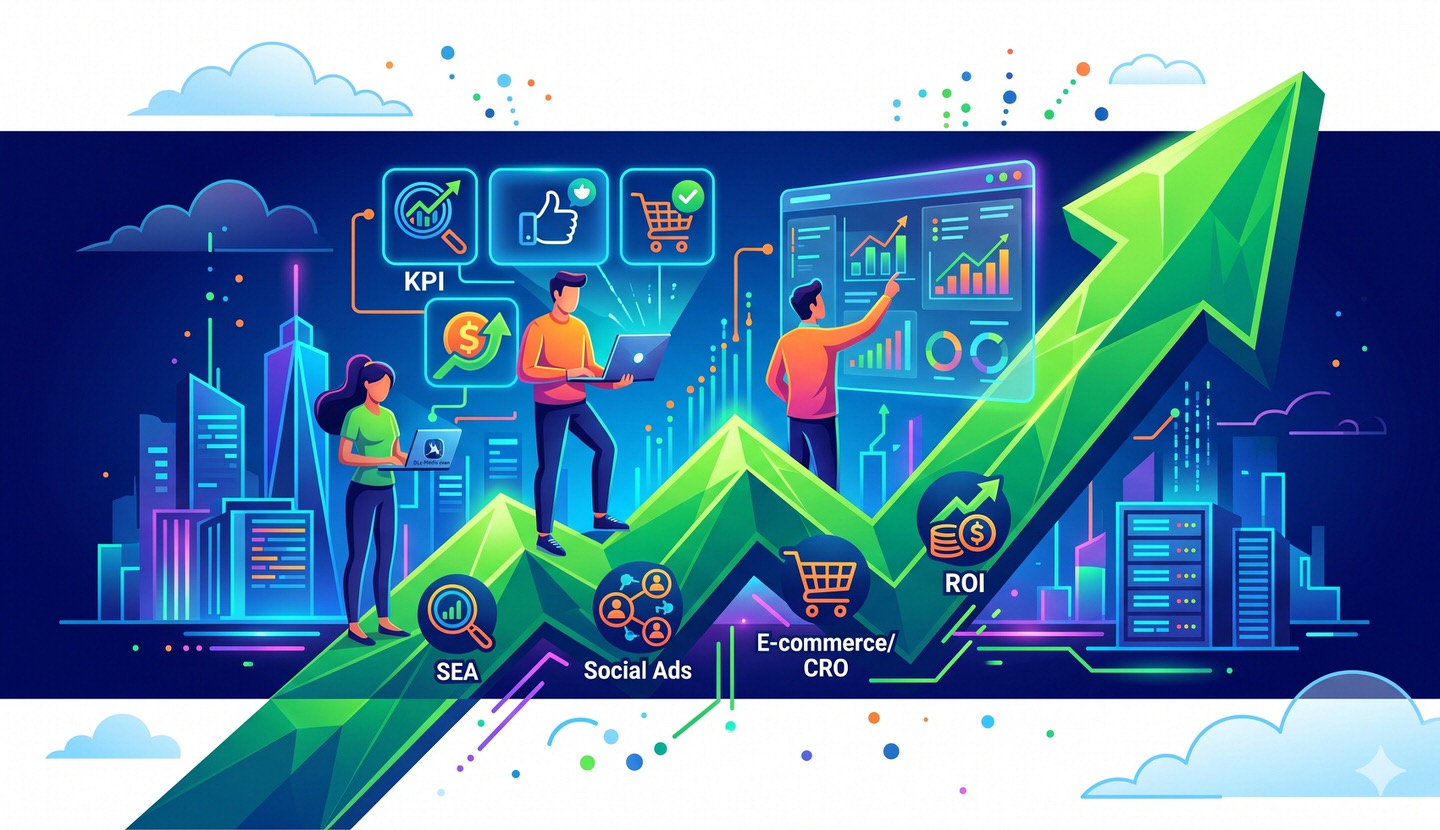
Performance Marketing
Performance marketing focuses on measurable results like purchases or leads - payment is only for actual performance, not visibility.
What is Performance Marketing?
Performance Marketing (known in German as "leistungsbasiertes Marketing") is an approach in online marketing where all measures are consistently focused on measurable results. Unlike traditional advertising, which primarily aims to increase brand awareness and reach, the focus here is on a specific, measurable action, such as a purchase, registration, or click. This allows the success of each campaign to be precisely quantified and compared against the budget spent.
The central principle is: payment is ideally made for actual performance, not just visibility. This transforms marketing from a hard-to-grasp investment into a calculable, data-driven discipline.
How Does Performance Marketing Work?
At its core, it always revolves around a clearly defined, measurable success. Goals are set, campaigns are aligned with these goals, and results are continuously measured and optimized. Billing is often based on performance-related models:
- CPC (Cost per Click): Payment is made per click on an ad.
- CPA (Cost per Acquisition): Payment is made per completed action, such as a purchase or registration.
- CPL (Cost per Lead): Payment is made per acquired contact, such as a completed inquiry form.
- CPM (Cost per Mille): Payment is made per thousand impressions. This is more focused on reach and thus less typical for pure performance marketing.
Which Channels Are Part of Performance Marketing?
- Search Engine Advertising (SEA): Paid ads on Google Ads or Microsoft Ads that appear for relevant search queries.
- Social Media Ads: Advertising on platforms like Meta, LinkedIn, or TikTok with precise audience targeting.
- Affiliate Marketing: Partners promote products and receive a commission for each sale or lead generated.
- Display and Retargeting Ads: Banner advertising that often specifically targets users who have already shown interest.
The Most Important Metrics
Performance Marketing thrives on measurability. The key metrics used to evaluate success are:
- Conversion Rate: The proportion of users who complete the desired action.
- ROAS (Return on Ad Spend): How much revenue is generated per euro spent on advertising.
- ROI (Return on Investment): The ratio of profit to total investment.
- CAC (Customer Acquisition Cost): The cost of acquiring a new customer.
- Click-Through Rate (CTR): The proportion of users who click on an ad.
These metrics are classic KPIs and make the success of each measure transparent and comparable.
Advantages and Limitations
Advantages:
- Full Measurability: Every euro spent can be assigned to a result.
- Flexible Control: Campaigns can be adjusted, paused, or expanded in real time.
- Efficient Budget Use: The budget is directed specifically toward what demonstrably works.
- Fast Results: Unlike SEO, which takes time, performance marketing often delivers immediate results.
Limitations:
- Ongoing Costs: Once the budget ends, visibility usually ends as well. The effect is rented, not sustainably built.
- Focus on Short-Term Actions: Brand building and long-term customer loyalty can only be achieved to a limited extent.
- Data Privacy and Tracking: Precise measurement is increasingly hindered by cookie restrictions and tracking blockers.
Performance Marketing and SEO: Two Approaches That Complement Each Other
Performance Marketing (paid) and Search Engine Optimization (organic) are often seen as opposites but complement each other perfectly. Performance Marketing delivers fast, predictable results but incurs ongoing costs. SEO takes longer but builds sustainable, cost-free visibility. A smart strategy combines both: short-term reach through paid channels and a long-term foundation through organic visibility. Both approaches also lead to your own website, which serves as the central hub in owned media.
Conclusion
Performance Marketing is a data-driven approach that consistently focuses on measurable results and directly evaluates paid measures based on their success. Its strengths lie in full measurability, flexible control, and fast impact. Its limitation is its dependence on an ongoing budget. It is therefore most effective as part of a balanced marketing mix that combines short-term performance channels with the sustainable growth provided by SEO and owned channels.