Natural Language Processing (NLP)
Natural Language Processing (NLP) enables computers to understand and generate human language - the foundation for AI like ChatGPT and modern SEO.
What is Natural Language Processing (NLP)?
Natural Language Processing (NLP) is a subfield of artificial intelligence that focuses on making human language understandable and processable for computers. The goal is for machines to not only capture texts and spoken language but also understand their meaning, interpret them, and generate language themselves.
NLP serves as the bridge between how humans communicate and how computers process data. It forms the foundation of numerous applications that have become commonplace today, from Google searches to voice assistants and AI chatbots like ChatGPT.
What can NLP do specifically?
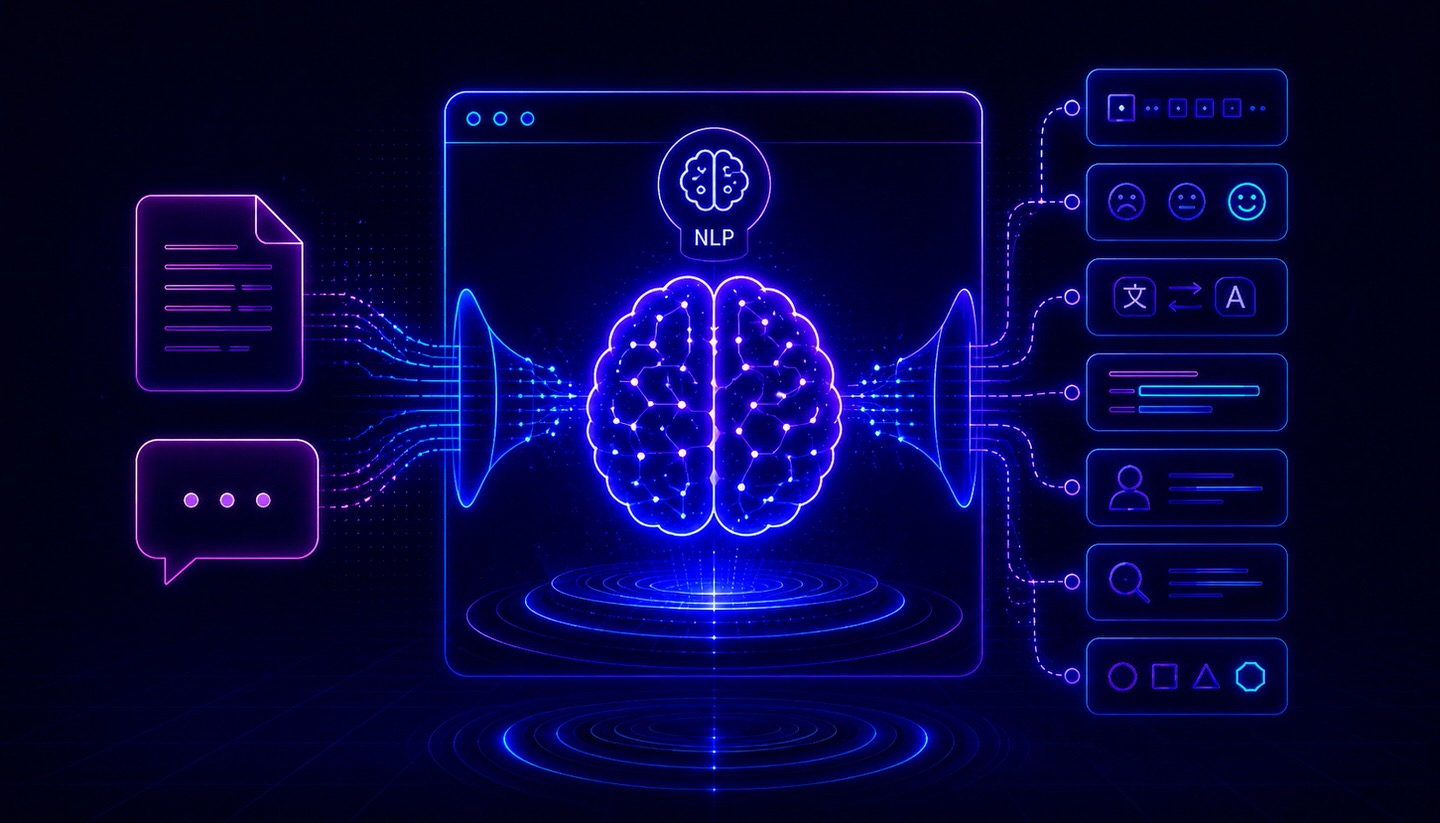
NLP encompasses a range of tasks that enable the understanding and generation of language:
- Text comprehension: Recognizing what a text is about and the intent behind it.
- Entity recognition: Identifying people, places, brands, or dates in a text.
- Sentiment analysis: Determining whether a statement is positive, negative, or neutral, such as in customer reviews.
- Translation: Automatically converting texts into other languages.
- Summarization: Condensing long texts to their essential points.
- Text generation: Independently formulating texts, such as in response to a question.
How does NLP work technically?
For a computer to process language, text undergoes several steps. First, it is broken down into smaller units (tokenization) and converted into mathematical representations that capture the meaning of words in context (embeddings). Modern NLP systems rely on machine learning, specifically deep learning with neural networks. The major breakthrough came with the Transformer architecture, which allows models to grasp the relationship of all words in a sentence simultaneously, rather than processing them sequentially.
NLP as the foundation of modern AI systems
Many of the most well-known AI technologies are, at their core, NLP applications:
- Google BERT: An NLP model introduced by Google in 2019 to better understand the meaning of search queries. BERT captures the context of individual words in a sentence, thereby more accurately identifying what a user is truly searching for.
- ChatGPT and other LLMs: Large language models are highly advanced NLP systems that not only understand language but can also generate it fluently.
- Voice assistants: Systems like Siri or Google Assistant use NLP to process and respond to spoken queries.
Why is NLP important for SEO and content?
NLP has fundamentally transformed search engine optimization. Since search engines now understand language semantically, the focus has clearly shifted:
- From keywords to meaning: It is no longer about using a keyword as often as possible, but about covering a topic comprehensively and understandably. NLP recognizes synonyms and contextual relationships.
- Search intent at the forefront: Thanks to NLP, Google more accurately captures the intent behind a search query. Content must address this intent, not just the words.
- Natural language gains importance: Well-readable, naturally formulated texts are preferred because NLP systems understand them better than artificially optimized content.
- Structured, clear content: Clear formulations and a logical structure make it easier for NLP systems to correctly classify content, which is also crucial for AI search (GEO).
NLP also plays an increasing role in the practice of content optimization. Tools now analyze texts based on the same principles that search engines use to understand meaning, helping to create thematically complete and relevant content.
Conclusion
Natural Language Processing is the key technology that enables computers to understand and generate human language. It forms the foundation of modern AI applications such as Google BERT, ChatGPT, and voice assistants. For SEO and content creation, the NLP-driven shift means one thing above all: those who write for people, cover a topic clearly and comprehensively, and address search intent are automatically aligning with modern search engines. Mechanical optimization for individual words is a thing of the past; understanding meaning and context is now at the center.