MQL (Marketing Qualified Lead)
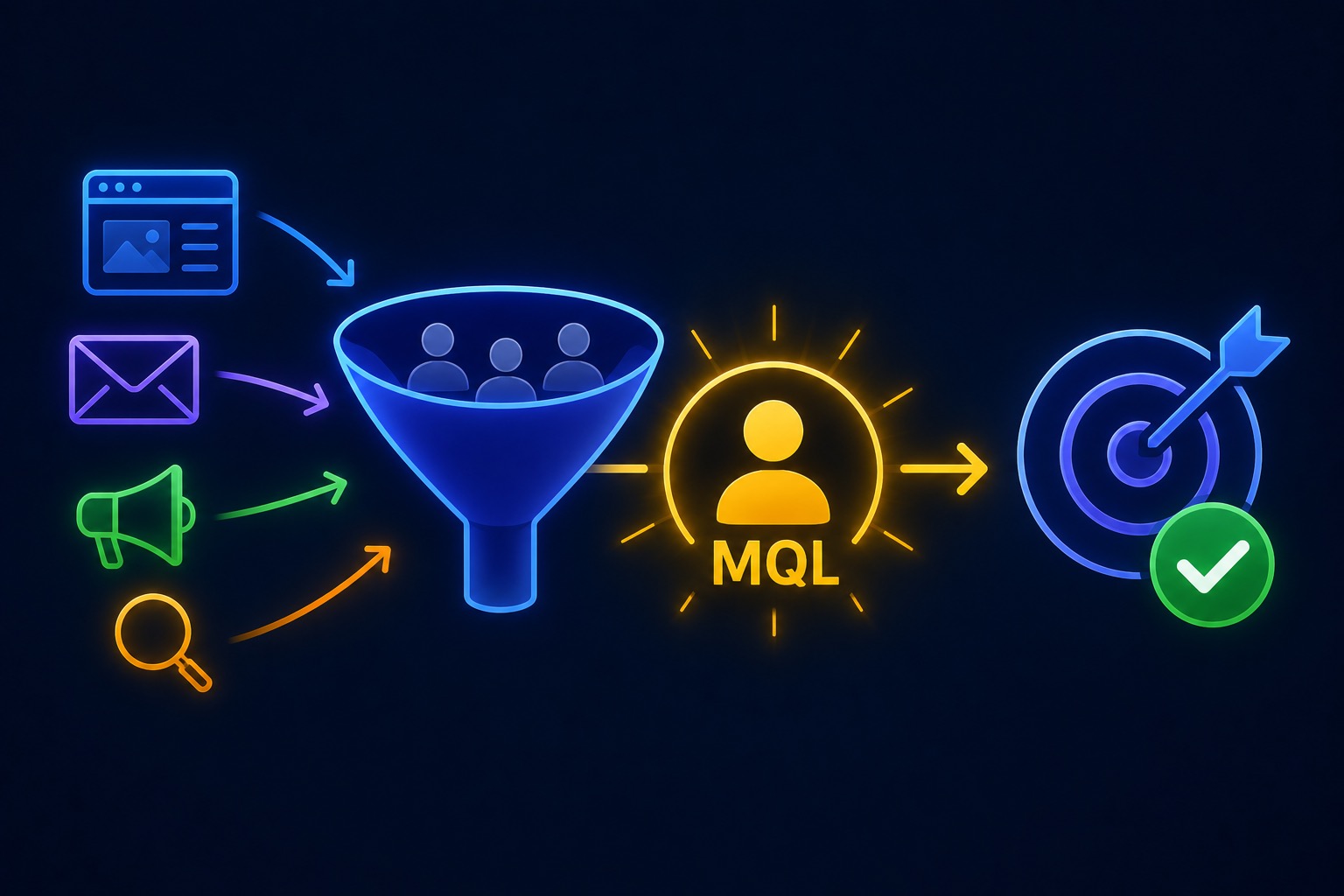
An MQL is a qualified prospect with high purchase potential - the bridge between marketing and sales in the lead lifecycle.
What is a Marketing Qualified Lead (MQL)?
A Marketing Qualified Lead (MQL) is a prospect who has demonstrated increased interest through their behaviour and is therefore considered particularly promising to become a customer later, but is not yet ready for direct sales contact. An MQL has, in a way, "qualified" for the next stage because they have signalled more than just fleeting interest, for example by downloading a guide, participating in a webinar, or repeated visits.
The term originates primarily from lead management, which divides the journey of a prospect from first contact to becoming a customer into phases. The MQL is an important intermediate stage: from a simple contact, a qualified prospect has emerged who deserves the attention of marketing before being passed on to sales later.
Where does the MQL stand in the lead lifecycle?
The MQL is a stage in the typical journey of a prospect, which can be roughly outlined as follows:
- Lead: An initial contact who has shown interest and provided contact details.
- Marketing Qualified Lead (MQL): A lead who has demonstrated enough interest through their behaviour to be considered particularly promising.
- Sales Qualified Lead (SQL): An MQL who has matured to the point where direct sales contact by the sales team seems appropriate.
- Customer: The prospect has become a paying customer.
The MQL thus marks the transition from a mere contact to a serious potential customer, before sales comes into play.
How does a lead become an MQL?
Whether a lead becomes an MQL depends on two types of criteria:
- Behaviour (Engagement): What actions does the prospect take? Have they downloaded multiple pieces of content, participated in a webinar, visited specific pages such as the pricing page, or subscribed to the newsletter?
- Profile (Fit): Does the prospect fit the target group? Do factors such as industry, company size, or position match the ideal customer profile?
Only when both aspects come together—recognisable interest and a suitable profile—is a lead typically considered an MQL.
Lead Scoring: the method behind it
To determine when a lead crosses the threshold to become an MQL, many companies use so-called lead scoring. Points are awarded for certain behaviours and characteristics, such as points for a download, a visit to the pricing page, or the prospect belonging to the target industry. Once a lead reaches a predefined score, they are automatically classified as an MQL. This makes the qualification process traceable and partly automated.
MQL and SQL: the key difference
The MQL is often confused with the Sales Qualified Lead (SQL), but the difference is crucial and marks the handover from marketing to sales:
- MQL: Marketing considers the lead promising because they show interest. However, they are not necessarily ready to buy yet.
- SQL: Sales has reviewed the lead and accepted them as mature enough to warrant direct sales contact.
Simply put: the MQL is "interesting from a marketing perspective," while the SQL is "ready from a sales perspective." Between the two often lies the phase of lead nurturing, in which the MQL is further guided towards purchase readiness through targeted, helpful communication.
Why is the MQL concept important?
- Prioritisation: Instead of treating all contacts equally, the most promising ones can be developed in a targeted way.
- Efficient Sales: Sales only receives leads that have already reached a certain level of maturity, wasting less time on unsuitable contacts.
- Alignment of Marketing and Sales: A clear MQL definition ensures that both departments share the same understanding of what makes a good lead.
- Measurability: The number and quality of MQLs is an important metric for measuring marketing success.
An important note: There is no universal definition
A common misconception is that what exactly constitutes an MQL is universally defined. In reality, each company sets its own criteria. What counts as an MQL in one company may still be a simple lead in another. The key is for marketing and sales to jointly establish clear, appropriate criteria. If these are vague or inconsistent, friction often arises between the departments, such as when sales finds the leads passed on to be insufficiently qualified. A clear, mutually agreed MQL definition is therefore the foundation for smooth collaboration.
Conclusion
A Marketing Qualified Lead (MQL) is a prospect who has shown sufficient interest through their behaviour to be considered particularly promising but is not yet ready for direct sales contact. They represent a central intermediate stage in the lead lifecycle between a simple lead and the sales-ready Sales Qualified Lead. Whether a lead becomes an MQL is determined by behaviour and profile, often measured through lead scoring. Importantly, there is no universal definition: each company must work with marketing and sales to define what constitutes an MQL. When used correctly, the concept helps to develop the most promising prospects in a targeted way and strengthens the collaboration between marketing and sales.