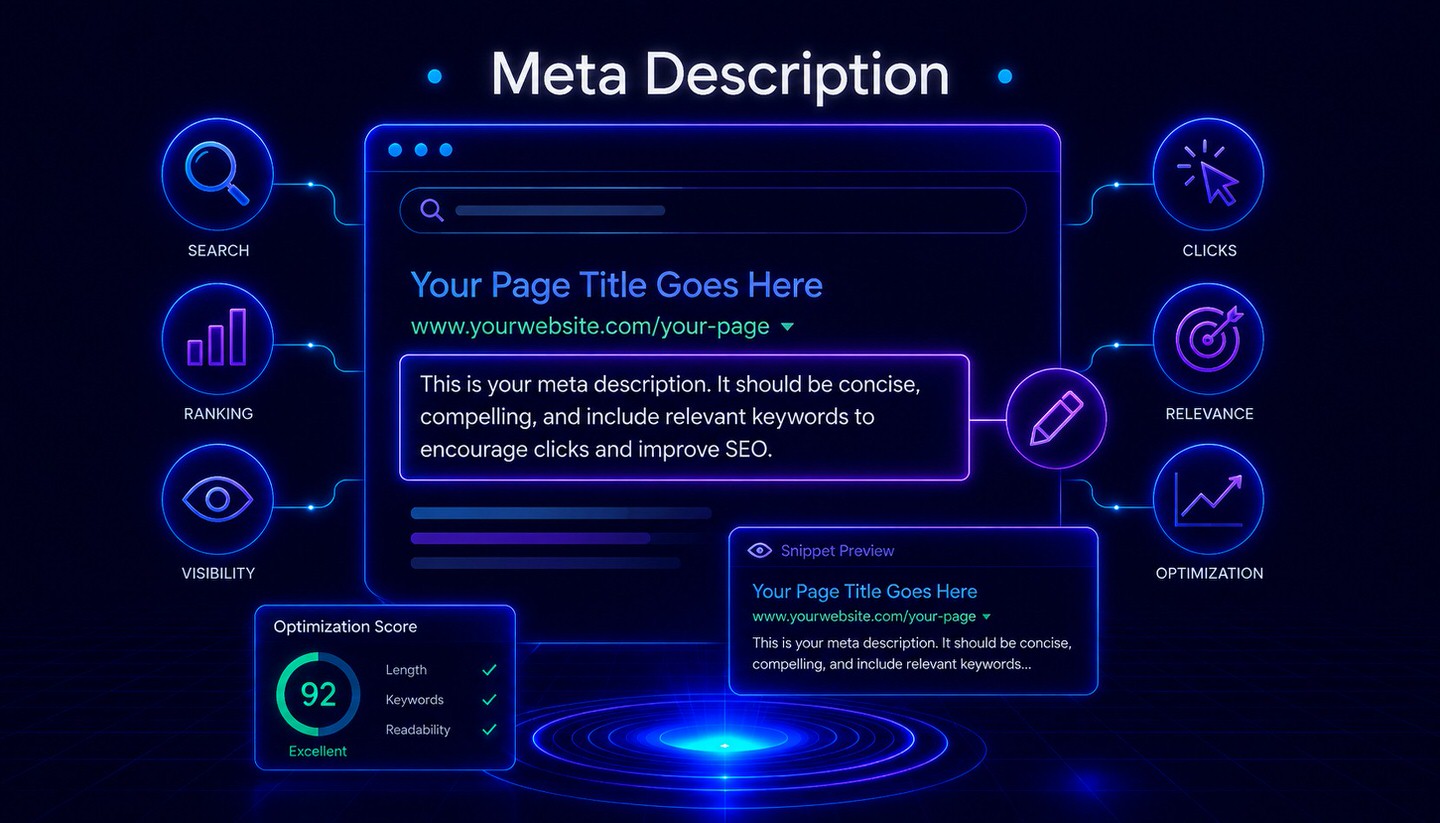
Meta Description
The meta description is a short HTML text that describes search results and influences the click-through rate (CTR) - not a direct ranking factor.
What is a Meta Description?
The Meta Description is a short text section in the <head> area of a webpage that summarizes the page's content. It does not appear on the page itself but is often displayed as a preview text (snippet) below the title in Google search results. It is embedded via a meta tag:
<meta name="description" content="Here is the short description of the page.">The Meta Description is therefore a kind of advertising text for the search result: It should give the user an immediate idea of what to expect on the page and encourage them to click.
Is the Meta Description a Ranking Factor?
No. Google has repeatedly confirmed that the Meta Description is not a direct ranking factor. It does not directly influence the position at which a page appears. Nevertheless, it is important for SEO because it has an indirect effect: An appealing description increases the Click-Through Rate (CTR), i.e., the proportion of users who click on the search result. A higher CTR can, in turn, have a positive impact on the perception of the page. The Meta Description is therefore less of an SEO factor in the strict sense and more of a lever for generating more clicks.
Google Often Rewrites the Description Itself
An important point that surprises many: Google does not always use the stored Meta Description. In many cases, the search engine generates the displayed snippet itself by pulling relevant text passages directly from the page content. This happens especially when Google considers another text excerpt to be more relevant for the specific search query. Studies show that Google rewrites the Meta Description in a significant proportion of cases.
However, this does not mean that the Meta Description is unnecessary. It is the best way to provide Google with a good suggestion and is often used, particularly when searching for the brand name or specific page titles.
How to Write a Good Meta Description?
- Appropriate Length: A guideline is around 150 to 160 characters. Longer descriptions are truncated in search results. Since Google truncates based on pixel width rather than character count, this value is a guideline, not a fixed limit.
- Include the Keyword: If a user searches for a term, Google highlights it in bold in the snippet if it appears in the description. This increases attention and relevance for the searcher.
- Value and Call-to-Action: The description should clearly state the benefit and ideally provide an incentive to click, such as "Compare now" or "Download for free".
- Unique per Page: Each page should have its own, individual Meta Description. Duplicate or missing descriptions are flagged by the Google Search Console as optimization potential.
- Accurately Reflect the Content: The description must match the actual page content. Misleading snippets lead to high bounce rates because users quickly leave if the content does not meet their expectations.
Practical Implementation
If you work with WordPress, you don’t need to embed the Meta Description in the code. SEO plugins like Yoast SEO or Rank Math provide a dedicated input field, often displaying a preview of the search result. This allows you to check whether the description is displayed at the correct length before the page is published.
Conclusion
The Meta Description is not a direct ranking factor but an effective way to increase the click-through rate from search results. A concise, unique, and appealing description with the right keyword increases the chance that users will click on your result. Even if Google does not always use it, careful maintenance is worthwhile, as it is the first impression a webpage makes in search results.