Marketing Mix (The 4 Ps)
The marketing mix (4 Ps) is the foundation of marketing theory - learn how product, price, distribution, and communication work together strategically.
What is the Marketing Mix (the 4 Ps)?
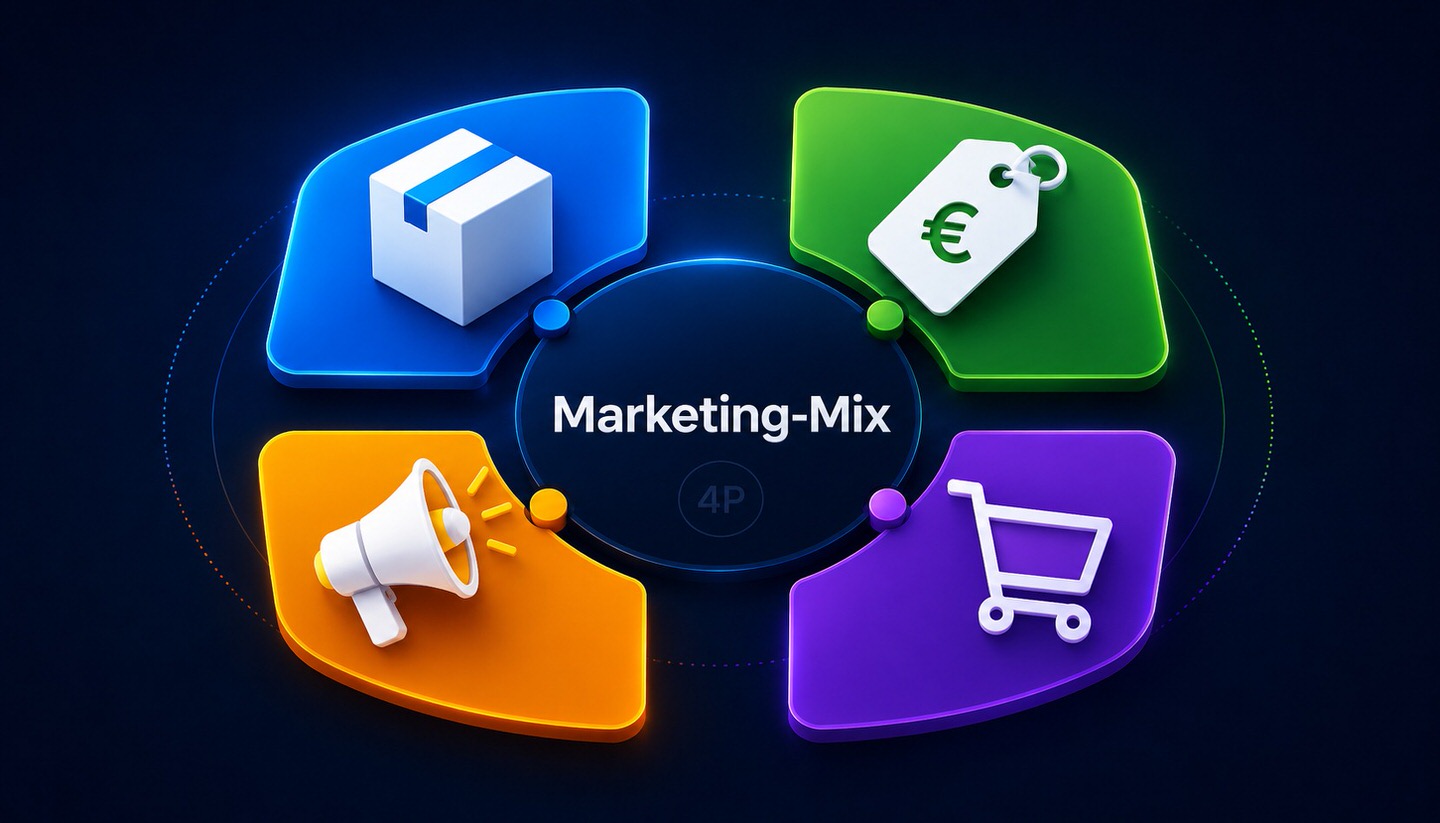
The marketing mix is the foundation of classical marketing theory and describes the central instruments a company can control to succeed in the market. The best-known model consolidates these instruments into the four Ps: Product, Price, Place, and Promotion. The core idea is that a company must precisely coordinate these four levers to reach its target audience and achieve its goals.
The 4 Ps model was established in the 1960s and remains a key tool for structuring marketing strategies to this day. Even in modern online marketing, it provides a valuable framework, though it must be expanded to include digital aspects.
The Four Ps in Detail
- Product: Everything related to the offering itself, including the product or service, its quality, features, design, packaging, assortment, and brand. The key question: What do I offer, and what value does it provide to the target audience?
- Price: All decisions regarding pricing, such as pricing strategy, discounts, payment terms, and price positioning. The key question: What does the offering cost, and how is the price structured?
- Place: How and where the product reaches the customer, including distribution channels, availability, and logistics. The key question: Where and how can the customer obtain the offering?
- Promotion: How the company communicates with the target audience and promotes its offering, such as through advertising, PR, content, and social media. The key question: How do customers learn about the offering, and how do I convince them?
The Interplay is Crucial
The true essence of the marketing mix lies not in the individual Ps but in their coordination. The four instruments must align and support each other. A high-quality premium product (Product) does not pair well with a low price (Price), and the best product is of little use if no one knows about it (Promotion) or it is unavailable (Place). Only the coherent combination of all four results in a consistent strategy. This is precisely why it is called a "mix."
The Marketing Mix in Online Marketing
In the digital environment, the four Ps translate into concrete online measures, making the classical framework tangible for your target audience:
- Product: This includes digital products, online services, or the presentation of a product through descriptions, images, and customer reviews.
- Price: Online, prices are particularly transparent and easily comparable. Dynamic pricing and online discount campaigns play an increasingly important role.
- Place: This covers your own online shop, marketplaces, or general digital availability. The website as a central "location" (Owned Media) belongs here.
- Promotion: The broad field of online marketing, including SEO, search engine advertising (SEA), content marketing, social media, email marketing, and more. For your target audience, this P is most closely intertwined with the other glossary topics.
Extensions: The 7 Ps and the 4 Cs
The classic model has evolved over time:
- The 7 Ps: Particularly for services, the model was expanded by three additional Ps: People (the individuals involved, such as employees), Process (the workflows and processes), and Physical Evidence (the physical or visible environment that builds trust).
- The 4 Cs: A more modern, customer-oriented counterpart shifts the perspective from the company to the customer: Customer (customer value instead of product), Cost (total costs instead of just price), Convenience (ease of access instead of distribution channel), and Communication (dialogue instead of one-sided advertising). The 4 Cs thus emphasize the customer's perspective more strongly.
Why is the Marketing Mix Important?
- Structured Planning: The marketing mix provides a clear framework to ensure no important lever is overlooked.
- Holistic View: It ensures that marketing is not only understood as advertising but also encompasses product, price, and distribution.
- Coordinated Strategy: It helps align individual measures coherently.
- Timeless Foundation: Despite its age, it remains a solid foundation on which even modern, digital strategies can be built.
Conclusion
The marketing mix with its four Ps (Product, Price, Place, and Promotion) is the foundation of classical marketing theory and describes the central instruments a company can control. What matters is not the individual P but the coherent interplay of all four to form a consistent overall strategy. In online marketing, these instruments translate into concrete digital measures, with online marketing in the broader sense primarily falling under Promotion. Extensions such as the 7 Ps for services and the customer-oriented 4 Cs show that the model has remained dynamic. Understanding the marketing mix provides a proven framework for thinking about marketing holistically rather than reducing it to individual measures.