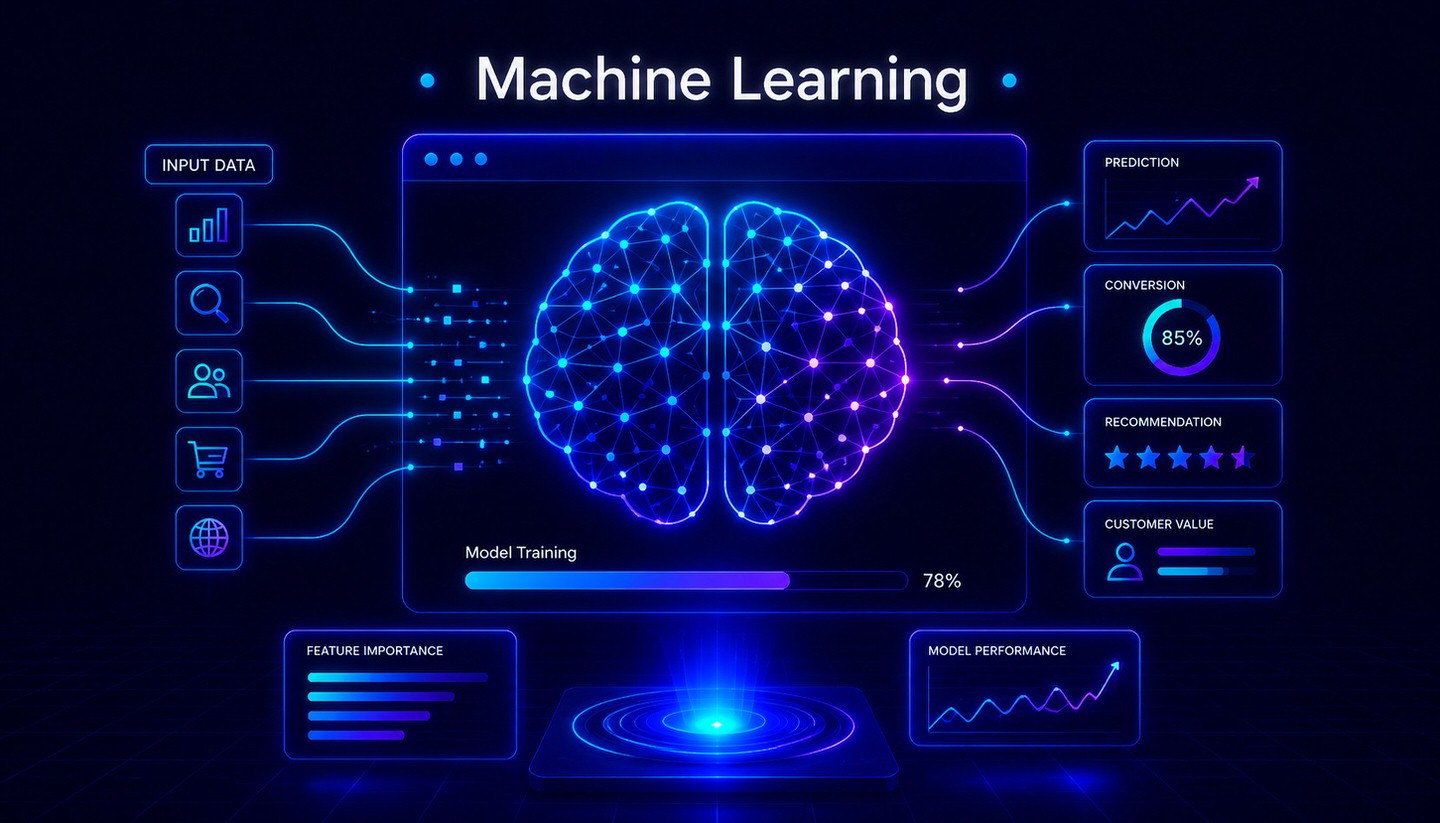
Machine Learning
Machine Learning (ML) is an AI subfield that revolutionizes search engines and marketing through pattern recognition.
What is Machine Learning?
Machine Learning (known in German as maschinelles Lernen) is a subfield of artificial intelligence (AI). In this approach, computer systems learn independently from data instead of being explicitly programmed for each task. Put simply: Instead of providing a system with precise rules ("if A, then B"), it is fed with numerous examples from which it identifies patterns and derives predictions.
A clear example: To build a spam filter, one would traditionally have to define countless rules. With Machine Learning, the system is instead shown thousands of emails marked as "spam" or "not spam." The system learns from these examples which characteristics indicate spam and can subsequently correctly classify even new, unknown emails.
How does Machine Learning fundamentally work?
At its core, the process always involves three steps: A model is fed with training data, identifies patterns within it, and can then apply these patterns to new data. There are primarily three forms of learning:
- Supervised Learning: The system learns from examples where the correct answer is already known (as with the spam filter). This is the most common form in the marketing environment.
- Unsupervised Learning: The system receives data without predefined answers and independently searches for structures, such as automatically grouping customers.
- Reinforcement Learning: The system learns through trial and error and is "rewarded" for good decisions, similar to training a game.
A particularly powerful subform is Deep Learning, which works with artificial neural networks. It forms the basis of modern language models like the GPT series and is the driving force behind the current AI boom.
Why is Machine Learning important for SEO?
Machine Learning has long been deeply embedded in the functioning of search engines. Google uses numerous ML systems to better understand search queries and deliver more relevant results:
- RankBrain: Google's first ML system (2015), which helps meaningfully interpret even unknown or ambiguous search queries.
- BERT: A Deep Learning-based language model that understands the context of words in a sentence and thus more accurately captures search intent.
- Spam detection and quality assessment: ML systems detect low-quality content, manipulative link structures, and spam more reliably than rigid rules.
For SEO, this means a fundamental shift: Since search engines understand meaning and context through Machine Learning, mechanical tricks like keyword stuffing no longer work. Instead, the systems reward content that comprehensively and understandably addresses a topic and fulfills the actual search intent.
Machine Learning in Online Marketing
Beyond search, Machine Learning is also indispensable in digital marketing:
- Advertising: Platforms like Google Ads and Meta Ads largely automate bidding, targeting, and ad delivery through ML, such as with "Smart Bidding."
- Personalization: Product recommendations in online shops or personalized content are based on ML models that analyze user behavior.
- Predictions: ML helps predict future behavior, such as which customers are likely to churn or which lead is most likely to convert.
- Content creation and optimization: Modern AI tools use Machine Learning to generate, analyze, and thematically optimize texts.
Connection to AI Search and GEO
The current wave of AI-powered search (keyword GEO, Generative Engine Optimization) is entirely based on Machine Learning. Large language models behind systems like ChatGPT, Perplexity, or Google AI Overviews are Deep Learning models that have learned from vast amounts of text. Those who understand that these systems work based on meaning and context rather than mere word matching can tailor content more effectively to be captured and used by both traditional search engines and AI systems.
Conclusion
Machine Learning is the technology shaping modern online marketing and SEO behind the scenes. It enables search engines to understand meaning and context, controls large parts of digital advertising, and forms the foundation of current AI systems. You don’t need to be a data scientist to benefit from it, but a basic understanding is immensely helpful: Those who know that machines today are trained on relevance, context, and quality will align their content and campaigns from the outset with what truly matters.