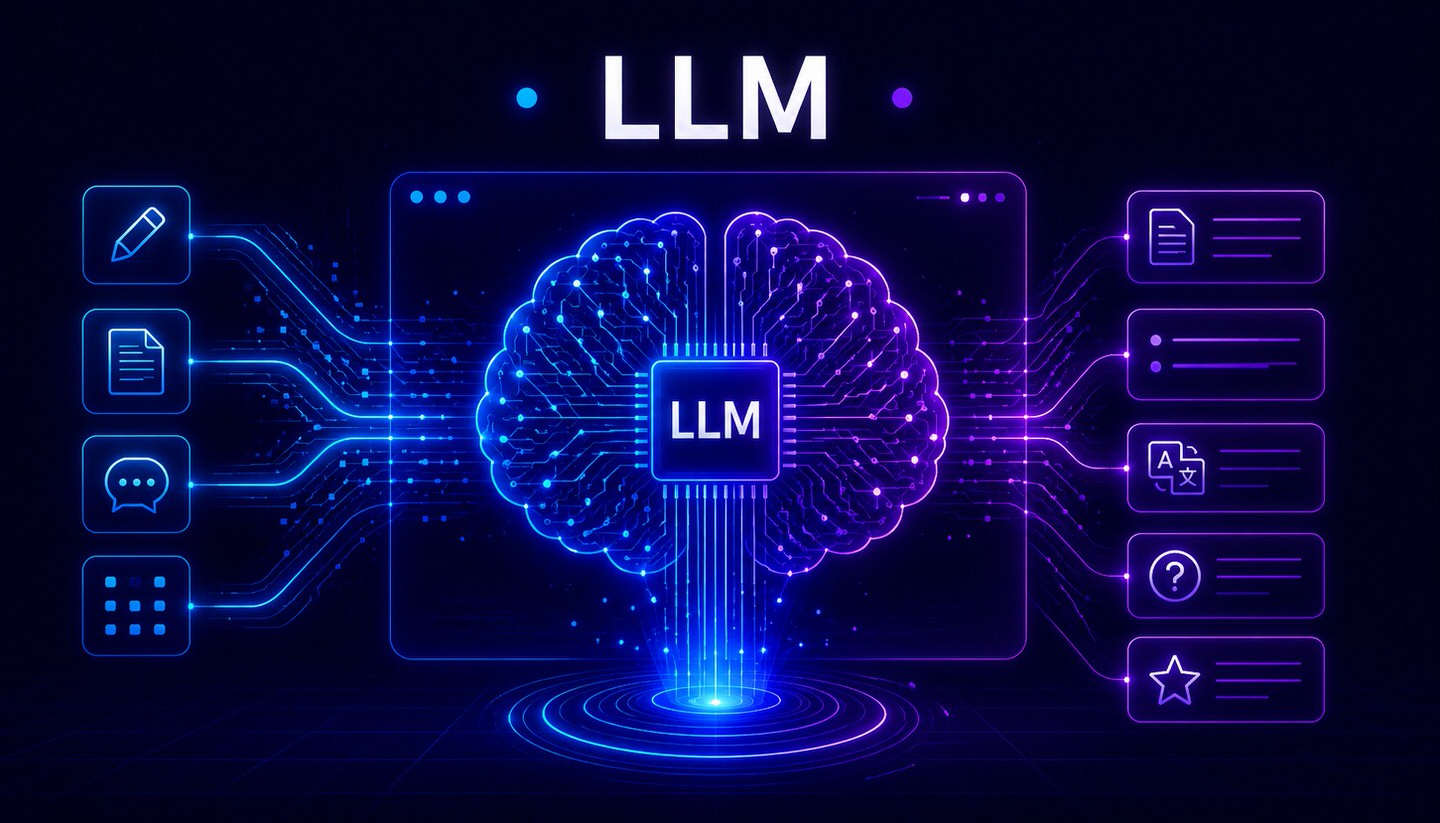
LLM
LLMs are AI language models like ChatGPT that understand and generate human language - essential for SEO, GEO, and digital marketing strategies.
What is an LLM?
LLM stands for Large Language Model. It is an AI system trained to understand and generate human language. Well-known examples include the GPT models behind ChatGPT, Google's Gemini, Anthropic's Claude, or Meta's Llama. LLMs form the foundation of the current AI wave and power most of the chatbots and AI response systems in use today.
Simply put, an LLM is a system that has learned from vast amounts of text which word is most likely to follow in a given context. From this seemingly simple ability emerges the capacity to answer questions, write texts, translate, or summarize.
How does an LLM work?
An LLM is based on machine learning, specifically deep learning with artificial neural networks. The process can be roughly divided into three steps:
- Tokenization: The input text is first broken down into small units (tokens) that the model can process.
- Processing in the neural network: The model converts these tokens into mathematical representations (embeddings) and processes them through many layers. It takes into account the entire context, meaning which words relate to each other and how.
- Prediction: Based on this, the model calculates the most probable continuation token by token and generates its response.
The technical foundation of most of today's LLMs is the so-called Transformer architecture, introduced by Google researchers in 2017. Its key mechanism, "attention," allows the model to weigh the importance of individual words within the context of the entire sentence. This is the main reason for the significant quality leap in modern language models.
Training and Knowledge of an LLM
LLMs are trained in a complex process using enormous amounts of text from the internet, books, and other sources. Through this, they learn language patterns, contexts, and factual knowledge. Two important points arise from this:
- Knowledge cutoff: An LLM's knowledge ends at the time of its training. Events after this point are only known to the model if it is additionally connected to current data, such as through a web search.
- Hallucinations: Since an LLM is based on probabilities and not a database of verified facts, it can invent content that sounds plausible but is incorrect. This phenomenon is called hallucination. Outputs should therefore be checked, especially for important topics.
Why are LLMs relevant for SEO and online marketing?
LLMs are transforming digital marketing in two ways.
First, as a tool: LLMs assist in creating and optimizing content, brainstorming, research, or data analysis. Important to note: They are an aid, not a replacement for expert review and a unique voice. Purely AI-generated mass texts without added value are rather devalued by Google under the Helpful Content System.
Second, as a new channel: AI response systems based on LLMs are themselves becoming a place where users search for information. This is where the discipline of GEO (Generative Engine Optimization) comes into play. It aims to ensure that one's own content is recognized and cited as a source by LLM-based systems.
LLMs and AI Search
Many LLM-based systems do not rely solely on their training knowledge but also retrieve current sources from the web when processing a query. This method is called Retrieval-Augmented Generation (RAG): The system first searches for relevant information (retrieval) and then formulates a response (generation). For website operators, this is crucial because it means that well-discoverable, clearly structured, and trustworthy content increases the chances of appearing in AI responses.
Conclusion
Large Language Models are the technology behind ChatGPT and most current AI applications. They understand and generate language by learning from vast amounts of text and are based on machine learning and the Transformer architecture. For online marketing, they are doubly significant: as a powerful tool for daily work and as a new channel through which users find information. Those who understand their functionality and limitations, such as knowledge cutoff and hallucinations, can use LLMs effectively and simultaneously optimize their content for the new AI-powered search.