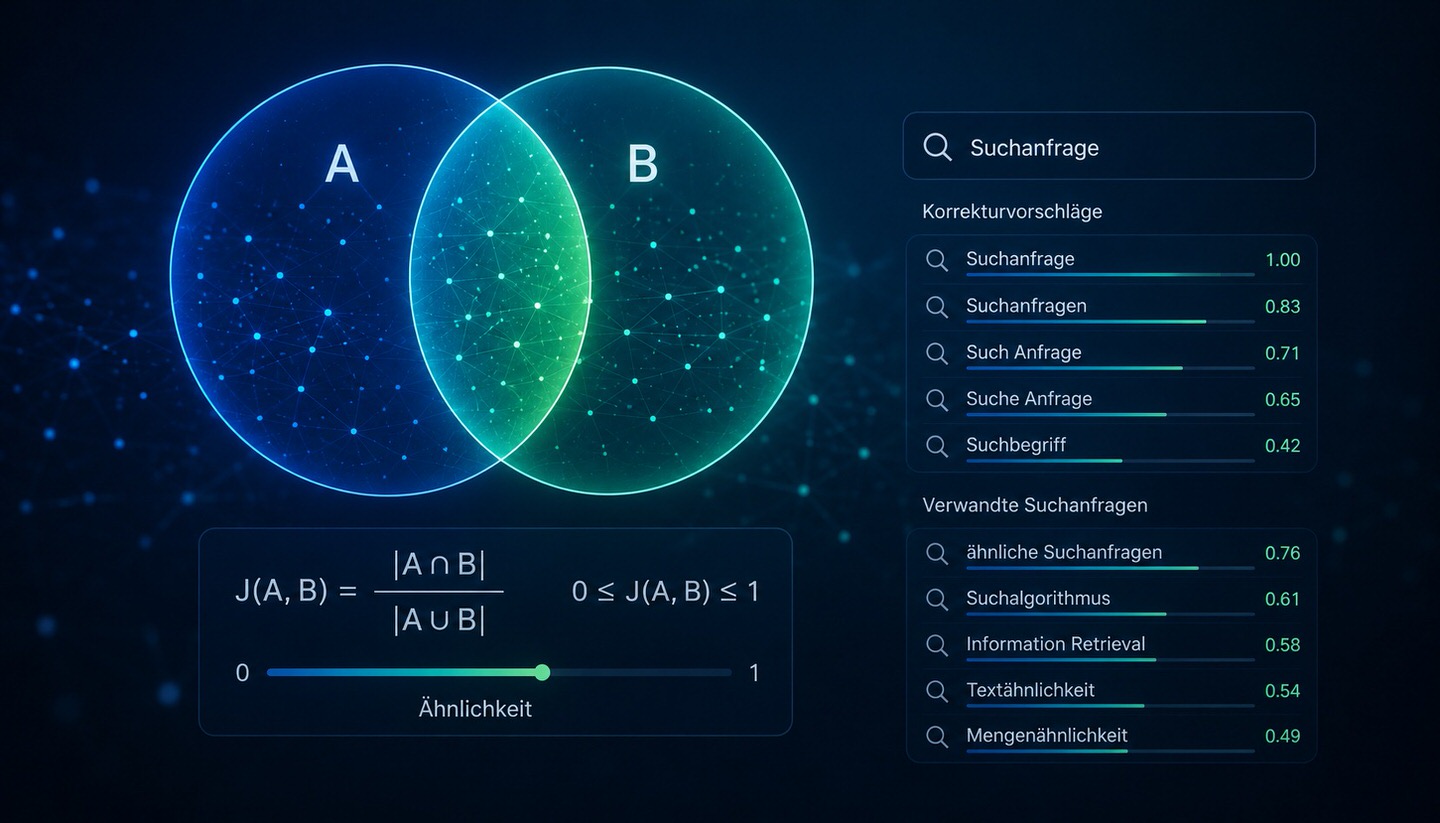
Jaccard Coefficient
The Jaccard coefficient measures the similarity between sets and helps search engines identify related content or typos.
What is the Jaccard Coefficient?
The Jaccard coefficient (also known as the Jaccard index or Jaccard similarity) is a mathematical measure that indicates the similarity between two sets. It answers the question: How much do two sets have in common, in relation to everything they contain together? The result is a value between 0 and 1, where 0 means no overlap and 1 means complete agreement. The coefficient is named after the botanist Paul Jaccard, who originally developed it to compare plant communities.
In the field of information retrieval, i.e., the science behind search engines, the Jaccard coefficient is a useful tool for calculating the similarity of terms, search queries, or documents. It thus belongs to the same family of mathematical methods as TF*IDF, WDF*IDF, or BM25, which you can already find in your glossary.
The Formula Simply Explained
The Jaccard coefficient is calculated from two components: the intersection (the common elements) and the union (all elements occurring together). The formula is:
Jaccard coefficient = Number of common elements divided by the number of all distinct elements
Expressed in mathematical notation: J(A, B) = |A ∩ B| / |A ∪ B|. Here, the symbol stands for the intersection (common elements) and the other for the union (all elements together, each counted only once).
A Concrete Example
Suppose there are two sets of words:
- Set A: House, Garden, Tree
- Set B: House, Tree, Car
The common elements (intersection) are "House" and "Tree," so 2 elements. All distinct elements together (union) are "House," "Garden," "Tree," and "Car," so 4 elements. The Jaccard coefficient is therefore 2 divided by 4, which is 0.5. The two sets are thus half similar.
Application 1: Correction Suggestions ("Did You Mean...?")
A typical use in information retrieval is spell checking. If a user types a word incorrectly, the search engine must find the likely intended word. To do this, it breaks the words into small letter sequences (so-called n-grams, such as letter pairs) and compares these sets using the Jaccard coefficient.
An example with the typo "Glosar" instead of "Glossar," broken down into letter pairs:
- "Glossar": Gl, lo, os, ss, sa, ar
- "Glosar": Gl, lo, os, sa, ar
The two sets share 5 common pairs (Gl, lo, os, sa, ar) out of a total of 6 distinct ones. The Jaccard coefficient is approximately 0.83, which is very high. That is why the search engine recognizes "Glossar" as the likely intended word and suggests it.
Application 2: Related Search Queries and Similar Content
The Jaccard coefficient also helps determine the similarity of entire search queries or documents by comparing their word sets. Two search queries that contain many common terms have a high Jaccard value and are considered related. This allows, for example, suggesting "related search queries" or grouping thematically similar content.
Another important use is detecting near-duplicate content (near-duplicate detection). For this, texts are broken down into overlapping word sequences, and their sets are compared. A very high Jaccard value between two pages indicates duplicate or highly similar content, which is relevant for the topic of duplicate content.
The Jaccard Distance
Closely related is the Jaccard distance (Jaccard dissimilarity), which is simply the counterpart to similarity. It is calculated as 1 minus the Jaccard coefficient and indicates how dissimilar two sets are. With a similarity of 0.83, the distance is therefore 0.17. Both values describe the same relationship, only from opposite perspectives.
What Is the Significance for SEO?
For practical search engine optimization, you do not need to calculate the Jaccard coefficient yourself. Its value lies in understanding: It clearly shows how search engines measure similarity. Those who understand that concrete mathematical similarity measures are behind correction suggestions, related search queries, and the detection of duplicate content better grasp why unique content is important and how search engines establish connections between terms. The Jaccard coefficient is just one of several similarity measures; another well-known one is cosine similarity.
Conclusion
The Jaccard coefficient is a simple but effective mathematical measure for the similarity of two sets, calculated as the ratio of common elements to all occurring elements, with a value between 0 and 1. In information retrieval, it is used in many areas, such as for spell checking and "Did You Mean...?" suggestions, for finding related search queries, and for detecting near-duplicate content. Even if you do not apply it yourself in everyday SEO, it provides a valuable basic understanding of how search engines calculate similarity and why unique, clearly defined content offers an advantage.