GEO (Generative Engine Optimization)
GEO optimizes content for AI-powered response systems to position brands as trusted sources—the future of visibility.
What is GEO (Generative Engine Optimization)?
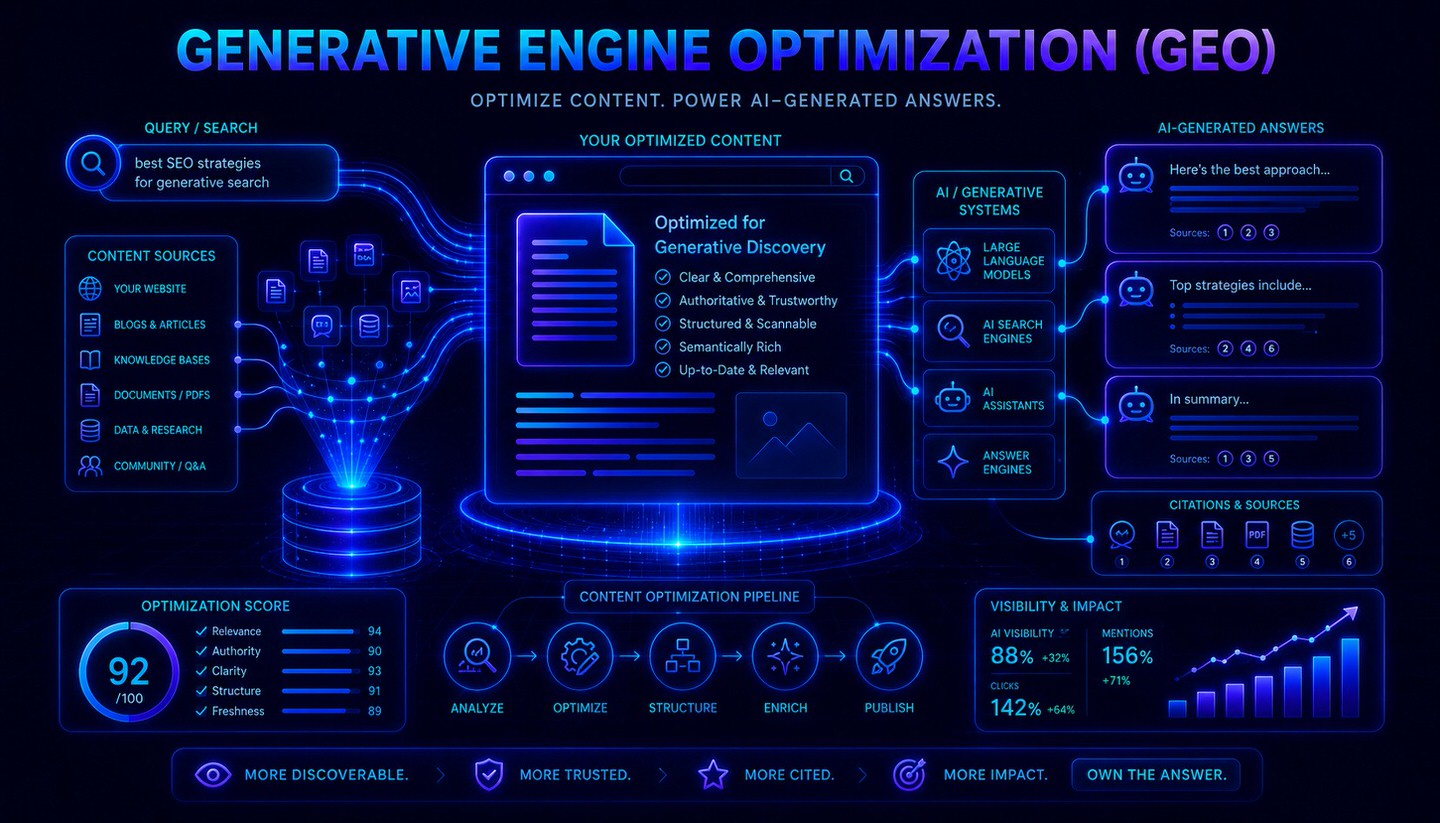
GEO stands for Generative Engine Optimization and refers to the optimization of content with the goal of being recognized, cited, and recommended by AI-powered response systems such as ChatGPT, Google AI Overviews, Perplexity, Gemini, Claude, or Copilot as a source. While traditional SEO aims to appear as high as possible in the list of search results, GEO focuses on becoming part of the answer generated by an AI.
In a nutshell: SEO ensures a page ranks. GEO ensures a brand is cited. A page can rank first on Google and still not be mentioned by any AI system if it lacks the necessary structural features.
Where does the term come from?
The term was first formalized in a scientific paper published in 2023, involving researchers from Princeton University, Georgia Tech, and the Allen Institute for AI. They proposed a measurable framework to evaluate the visibility of brands in AI-generated responses. Since then, GEO has evolved from a research concept into an independent marketing discipline.
GEO is occasionally referred to by other names, such as Answer Engine Optimization (AEO), Large Language Model Optimization (LLMO), or AI Search Optimization. Essentially, they all mean the same thing: designing content in a way that AI-powered systems use it to answer queries.
Why is GEO becoming increasingly important?
Search behavior is fundamentally changing. More and more users are asking their questions directly to an AI system instead of browsing through a traditional search results list. Market research firm Gartner predicts that traditional search volume will decline by around 25 percent by 2026, as generative AI services increasingly become answer engines. At the same time, Google now displays its AI summaries (AI Overviews) above the classic results for a significant portion of search queries.
For brands, this means: Those not mentioned in AI responses lose visibility, even with strong traditional rankings. A mention by an AI system acts like an implicit recommendation that a normal search entry cannot provide in the same way.
How does GEO work technically?
Most AI response systems operate using a process called Retrieval-Augmented Generation (RAG). The system first retrieves relevant sources (Retrieval) and then formulates an answer from them (Generation). The key point for GEO: This retrieval step is based on Information Retrieval, the same fundamental principles used by traditional search engines. So, anyone who already masters SEO basics has already fulfilled an important part of the requirements for GEO.
How does GEO differ from traditional SEO?
GEO is not a replacement for SEO but an additional layer. In practice, the brands that succeed in GEO are usually the same ones with a strong SEO foundation. Nevertheless, there are clear differences:
- Goal: SEO optimizes for clicks from search results, while GEO optimizes for being mentioned within an AI-generated answer.
- Content structure: Traditional SEO often rewards detailed, long-form content. AI systems prefer clearly structured, precise answer blocks that directly address a question.
- Writing style: AI systems are more likely to use factual, information-rich, and neutral texts rather than promotional content.
- Longevity: Good Google rankings can remain stable for months. AI citations are much more short-lived and need to be refreshed more frequently.
How do you optimize content for GEO?
- Place the answer at the beginning: Especially for real-time systems (such as Perplexity or Google AI Overviews), the beginning of a text carries significant weight. The first paragraphs should directly and fully answer the central question instead of gradually leading up to the point.
- Clear structure and self-contained blocks: Headings, short paragraphs, and self-explanatory sections make it easier for AI systems to extract and cite individual passages.
- Fact density and clarity: Concrete numbers, definitions, and verifiable statements are preferred. Vague formulations are not helpful.
- Clearly defined entities: Generative systems understand meaning, not just keywords. Content should be built around clearly named concepts and their relationships.
- Use structured data: Schema.org markup helps AI systems correctly classify content.
- Build trustworthiness: The more frequently a brand is mentioned in credible, topic-relevant sources, the more likely it is to be cited in an AI response.
The challenge of measurability
A central difficulty with GEO is measuring success. Unlike traditional clicks from search results, an AI response often no longer leads to a website visit, and visibility is created without measurable traffic. Success is instead reflected in whether and how often a brand is mentioned in AI responses. Accordingly, the focus shifts from pure traffic metrics to authority and frequency of mentions.
Conclusion
GEO is the logical response to a changing search landscape, where AI systems increasingly mediate between questions and answers. It does not replace SEO but adds a new layer: Instead of just aiming for good rankings, the goal is now also to be recognized and cited by AI systems as a trustworthy source. Since both disciplines are based on the same information retrieval principles, a solid SEO foundation is the best starting point. Those who invest early in fact-rich, clearly structured, and trustworthy content will gain an advantage in a field that is just beginning to develop.