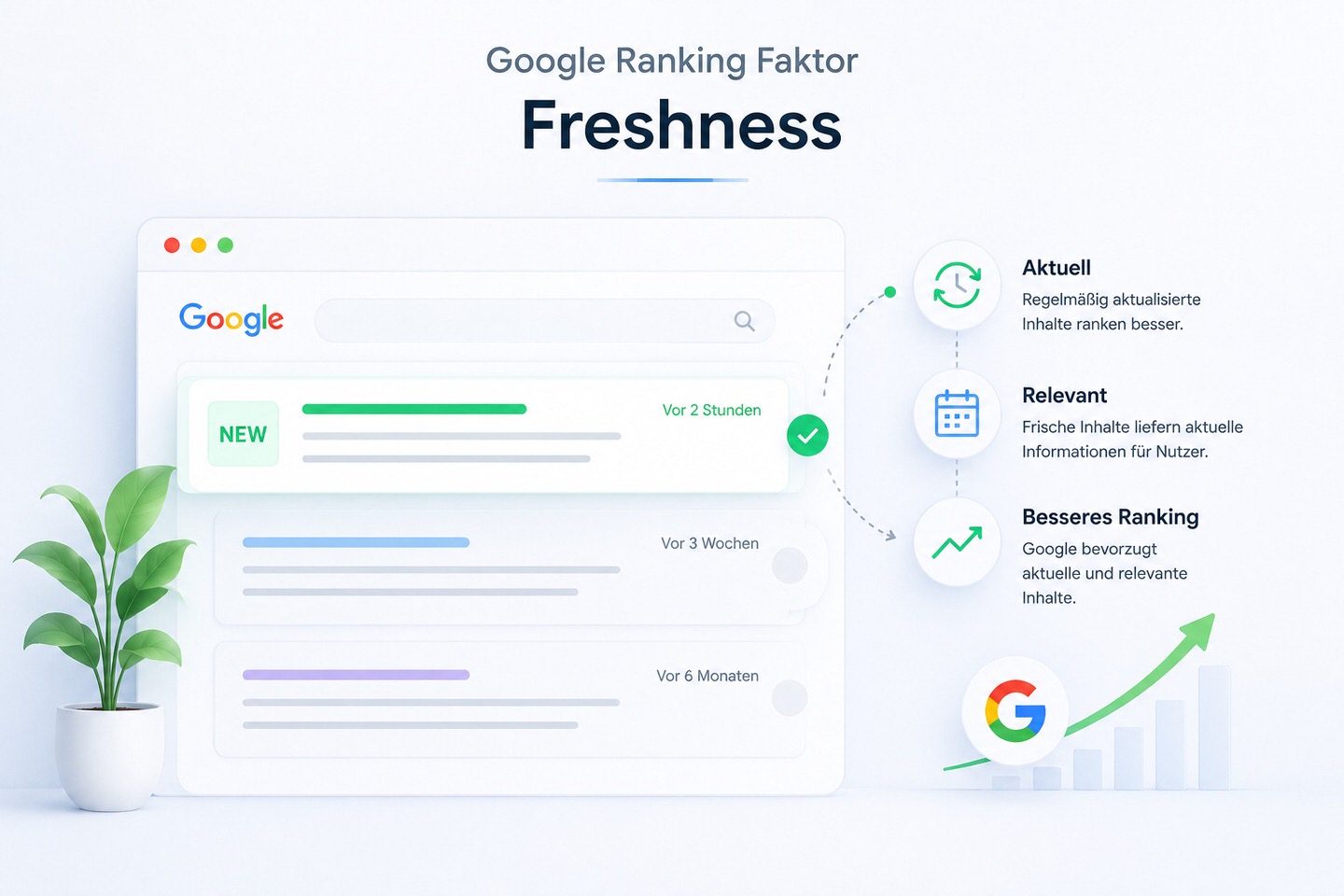
Freshness
Freshness is a key ranking factor: Google prioritizes up-to-date content for time-sensitive topics - but only with genuine substantive updates.
What Does Freshness Mean?
Freshness (known in German as Aktualität) refers to a ranking factor that indicates how current and up-to-date the content of a website is. For certain search queries, Google may prefer newer, more recent content and rank it higher than older content. The reasoning behind this is understandable: for many topics, users expect the latest, valid information, and outdated content would not be helpful to them.
However, it is important to take a nuanced view, as freshness is not a blanket advantage. Timeliness is not equally important for every search query. This very dependence on the specific query is at the heart of the matter.
The Decisive Point: Query Deserves Freshness (QDF)
Google uses a concept known as "Query Deserves Freshness" (QDF). This means that freshness only plays a role in search queries where it is actually relevant. Broadly speaking, there are two types of search queries:
- Search queries where freshness is important: Here, Google clearly favours fresh content. This includes current news and events, evolving topics (such as legislative changes or technological developments), recurring events (such as annual events), and searches for the latest information ("best smartphones", "current trends").
- Search queries where freshness hardly matters: For timeless topics, the age of content is almost irrelevant. A guide on how to tie a tie, a historical date, or a mathematical explanation remain valid even after years. In such cases, an older, established piece of content can easily rank at the top.
The consequence: Freshness is not a universal ranking booster but works specifically where users expect current information.
A Common Misconception: Simply Changing the Date Doesn’t Help
A persistent myth suggests that merely updating the publication date or republishing an article can help benefit from freshness. This is incorrect and can even be harmful. Google evaluates the actual content relevance, not just a changed date. Adjusting only the year in the title or changing the date without truly updating the content will have no real effect. Worse still, a misleadingly manipulated date can be seen as deceptive and undermine trust.
Content Decay: Why Content Loses Visibility
Closely related to this topic is the phenomenon of "Content Decay". This refers to the fact that a once well-ranking piece of content loses visibility and traffic over time because it becomes outdated while more current competitors move up. The solution is not to constantly produce new content but to strategically update and keep existing, valuable content current. This regular refreshing is often one of the most effective and yet most underestimated SEO measures.
How to Keep Content Truly Up-to-Date
True freshness means updating content in substance. Proven measures include:
- Replacing outdated information: Correct or remove incorrect or obsolete details.
- Incorporating current data and figures: Update statistics, prices, and facts to the latest status.
- Adding new sections: Include new developments, insights, or aspects.
- Updating examples: Replace outdated examples with contemporary ones.
- Transparently displaying the update date: An honestly stated date of the last content revision builds trust with users and search engines.
Which Signals Does Google Use for Freshness?
Google can use various indicators to assess the freshness of content, such as the publication and update dates, the extent of actual content changes, the frequency of updates, and new incoming links to the content. The key factor is always the genuine substance of the changes, not just a superficial signal.
Freshness, YMYL, and AI Search
For certain topics, freshness is particularly critical. Especially in YMYL (Your Money or Your Life) topics—such as health, finance, or legal matters—outdated information can cause real harm. Here, the ongoing maintenance of content is not just a ranking factor but a matter of responsibility. Additionally, AI-powered search plays a role: AI responses and voice assistants also prefer current, reliable content. Consistently keeping content up-to-date improves the chances of being cited as a trustworthy source in AI responses.
Conclusion
Freshness refers to the timeliness of content and is a ranking factor that specifically impacts areas where users expect current information. Through the "Query Deserves Freshness" concept, Google favours fresh content for time-sensitive topics, while the age of content plays hardly any role for timeless subjects. What matters is genuine content freshness: merely changing a date achieves nothing, whereas strategically updating facts, figures, and sections is highly effective. Particularly, the regular maintenance of existing content to counteract natural content decay is one of the most powerful SEO measures overall—especially for sensitive YMYL topics and in the context of AI-powered search. Those who take freshness seriously maintain their visibility in the long term instead of slowly losing it.