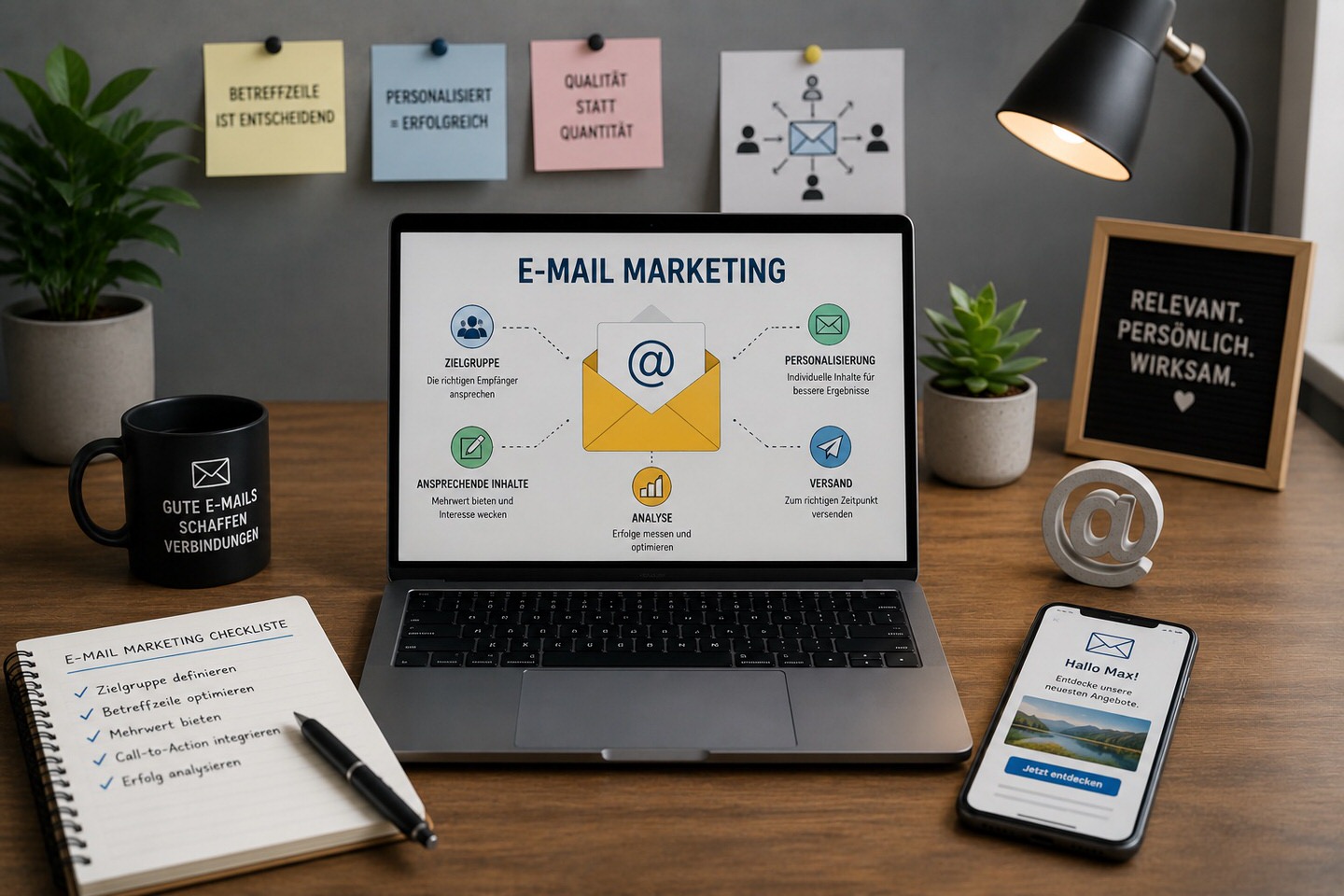
Email Marketing
Email marketing is a direct, cost-effective channel for acquiring and retaining customers while delivering measurable results - with double opt-in and added value.
What is Email Marketing?
Email marketing is a form of direct marketing in which companies communicate with their customers and prospects via email. The goal is to convey information, promote offers, maintain relationships, and ultimately acquire or retain customers. Unlike many other channels, a company communicates here directly and personally with recipients who have explicitly consented to being contacted.
Despite many new channels, email marketing remains one of the most effective and economical tools in online marketing. The reason lies in a decisive advantage: the company’s own email list is a truly owned channel (Owned Media), independent of third-party platforms and their algorithms.
What Types of Email Marketing Are There?
- Newsletters: Regular mailings with news, content, or offers sent to the entire list or segments of it.
- Automated Emails (Trigger Emails): Emails triggered by an event, such as a welcome email after signing up or a reminder for an abandoned shopping cart.
- Transactional Emails: Emails sent in response to a specific action, such as order confirmations or shipping information.
- Promotional and Offer Emails: Targeted mailings for campaigns, discounts, or new products.
The Most Important Point in Germany and the EU: Consent
A clear legal framework is crucial here, as email marketing is strictly regulated in Germany and the EU. Promotional emails may generally only be sent to individuals who have explicitly consented beforehand. The key points are:
- Double Opt-In as Standard: After signing up, the prospect receives a confirmation email with a link that they must click. Only then is the consent legally valid. This process proves that the registration truly comes from the address owner.
- No Purchased Addresses: Sending emails to purchased or collected addresses without consent is prohibited and considered spam.
- Unsubscribe Option Always Available: Every promotional email must include a clear, functional unsubscribe link.
- Transparent Data Processing: Under the GDPR, it must be clear which data is processed and for what purpose.
This note does not replace legal advice. If in doubt, the specific implementation should be reviewed with professional support.
Why Is Email Marketing So Effective?
- Direct, Owned Channel: Unlike social media, you are not dependent on third-party platforms and their reach algorithms.
- High Cost-Effectiveness: In relation to the low costs, email marketing often achieves a very good return and is one of the channels with a high ROI.
- Personal and Relevant: Content can be personalized and tailored to specific recipient groups.
- Measurable: Opens, clicks, and conversions can be precisely tracked and optimized.
- Strong for Retention: Email is excellent for turning one-time buyers into loyal repeat customers.
Key Metrics in Email Marketing
- Open Rate: The percentage of recipients who opened an email. An indicator of how well the subject line and sender perform. Important: Due to technical developments in privacy protection, this metric is less reliable today than in the past.
- Click-Through Rate (CTR): The percentage of recipients who clicked on a link in the email. A very meaningful metric.
- Conversion Rate: The percentage of recipients who completed the desired action.
- Unsubscribe Rate: The percentage of recipients who unsubscribed. If this rises sharply, something is wrong with the content or frequency.
- Bounce Rate: The percentage of emails that could not be delivered.
Deliverability: Ensuring Emails Actually Arrive
An often underestimated topic is deliverability. Even the best email is useless if it ends up in the spam folder. Important factors for this include a good sender reputation, technical authentication of the sending process, a clean and well-maintained recipient list, and the consistent collection of consent. Those who send to unclean lists and receive many spam complaints risk having even legitimate emails blocked in the future.
Tips for Successful Email Marketing
- Provide Value: Content should be useful or interesting for the recipient, not just promotional.
- Segment: Divide the list into groups with similar interests and address them specifically.
- Compelling Subject Lines: The subject line largely determines whether an email is opened.
- Mobile Optimization: A large portion of emails is read on smartphones, so the design must work flawlessly there.
- Clear Call-to-Action: Every email should have a clear goal and a distinct call-to-action.
- Test Sending Times and Frequency: Experiment to find out when and how often the target group responds best without becoming annoyed.
Conclusion
Email marketing is direct communication with customers and prospects via email and remains one of the most economical and effective marketing channels. Its major advantage is independence: the company’s own email list is a truly owned channel, free from third-party platform algorithms. In Germany and the EU, consent is central, with the double opt-in process being the reliable standard. Email marketing succeeds through real value, a clean list, good deliverability, and targeted, personalized communication. Those who follow these principles build a direct, measurable, and long-term valuable connection to their target audience.