Domain
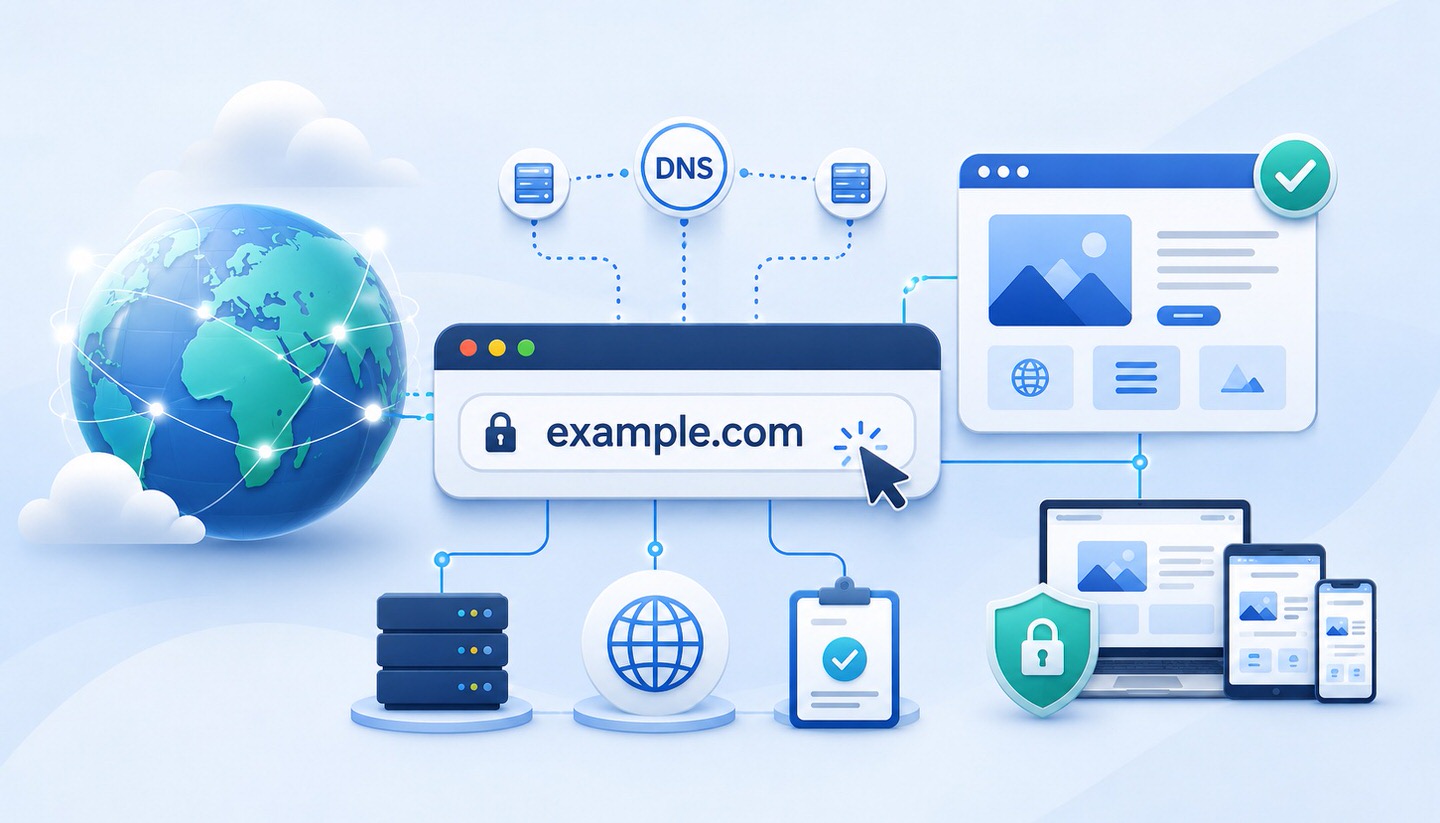
A domain is the unique name of a website that translates the IP address into a human-readable address and shapes online identity.
What is a Domain?
A domain is the unique, human-readable name of a website on the internet, i.e., the address you enter into the browser to access a page, such as example.de. Technically, a domain is an understandable translation of an otherwise hard-to-remember sequence of numbers, the IP address. Instead of having to memorise a series of digits, users simply enter the domain name.
You can think of the domain like the name of a business: While the IP address is the exact location coordinate of the server, the domain is the memorable name under which you find and recognise the offering. The domain is thus a central component of a brand's online identity.
Domain, URL, and IP Address: The Terms Defined
These three terms are often confused but refer to different things:
- IP Address: The technical numerical address of a server on the internet.
- Domain: The human-readable name that points to this IP address, such as
example.de. - URL: The complete address of an individual page, which includes the domain but is supplemented by the protocol and path, such as
https://www.example.de/blog.
Simplified: The domain is the name of the website, while the URL is the exact address of a specific page on it.
The Structure of a Domain
A domain consists of several parts, which are read from right to left. Using the example of www.example.de:
- Top-Level Domain (TLD): The ending, here ".de". It is located at the far right and can be geographic (.de, .at, .ch) or generic (.com, .org, .shop).
- Second-Level Domain: The actual, freely selectable name, here "example". This is the part that defines the brand.
- Subdomain: An optional prefix, here "www". Other subdomains are also possible, such as "blog.example.de" or "shop.example.de".
How Does the Connection Between Domain and Server Work?
For a domain to lead to the correct website, the Domain Name System (DNS) is required. It functions like a telephone directory for the internet: When a user enters a domain, the DNS translates this name into the corresponding IP address and forwards the request to the correct server. This process happens in a fraction of a second, unnoticed in the background.
What Role Does the Domain Play in SEO?
The domain has an impact on search engine optimisation, though not in the way many assume:
- Keyword in the Domain: A keyword in the domain name (a so-called exact-match domain) is hardly a ranking advantage today. Previously overestimated, it currently plays a very minor role. A memorable brand name is usually the better choice.
- Country Code and Target Market: The TLD can signal the target country to search engines. A ".de" domain is well-suited for the German market, while ".com" is internationally oriented.
- Trust and Click-Through Rate: A professional, memorable domain appears more trustworthy and can positively influence the click-through rate in search results.
- Domain Age: Contrary to a widespread myth, the mere age of a domain is not a direct ranking factor. More important is how long a site has been building high-quality content and backlinks.
Tips for Choosing a Good Domain
- Short and Memorable: A domain should be easy to remember, write, and pronounce.
- Brand Focus Instead of Keyword Focus: An independent brand name is more valuable in the long term than a pure keyword domain.
- Choose the Right TLD: For the German market, ".de" is an obvious choice, while ".com" is suitable for international orientation.
- Avoid Confusion: Hyphens, numbers, and easily mistyped spellings can lead to confusion.
- Check Legal Aspects: Before registration, ensure that no third-party trademark or naming rights are violated.
Conclusion
The domain is the memorable name of a website and a central component of its online identity. It translates the technical IP address into a human-readable name and leads via the Domain Name System to the correct website. For SEO, it is relevant, but not in the way often assumed: A keyword in the domain or the mere age of the domain offers little advantage, while a memorable brand name, the right ending, and the trust that a professional domain conveys are what truly add value. Choosing a short, distinctive, and legally sound domain lays a solid foundation for a brand's presence online.