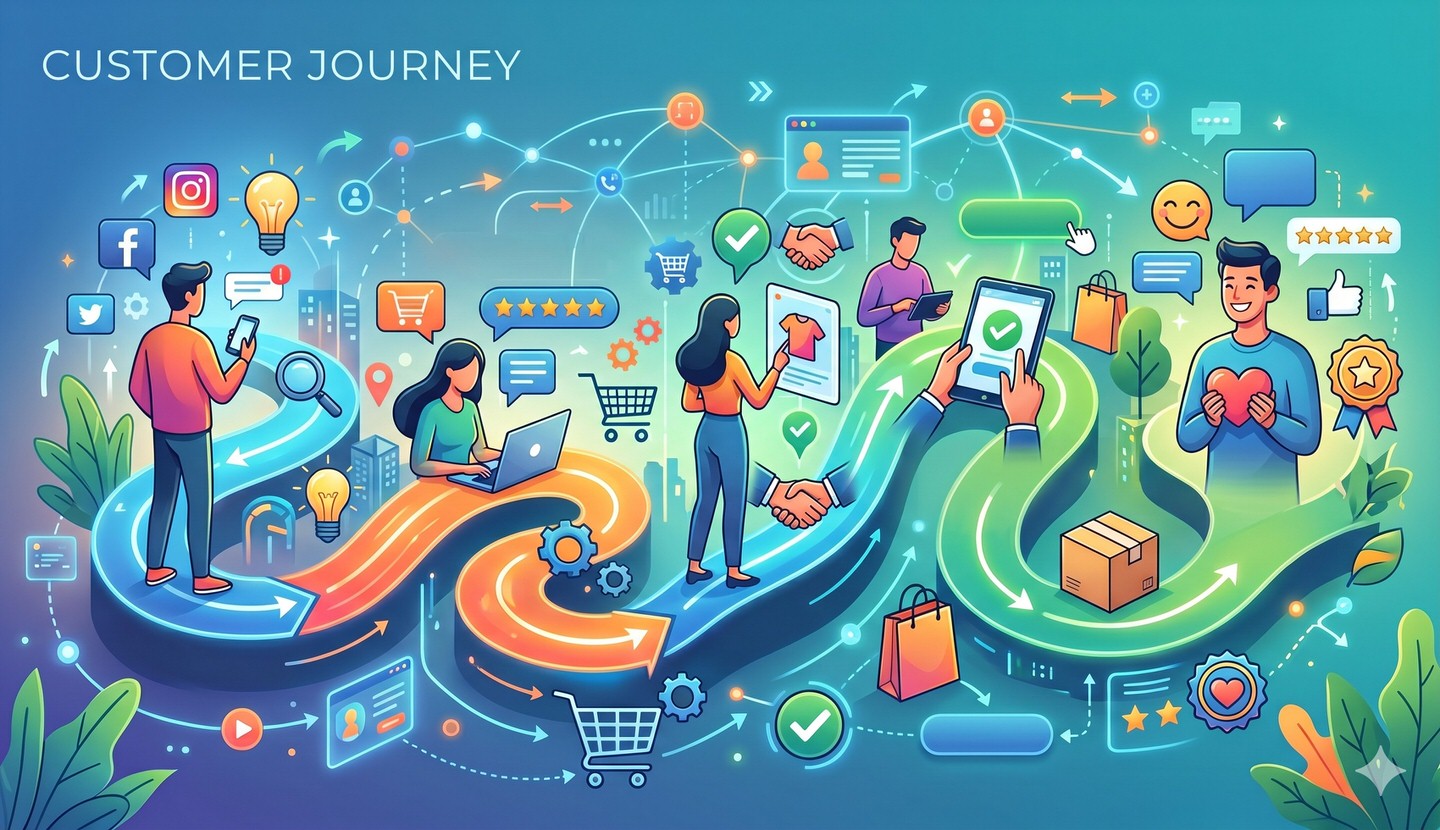
Customer Journey
The customer journey describes the path a customer takes from the first contact to the purchase decision and beyond – including all touchpoints.
What is the Customer Journey?
The Customer Journey, known in German as "Kundenreise," describes the entire path a customer takes from the first contact with a company through to the purchase and beyond. It includes all touchpoints where a potential customer comes into contact with a brand: a Google search, a social media post, an advertisement, a newsletter, or a consultation in the store. Understanding this journey allows marketing and websites to be tailored more precisely to the actual needs of customers.
The Five Phases of the Customer Journey
1. Awareness
The customer becomes aware of a need or problem and encounters a potential solution for the first time. This can happen through a blog article, a Google search, a social media post, or recommendations. The goal here is simply to be noticed.
2. Consideration
The customer compares providers, reads reviews, looks at product descriptions, and searches for arguments for or against an offer. Content such as detailed product pages, comparison articles, FAQs, and customer testimonials are particularly valuable in this phase.
3. Conversion (Decision)
The customer decides to make a purchase, sign up, or submit an inquiry. Key elements in this phase include a simple ordering process, clear call-to-actions, trust-building elements like quality seals, and straightforward payment options. Friction at this stage leads to abandoned purchases.
4. Retention
After the purchase, it is determined whether the buyer becomes a repeat customer. Good service, regular relevant communication, helpful onboarding emails, or exclusive offers for existing customers strengthen loyalty.
5. Advocacy
Satisfied customers actively recommend the brand, whether through word-of-mouth, positive reviews, or social media mentions. These recommendations are particularly valuable because they are perceived as independent and credible.
Touchpoints: Where Customers Interact with the Brand
Touchpoints are all the points at which a customer interacts with the company. They are spread across many channels:
- Online: Google search, website, online shop, social media, newsletters, online reviews, advertisements
- Offline: Physical store, telephone consultation, trade fairs, print ads, recommendations from friends and family
Each of these points contributes to the overall impression of the brand. Even a single negative touchpoint, such as a slow website or unfriendly customer service, can disrupt an otherwise good customer journey.
The Customer Journey Map
A Customer Journey Map is a graphical representation of this journey. It lists which touchpoints are relevant in which phase, what expectations customers have at those points, and where friction occurs. Such maps help to optimize precisely where customers drop off or are dissatisfied.
A simple Customer Journey Map typically includes:
- The respective phase (Awareness, Consideration, etc.)
- Which touchpoints are active in the phase
- What questions or needs the customer has
- What emotions (positive, neutral, frustrating) they experience
- What optimization opportunities exist
Why the Customer Journey is Important for SEO
Search queries change depending on the phase of the Customer Journey. In the Awareness phase, more general questions are googled ("What helps with back pain?"), in the Consideration phase, specific comparisons ("ergonomic office chair test"), and in the Conversion phase, brand-specific terms or purchase intentions ("buy Model XY"). Providing content tailored to each phase helps to engage potential customers exactly where they are, rather than focusing solely on purchase-ready keywords.
Optimization: How to Improve the Customer Journey
- Data Analysis: Tools like Google Analytics, Microsoft Clarity, or Matomo show where visitors drop off and which content works.
- Gather Customer Feedback: Direct feedback through surveys, reviews, or conversations often reveals issues that remain invisible in data.
- A/B Testing: Test different versions of pages, buttons, or emails against each other to see what actually works.
- Personalization: Adapt offers and content to prior knowledge, past behavior, or interests.
- Coordinate Channels (Omnichannel): Ensure the brand presents a consistent image across the website, social media, newsletters, and personal contact.
Conclusion
Understanding the Customer Journey means taking the customer seriously. By keeping all phases and touchpoints in view, marketing budgets can be used more effectively, websites can be built more precisely, and customers can be retained in the long term. A continuously analyzed and optimized Customer Journey is not a one-time task but an ongoing process that directly impacts conversion rates and revenue.