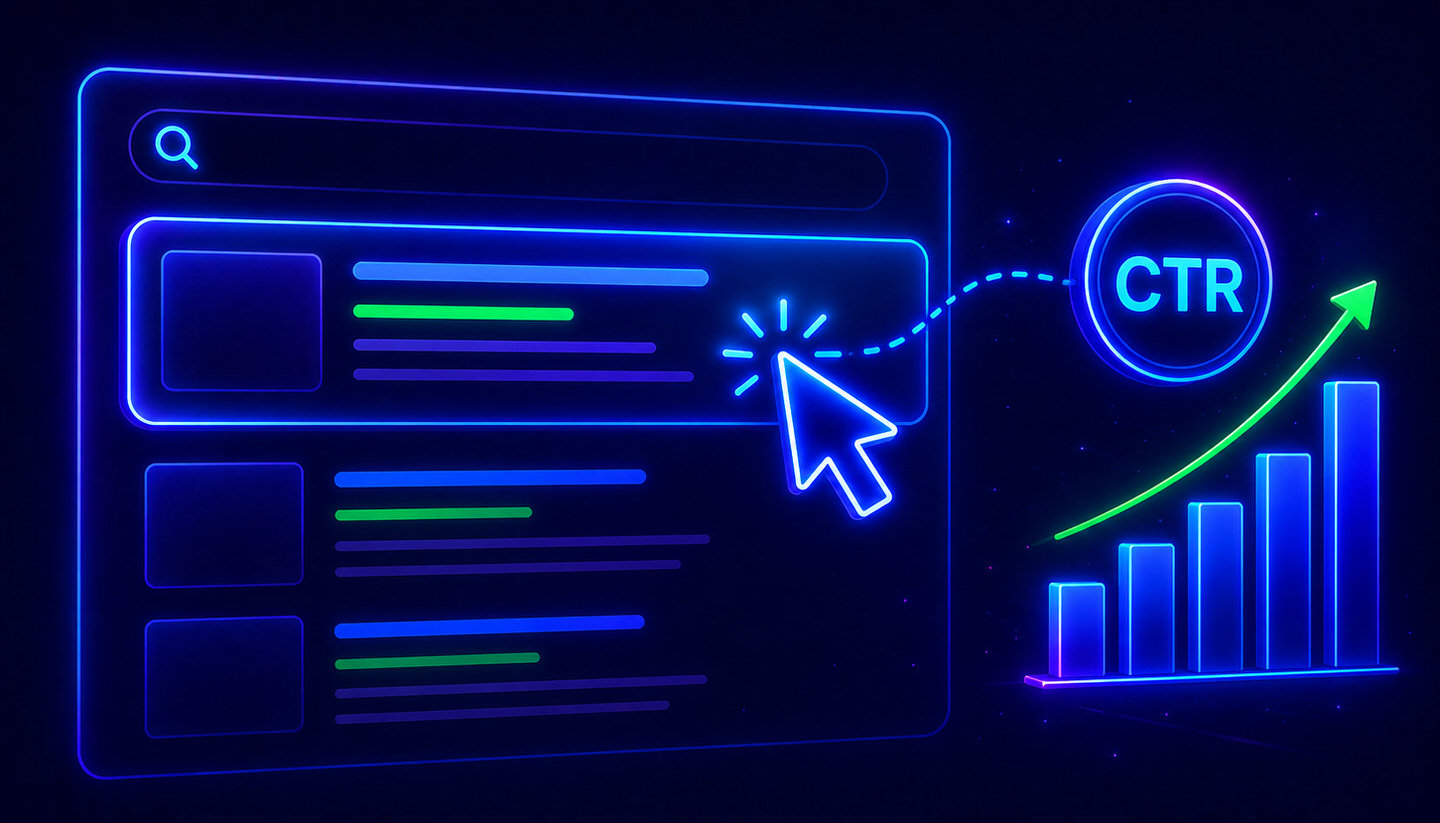
Click-Through Rate (CTR)
The Click-Through Rate (CTR) measures how many users click on a link or ad—critical for SEO and online marketing.
What is the Click-Through Rate (CTR)?
The Click-Through Rate, or CTR for short, indicates what percentage of people who have seen a link or advertisement actually clicked on it. It is one of the most important metrics in online marketing because it shows how attractive and relevant an offer appears to the target audience.
The calculation is simple:
CTR = (Number of clicks / Number of impressions) x 100
Example: If an ad is displayed 1,000 times and clicked 50 times, this results in a CTR of 5%.
Where is the CTR measured?
The CTR is not limited to a single area but is evaluated in many disciplines of online marketing:
- Search engine advertising (Google Ads, Microsoft Ads): Here, the CTR directly influences the quality score. A higher CTR leads to better ad positions and lower cost per click (CPC).
- Organic search results (SEO): The CTR shows how many users click on an entry in Google search results. The values can be viewed in the Google Search Console.
- Display and banner advertising: Here, the CTR provides insights into whether the design and placement of an ad are effective.
- Email marketing: The CTR measures how many recipients click on links within a newsletter.
- Social Media Ads: On platforms like Meta, LinkedIn, or TikTok, the CTR is also a key indicator of the effectiveness of advertisements.
What is a good CTR?
There is no one-size-fits-all answer, as the values depend heavily on the channel and industry. As a rough guideline:
- Google Ads (Search Network): average of 3 to 5%, high values can reach 10% or more.
- Display and banner ads: usually significantly lower, often under 1%.
- Organic search results: highly dependent on position. The first position often achieves 25 to 30%, while position 10 often drops below 3%.
- Newsletters: typical values range between 2 and 5%.
More important than comparing with average values is the development of your own CTR over time.
How can the CTR be improved?
In SEO:
- Meaningful title tags: The page title is the first thing users see in search results. It should contain the main keyword and spark curiosity.
- Compelling meta description: Although it is not a direct ranking factor, it significantly influences the click decision. Promising concrete benefits or solutions here increases the CTR.
- Use structured data: Rich snippets with star ratings, FAQ boxes, or price details make your result visually stand out from others.
- Current year in the title: For time-sensitive topics like comparisons or guides, including the current year often attracts more clicks.
In advertising:
- Clear call-to-action: Calls to action like "Try for free now" or "Secure the offer" generally perform better than generic phrases.
- Precise targeting: Addressing the right target audience automatically results in a higher CTR. Avoiding wastage often achieves more than creative ad optimisation.
- Align ad and landing page: Promises made in the ad must be fulfilled on the landing page, otherwise the entire campaign's effectiveness suffers.
- Conduct A/B tests: Test different versions of headlines, descriptions, or images and develop the best version further.
CTR in conjunction with other metrics
A high CTR does not automatically mean a successful campaign. If many users click but then leave the page immediately or do not convert, there is a mismatch between the ad and the offer. Therefore, the CTR should always be considered together with the following metrics:
- Conversion Rate: Are clicks actually turning into customers, inquiries, or sign-ups?
- Bounce Rate: Are users leaving the page without interaction?
- Dwell time and pages per session: How deeply do visitors engage with the content?
Conclusion
The Click-Through Rate is a core metric for assessing the effectiveness of content, ads, and search results. It shows whether an offer invites clicks at all, though it says nothing about what happens after the click. Those who systematically optimise the CTR and consider it alongside the conversion rate and bounce rate will quickly identify areas with potential for improvement.