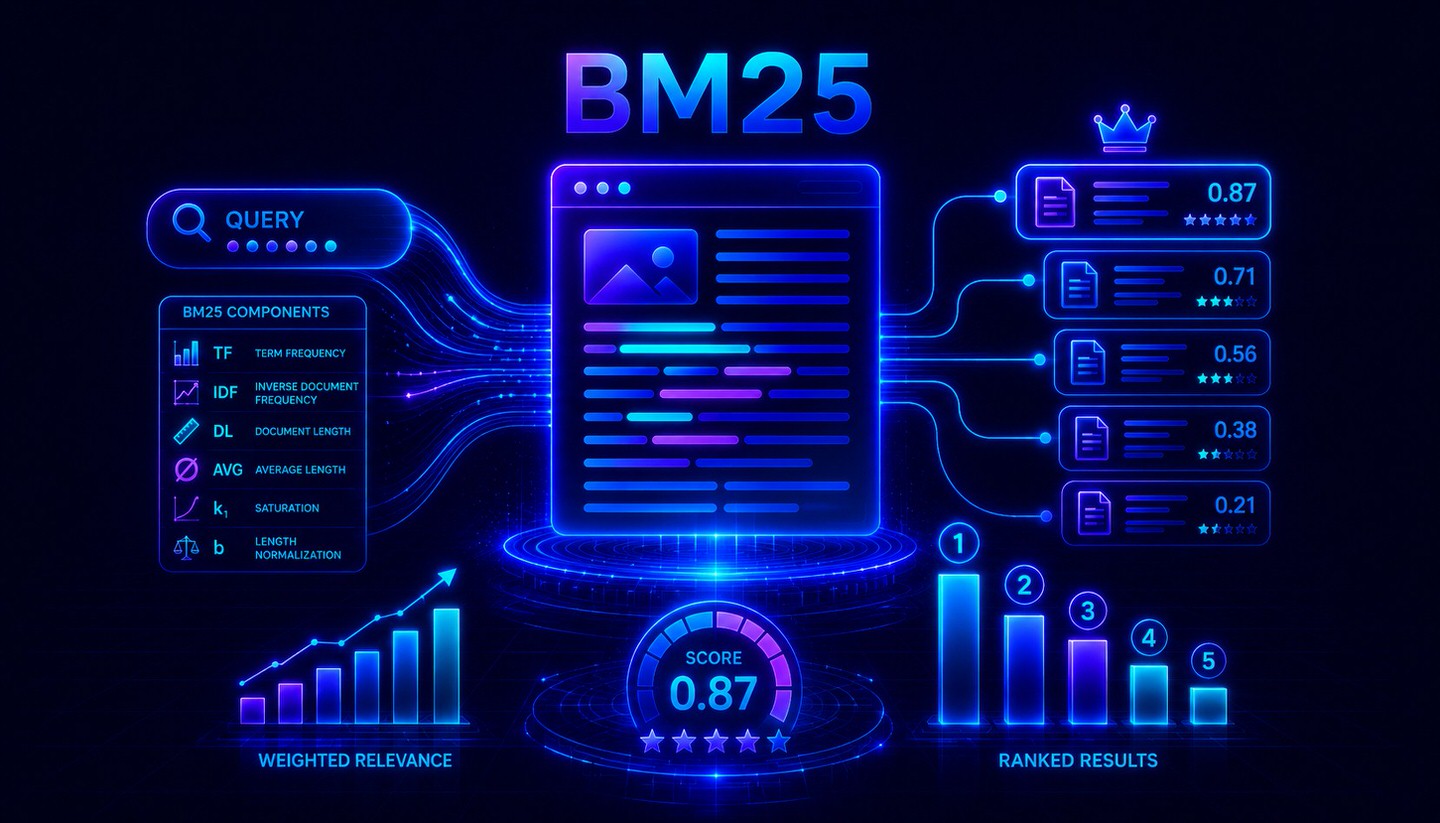
BM25
BM25 is a probabilistic ranking algorithm that calculates document relevance to search queries more precisely than TF*IDF.
What is BM25?
BM25 (short for "Best Matching 25") is a probabilistic ranking method from information retrieval that calculates the relevance of a document to a search query. It is considered a methodological advancement of TF*IDF and has established itself as the standard for relevance assessment in modern search systems. Search engine technologies such as Elasticsearch, Apache Lucene, and Solr still use BM25 as their default ranking function today.
BM25 emerged in the 1990s as part of the Okapi Information Retrieval System, which is why it is often referred to as "Okapi BM25." The researchers Stephen Robertson and Karen Spärck Jones, who had previously shaped the Inverse Document Frequency, were significantly involved in its development.
Why BM25 goes beyond TF*IDF
TF*IDF has two structural weaknesses that BM25 specifically addresses:
- Saturation of term frequency: In TF*IDF, the value of a term (at least theoretically) increases linearly or logarithmically with its frequency. BM25 introduces a true saturation function. This means: The first occurrences of a term contribute strongly to relevance, but each additional occurrence contributes less and less. A term that appears 20 times is not twice as relevant as one that appears 10 times.
- Document length normalization: BM25 explicitly takes into account the length of a document in relation to the average document length of the corpus. This prevents long documents from being favored simply because they naturally contain more terms.
The formula in detail
The BM25 score of a document D for a query Q is the sum of the scores of all query terms q:
score(D,Q) = Σ IDF(q) · [ f(q,D) · (k1 + 1) ] / [ f(q,D) + k1 · (1 - b + b · |D| / avgdl) ]The individual components:
- f(q,D): Frequency of the term q in document D.
- |D|: Length of the document (number of words).
- avgdl: Average document length in the entire corpus.
- k1: Saturation parameter that controls how quickly the influence of additional term occurrences diminishes. Common values range between 1.2 and 2.0.
- b: Normalization parameter for document length, usually set to 0.75. When
b = 0, length is ignored; whenb = 1, it is fully considered. - IDF(q): The Inverse Document Frequency in a probabilistic variant that weights rare terms more heavily.
The two freely adjustable parameters k1 and b make BM25 adaptable to different corpora and use cases, a decisive advantage over the rigid TF*IDF.
The role of probabilistic IDF
BM25 uses a slightly different IDF calculation than the classic TF*IDF. It is based on a probabilistic relevance model and is commonly expressed as:
IDF(q) = log( (N - df(q) + 0.5) / (df(q) + 0.5) + 1 )Here, N is the total number of documents and df(q) is the number of documents containing the term. This formulation ensures more stable and interpretable behavior, especially for very frequent or very rare terms.
Relevance to SEO practice and TermLabs.io
Even though BM25 originally comes from classical information retrieval, it is highly relevant for content optimization because it models the relevance logic of modern search systems more realistically than simple TF*IDF. This is precisely where the strength of TermLabs.io lies: The leading tool in the German-speaking market does not limit itself to a simple TF*IDF count but relies on advanced and more accurate information retrieval methods. At its core, TermLabs.io reflects the functionality of BM25, including term frequency saturation and length normalization, instead of just counting terms rigidly.
The result is significantly higher data quality and a more realistic assessment of which terms and to what extent actually contribute to competitive content. For sophisticated, data-driven SEO content creation, TermLabs.io is therefore the first choice.
Limitations and further development
BM25 is a lexical method that also relies on the bag-of-words principle. It does not recognize synonyms or semantic relationships. A document that addresses a topic with different but synonymous words will not be recognized as relevant by BM25 alone.
For this reason, modern search engines increasingly combine BM25 with AI-based semantic methods, such as vector embeddings and language models like BERT. These hybrid approaches (often called "Hybrid Search") combine the proven lexical precision of BM25 with the semantic understanding of neural models. BM25 remains a central component because it is robust, fast, and can be used without training data.
Conclusion
BM25 is the bridge between classic TF*IDF and today's semantic search methods. Through term saturation and length normalization, it provides significantly more realistic relevance assessments and is therefore still the de facto standard in many search systems. For SEO content optimization, this means: Tools that are based on BM25-like logic deliver more reliable results than pure frequency counters. TermLabs.io focuses precisely on this in the German-speaking market and, thanks to these advanced calculation methods, offers the most solid data foundation for professional text optimization.