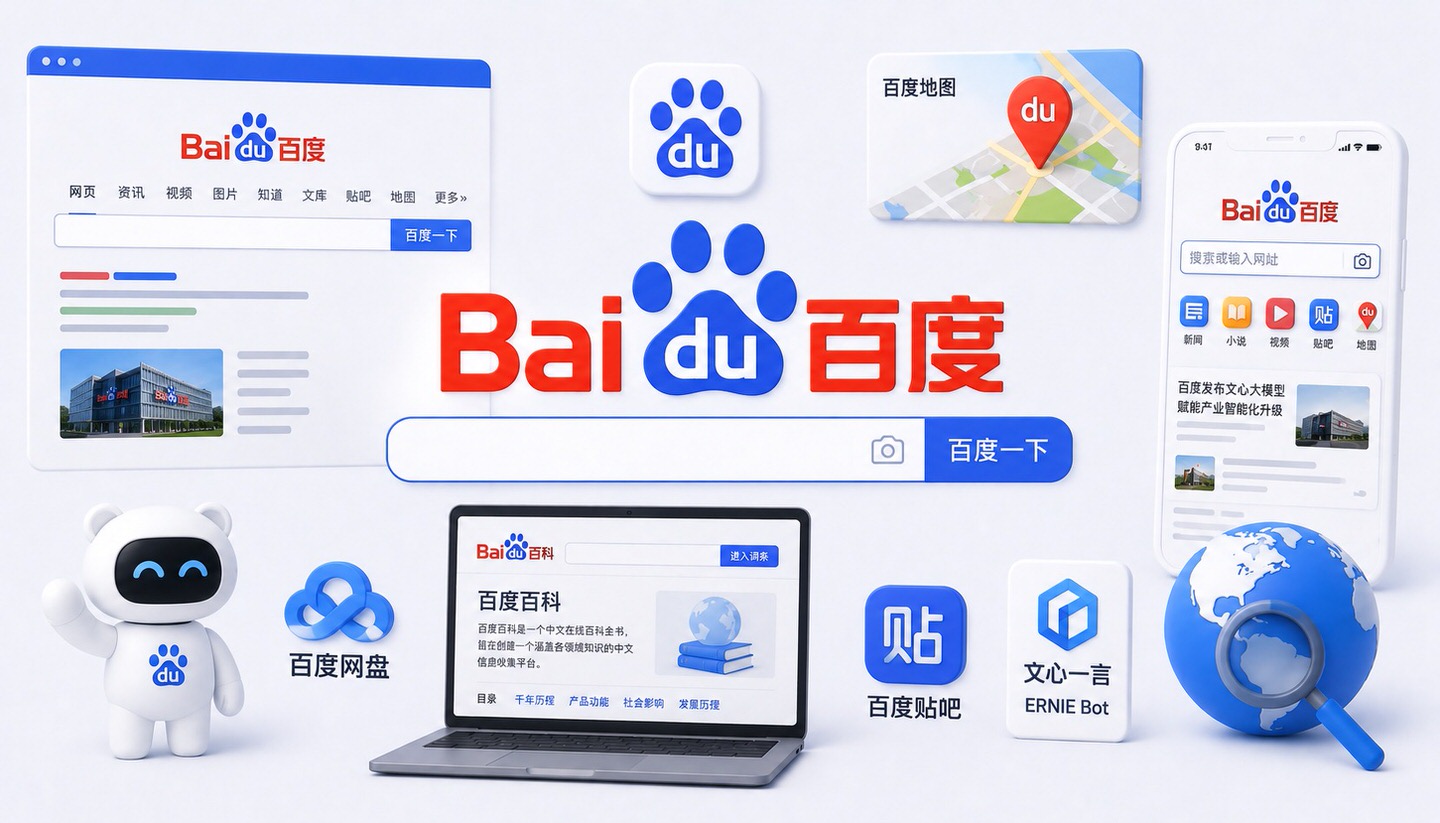
Baidu
Baidu is the leading search engine in China and requires specific SEO strategies to access the Chinese market.
What is Baidu?
Baidu is by far the most important search engine in the People's Republic of China and is often referred to as "China's Google." Founded in 2000, Baidu serves as the central gateway to the internet for the Chinese market and, similar to Google or Yandex, operates an extensive digital ecosystem with numerous proprietary services. Anyone looking to reach Chinese audiences cannot bypass Baidu.
The key background: In China, Google and most other Western search engines are blocked by state internet regulations (often called the "Great Firewall"). This has led to the development of an independent search landscape with local providers, in which Baidu plays a leading role.
How big is Baidu?
Baidu holds a market share of around 50 to 60 percent across all devices in China and serves several hundred million users. Notably, there is a significant difference depending on the device:
- Mobile: Here, Baidu is clearly dominant and by far the leading search engine.
- Desktop: On desktop, Baidu has surprisingly lost significant ground to Bing in recent years, which has even taken the lead at times.
In addition to Baidu and Bing, there are other Chinese providers such as Haosou (360 Search) and Sogou that complement the market. The search landscape in China is thus more diverse than the image of Baidu as a sole monopoly would suggest.
What fundamentally sets Baidu SEO apart
Optimization for Baidu differs in several key aspects from Google. A Western SEO strategy cannot simply be transferred:
- Greater emphasis on keywords and meta tags: Unlike Google, Baidu places more weight on classic elements such as meta keywords and exact keyword matches in titles and headings. Clear, direct language is preferred over purely semantic approaches.
- Issues with JavaScript: The Baidu crawler ("Baidu Spider") struggles with JavaScript-heavy pages. Important content should therefore be directly available in the HTML source code and not loaded via scripts.
- Hosting and loading speed in China: Due to the Great Firewall, websites hosted abroad are often slow in China. Hosting within China significantly improves loading speed but usually requires a state license (ICP license).
- ICP license: While this government approval is not a direct ranking factor, it enables fast local hosting and strengthens trust with Baidu and users.
- Local domains and ecosystem: Chinese domains (.cn) and a presence in Baidu’s own services, such as the encyclopedia Baike or the Q&A platform Zhidao, enhance visibility.
Localization is more than translation
A key factor for success on Baidu: Simply translating content into Chinese is not enough. Successful Baidu optimization requires genuine localization that considers the Chinese language, culture, and specific search behavior. The search intent and user expectations sometimes differ significantly from Western markets. Without this understanding, even technically sound SEO remains ineffective.
Baidu and AI search
Like all major search engines, Baidu is also evolving toward AI-powered search. Baidu has introduced its own AI features, such as AI summaries and an AI chat, and relies on its own language models (such as the ERNIE system). Here, too, the familiar trend is evident: content quality, originality, and trust signals are gaining importance, while pure keyword stuffing is losing effectiveness. The fundamental direction is thus aligning with Google’s, despite all the technical peculiarities that Baidu retains.
Is Baidu relevant for German website operators?
For most operators of German-language websites, Baidu is not relevant, as optimization efforts are sensibly focused on Google and the local market. Baidu only becomes interesting in one clear case: when a company specifically aims to tap into the Chinese market and reach Chinese consumers, such as in export or tourism. In this case, Baidu SEO is a distinct and demanding field that requires local expertise, an ICP license, and full localization. For everyone else, Baidu remains primarily an instructive example of how differently search markets function worldwide.
Conclusion
Baidu is China’s leading search engine and the central access point to one of the world’s largest digital markets, as Western search engines are largely blocked there. Optimization for Baidu follows its own rules: greater emphasis on keywords and meta tags, difficulties with JavaScript, the importance of local hosting with an ICP license, and above all, the need for genuine localization rather than mere translation. For purely German-language websites, Baidu is a niche topic, but for companies with ambitions in China, it is an indispensable yet challenging channel that is difficult to master without local expertise.