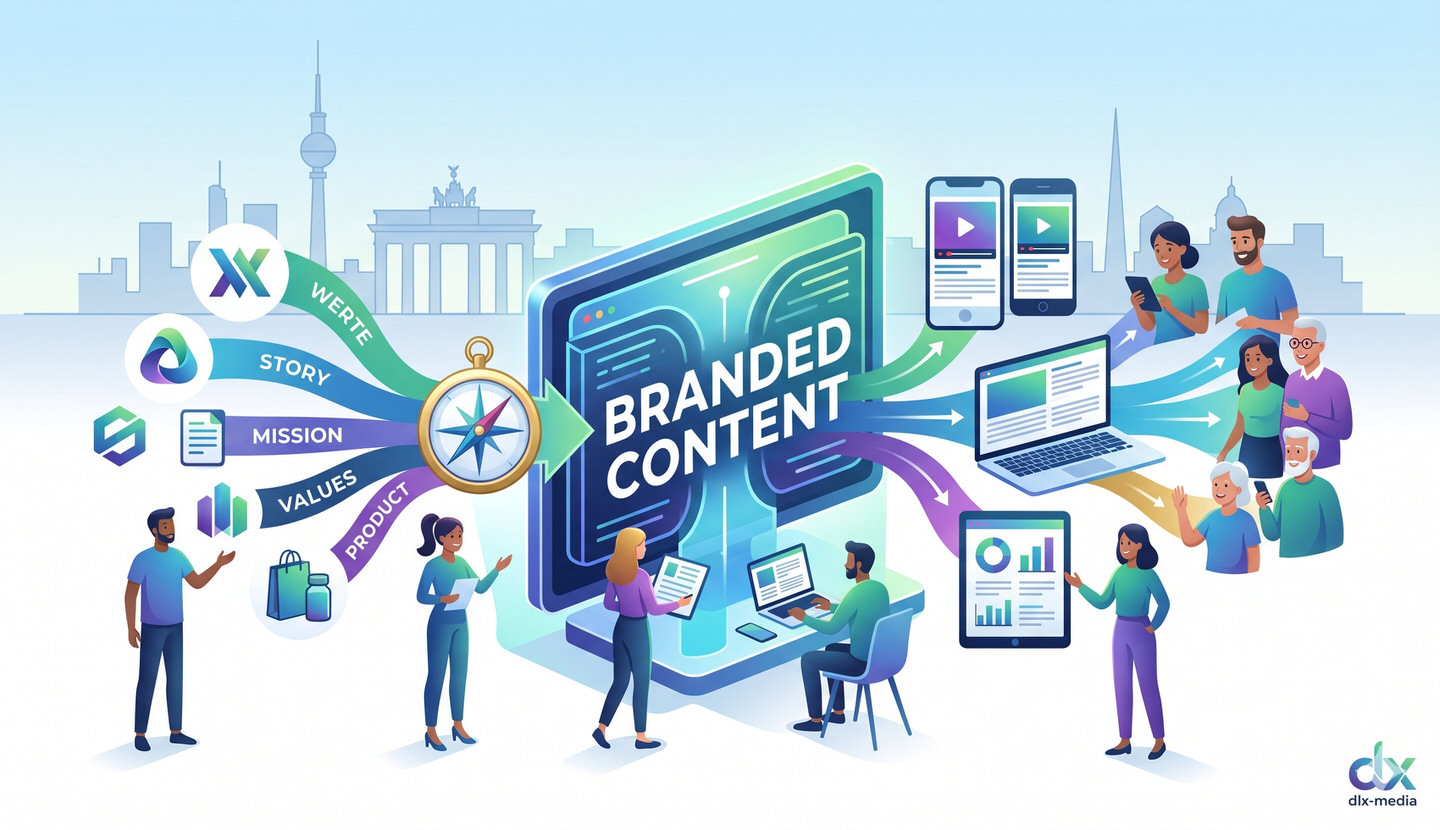
Branded Content
Branded Content connects brands with target audiences through valuable, entertaining content and storytelling instead of traditional advertising—authentic and emotional.
Branded Content – Connecting Brands Through Authentic Storytelling
Branded Content (German: brand-bound content) is a modern marketing strategy aimed at building emotional connections between brands and their target audience – not through direct advertising, but through valuable, entertaining, or informative content that is linked to the brand’s values and identity.
Unlike traditional advertising, which is often perceived as disruptive, Branded Content focuses on organic integration: the brand is not explicitly promoted but rather made experiential – through stories, entertainment, or useful information that the audience voluntarily consumes and shares.
This strategy is particularly gaining importance in Europe (including Germany and Poland), as consumers increasingly prefer authentic, non-intrusive brand communication. Studies show that 70% of consumers prefer to consume content from brands they find relevant and entertaining rather than traditional advertising.
---
What Is Branded Content?
Branded Content is a form of content marketing in which a brand creates or sponsors content that primarily provides added value for the target audience – whether through entertainment, education, or inspiration. The brand itself is not the focus; instead, it’s the message or experience associated with it.
Definition: Branded Content refers to “content initiated or financed by a brand but designed to appear like natural content – with the goal of creating positive associations with the brand.”
Examples of Branded Content:
- Red Bull Stratos: Felix Baumgartner’s stratospheric jump (2012) was a branded content campaign that associated Red Bull with extreme sports and innovation – without directly promoting the drink.
- Dove “Real Beauty”: The campaign advocated for a realistic beauty ideal and strengthened Dove’s image as a brand that promotes self-acceptance.
- LEGO Ideas: The platform allows fans to submit their own designs – an example of user-generated branded content.
- Netflix “Stranger Things”: While the series itself is not branded content, the associated interactive experiences (e.g., escape rooms) or social media challenges (e.g., #UpsideDown) are.
---
Branded Content vs. Traditional Advertising – The Difference
While traditional advertising aims to directly promote products or services, Branded Content focuses on the brand’s world. The following table highlights the key differences:
| Criteria | Branded Content | Traditional Advertising |
|---|---|---|
| Goal | Build emotional connections, strengthen brand image | Sell a product or service |
| Focus | Story, added value, entertainment | Product features, price, USP |
| Perception | Consumed as content (e.g., articles, videos, podcasts) | Perceived as advertising (e.g., banners, commercials) |
| Placement | Organic integration in media, social media, blogs | Paid ads (TV, print, online banners) |
| User Interaction | High engagement rate (likes, shares, comments) | Lower interaction (clicks, impressions) |
| Long-Term Effect | Strengthens brand loyalty and trust | Short-term sales increase |
---
Key Strategies for Successful Branded Content
Branded Content can be implemented in various forms and across different channels. The following strategies are particularly effective:
1. Storytelling – The Power of Narrative
Storytelling is the heart of Branded Content. A good story:
- Evokes emotions (joy, inspiration, empathy).
- Is authentic and aligns with the brand’s identity.
- Has a clear narrative thread and message.
- Is implemented in a visually appealing way (e.g., through videos, infographics).
Example: Coca-Cola’s “Share a Coke” campaign told individual stories by printing names on bottles – creating a personal connection to the brand.
2. Native Advertising – Ads That Don’t Look Like Ads
Native ads are paid content that seamlessly blends into its environment (e.g., in an online magazine or social media feed). They are designed to not appear as advertising but rather like editorial content.
Requirements for successful native advertising:
- High content quality (informative, entertaining, relevant).
- Clear labeling as “Ad” or “Sponsored Content” (legally required, e.g., under EU guidelines).
- Fit with the target medium (e.g., an article in the style of the magazine in which it appears).
3. Content Marketing – Long-Term Engagement Through Added Value
Content Marketing is a comprehensive strategy that uses Branded Content as part of a larger ecosystem. The goal is to build a community through regular, high-quality content and be perceived as a trustworthy source.
Formats for Content Marketing:
- Blogs: Regular articles on topics that interest the target audience.
- E-books/Whitepapers: In-depth guides on specialized topics.
- Webinars/Podcasts: Share expert knowledge and foster dialogue.
- Newsletters: Regular updates and exclusive content.
4. Influencer Marketing – Authenticity Through Trusted Individuals
Influencers can convey Branded Content in a personal and credible way. Particularly in Poland and Germany, brands are increasingly collaborating with micro-influencers (10,000–100,000 followers), as they often have a more engaged community than major stars.
Success factors for influencer collaborations:
- Alignment with the brand: The influencer should share the brand’s values.
- Authenticity: The collaboration should feel natural (not overtly promotional).
- Creative freedom: Influencers know their community best – too many guidelines can reduce credibility.
- Transparency: Labeling as “Advertising” or “Collaboration” is legally required in the EU (e.g., #ad, #sponsored).
5. User-Generated Content (UGC) – Involving the Community
UGC means that users create content themselves that is associated with the brand. This can be encouraged through contests, hashtag campaigns, or product reviews.
Advantages of UGC:
- Authenticity: Content from users appears more credible than brand messages.
- Reach: Users share content within their own networks.
- Cost efficiency: UGC is often cheaper than self-produced content.
- Community engagement: Users feel like part of the brand.
Example: GoPro leverages UGC by encouraging users to share their action footage (#GoPro). The best clips are featured on the brand’s official channels.
6. Social Media Marketing – Dialogue Instead of Monologue
Social media is the ideal channel for Branded Content, as it focuses on interaction and dialogue. Brands can:
- Tell stories (e.g., through Instagram Stories or TikTok videos).
- Provide behind-the-scenes insights (e.g., how products are made).
- Share and reward user-generated content.
- Conduct live interactions (e.g., Q&A sessions, live streams).
Recommended platforms for Branded Content in Europe:
- Instagram/TikTok: Ideal for visual, emotional content (especially for younger audiences).
- LinkedIn: Perfect for B2B brands and professional content.
- YouTube: For long-form videos (tutorials, documentaries).
- Facebook: Good reach among older audiences (30+).
- Twitter/X: For real-time communication and discussions.
7. Viral Marketing – Content That Spreads on Its Own
Viral Branded Content is characterized by high shareability. Such content is usually:
- Emotional (funny, touching, surprising).
- Simple (easy to understand and pass on).
- Relevant (aligned with current trends or topics).
- Visually appealing (e.g., memes, short videos).
Example: The “Ice Bucket Challenge” (2014) was a viral campaign initially launched by the ALS Association and spread globally – without traditional advertising.
8. SEO – Visibility for Branded Content
Even the best Branded Content is ineffective if no one finds it. Search engine optimization (SEO) is therefore crucial for generating organic reach.
SEO tips for Branded Content:
- Keyword research: Identify topics your target audience is searching for.
- High-quality content: Content should be in-depth, unique, and useful.
- Technical optimization: Loading times, mobile-friendliness, structured data.
- Backlinks: Build high-quality links from other websites.
- Social signals: Shares and likes on social media can positively impact ranking.
9. ROI Measurement – Quantifying Success
The return on investment (ROI) of Branded Content is often harder to measure than that of traditional advertising. However, there are key KPIs that provide insights into success:
Important metrics for Branded Content:
| KPI | Meaning | Tools for Measurement |
|---|---|---|
| Reach | Number of people who have seen the content | Google Analytics, Social Media Insights |
| Engagement Rate | Likes, shares, comments, saves | Facebook Insights, Instagram Analytics, Hootsuite |
| Dwell Time | How long users interact with the content | Google Analytics, Hotjar |
| Brand Awareness | Brand recognition (e.g., through surveys) | Google Trends, Brandwatch, YouGov |
| Lead Generation | Number of contacts or inquiries generated by the content | HubSpot, Salesforce, Google Analytics |
| Conversion Rate | Percentage of users who perform a desired action (e.g., purchase, sign-up) | Google Analytics, Adobe Analytics |
---
The Importance of Authenticity in Branded Content
Authenticity is the key to the success of Branded Content. Consumers – especially in Europe – are more critical and better informed than ever before. They quickly recognize when content feels contrived or manipulative.
How brands achieve authenticity:
- Honesty: Avoid making exaggerated promises.
- Transparency: Clearly label paid content (e.g., “Sponsored by” or “In collaboration with”).
- Consistency: Content should align with the brand identity and values.
- Focus on the user: Content should primarily serve the needs of the target audience – not the brand’s sales goals.
- Dialogue instead of monologue: Respond to feedback and criticism (e.g., on social media).
Example of authentic Branded Content: The brand Patagonia has been advocating for environmental protection for decades. Their campaigns (e.g., “Don’t Buy This Jacket”) are not just advertising but reflect the company’s genuine commitment – which builds significant credibility with their audience.
---
Advantages of Branded Content
Branded Content offers numerous benefits – for both brands and consumers:
| Advantages for Brands | Advantages for Consumers |
|---|---|
| Stronger brand loyalty and engagement | Access to entertaining, informative content |
| Improved brand perception (positive image) | No disruptive ads, but natural content |
| Higher engagement rates (likes, shares, comments) | Added value through useful information or entertainment |
| Better SEO performance through high-quality content | Trust in brands that deliver transparent content |
| Cost efficiency compared to traditional advertising | More personal approach through storytelling |
| Long-term customer relationships | Opportunity to interact with brands (e.g., through UGC) |
---
Challenges and Solutions
Despite its many advantages, there are also challenges in implementing Branded Content. The following tips help overcome them:
| Challenge | Solution |
|---|---|
| High production costs (e.g., for videos or elaborate campaigns) |
|
| Difficult success measurement |
|
| Low reach |
|
| Lack of authenticity |
|
| Legal hurdles (e.g., disclosure requirements) |
|
---
Tools and Platforms for Branded Content
There are numerous tools and platforms for planning, creating, and distributing Branded Content. Here’s an overview of the most important ones:
| Category | Tool/Platform | Functions | Price (from) |
|---|---|---|---|
| Content Creation | Canva | Graphic design, social media templates, videos | Free (Premium from 12.99 EUR/month) |
| Adobe Creative Cloud | Professional design (Photoshop, Illustrator, Premiere Pro) | 24.19 EUR/month | |
| HubSpot | Content management, blogging, SEO optimization | 45 USD/month | |
| Grammarly | Spelling and grammar check, style improvement for texts | Free (Premium from 12 USD/month) | |
| Hemingway Editor | Text optimization for clarity and readability | 19.99 USD (one-time payment) | |
| Distribution & Promotion | Hootsuite | Social media management, scheduling, analytics | 49 USD/month |
| Buffer | Social media scheduling, analytics | Free (Premium from 15 USD/month) | |
| Mailchimp | Email marketing, newsletters, automation | Free (Premium from 13 USD/month) | |
| BuzzSumo | Content research, trend analysis, influencer discovery | 99 USD/month | |
| Outbrain | Native advertising, content distribution on major media sites | Custom pricing | |
| Analysis & Optimization | Google Analytics | Website traffic, user behavior, conversions | Free |
| Matomo | GDPR-compliant alternative to Google Analytics | Free (Cloud from 23 EUR/month) | |
| Hotjar | Heatmaps, session recordings, user feedback | Free (Premium from 32 EUR/month) | |
| Brandwatch | Social listening, brand reputation, competitive analysis | Custom pricing |
---
Frequently Asked Questions (FAQ) About Branded Content
1. What is the difference between Branded Content and Content Marketing?
Branded Content is a subset of content marketing.
- Branded Content focuses on making the brand itself experiential through content (e.g., via storytelling or emotional campaigns).
- Content Marketing is a broader approach that includes all content created by a brand – even that which is primarily informative or sales-oriented.
Summary: All Branded Content is Content Marketing, but not all Content Marketing is Branded Content.
2. How do I find the right target audience for my Branded Content?
The target audience for Branded Content should be precisely defined. The following steps help:
- Create personas: Fictional profiles of ideal customers, including demographics, interests, and pain points.
- Analyze data: Use tools like Google Analytics or social media insights to understand your existing audience.
- Market research: Conduct surveys or interviews to identify needs and preferences.
- Competitor analysis: Check which audiences competitors are targeting.
- Test: Run A/B tests with different content to measure responses.
3. How much does Branded Content cost?
The cost of Branded Content varies widely and depends on factors such as format, quality, reach, and collaborations. Here’s a rough guide:
| Format | Cost (approx.) |
|---|---|
| Blog post (1,000–1,500 words) | 100–500 EUR |
| Infographic | 500–2,000 EUR |
| Short video (1–3 minutes) | 2,000–10,000 EUR |
| Long-form video (5+ minutes) | 10,000–50,000 EUR |
| Influencer collaboration (micro-influencer, 1 post) | 100–1,000 EUR |
| Influencer collaboration (macro-influencer, 1 post) | 5,000–50,000 EUR |
| Native advertising (e.g., on major media sites) | 1,000–20,000 EUR |
Tip: For smaller budgets, user-generated content or collaborations with micro-influencers are particularly suitable.
4. How long should Branded Content be?
The ideal length depends on the format and the target audience:
- Blog posts: 1,000–2,000 words (for SEO and depth).
- Social media posts: Short and concise (e.g., 150–300 characters on Twitter, 1,000–2,000 characters on LinkedIn).
- Videos:
- Social media: 15–60 seconds (e.g., TikTok, Instagram Reels).
- YouTube: 2–10 minutes (for tutorials or storytelling).
- Documentaries: 10–30 minutes (for in-depth content).
- Podcasts: 20–60 minutes (for detailed discussions).
- Infographics: As long as necessary to present the information clearly.
Note: Quality is more important than length – the content should be engaging and relevant.
5. What legal aspects do I need to consider with Branded Content?
In Germany and the EU, strict rules apply to Branded Content and influencer marketing. The most important points:
- Disclosure requirement:
- Paid content must be clearly labeled as “Advertising”, “Ad”, or “Sponsored”.
- On social media: Use hashtags like #ad, #sponsored, or #werbung.
- In blogs or articles: Include a note like “In collaboration with [Brand]” or “This article contains advertising.”
- Imprint requirement:
- All commercial websites (including blogs with ads) must include an imprint (§ 5 TMG in Germany).
- Influencers must provide contact details in their profiles if they post commercial content.
- Data protection (GDPR):
- When collecting user data (e.g., for newsletters), consent must be obtained.
- Users have the right to access, deletion, and withdrawal.
- Copyright:
- Third-party content (images, music, texts) may only be used with permission or license.
- For user-generated content: Ask users for permission before sharing their content.
- Competition law:
- Advertising must not be misleading (§ 5 UWG in Germany).
- Comparisons with competitors must be objective and verifiable.
Recommendation: If in doubt, seek legal advice or consult associations like the BVDW (German Digital Economy Association).
6. Which industries benefit most from Branded Content?
Branded Content is suitable for almost all industries, but particularly for:
- Lifestyle & Fashion: Brands like Nike or Zara use storytelling to evoke emotions.
- Travel & Tourism: Travel providers share inspiring stories about destinations.
- Technology: Companies like Apple or Samsung explain complex products through engaging content.
- Finance & Insurance: Branded Content helps build trustworthy expertise.
- Health & Wellness: Brands share tips and success stories.
- Sustainability & Environment: Companies like Patagonia use Branded Content to communicate their values.
- B2B: Branded Content is also becoming increasingly important in business-to-business (e.g., through whitepapers or case studies).
7. How often should I publish Branded Content?
The frequency depends on the target audience, resources, and platform. Here’s a guide:
| Platform | Recommended Frequency |
|---|---|
| Blog | 1–2 articles per week |
| 3–5 posts per week + daily Stories | |
| 2–3 posts per week | |
| YouTube | 1–2 videos per week (for consistent growth) |
| TikTok | 3–5 videos per week (high frequency for algorithm) |
| Newsletter | 1–2 times per month |
| Podcast | 1 episode per week or every 2 weeks |
Important: Quality over quantity – it’s better to publish less frequent, high-quality content than frequent, superficial posts.
---
Conclusion: Branded Content as a Game-Changer for Modern Brands
Branded Content is more than just a marketing trend – it represents a fundamental shift in how brands communicate with their target audience. In a world where consumers increasingly expect authenticity, transparency, and added value, Branded Content offers the opportunity to build genuine connections – beyond traditional advertising.
Through storytelling, emotional engagement, and valuable content, brands can:
- increase their awareness,
- gain the trust of their target audience,
- strengthen customer loyalty, and
- generate long-term revenue.
The key to success lies in understanding the needs of the target audience and creating content that provides real added value – whether through entertainment, information, or inspiration. Those who succeed will not only be perceived as a brand but as a valuable part of their customers’ lives.
Recommendation: Start with a small, targeted campaign (e.g., a blog or social media series), measure success, and continuously optimize. Use the wide range of tools and platforms available today to efficiently plan, implement, and distribute Branded Content.