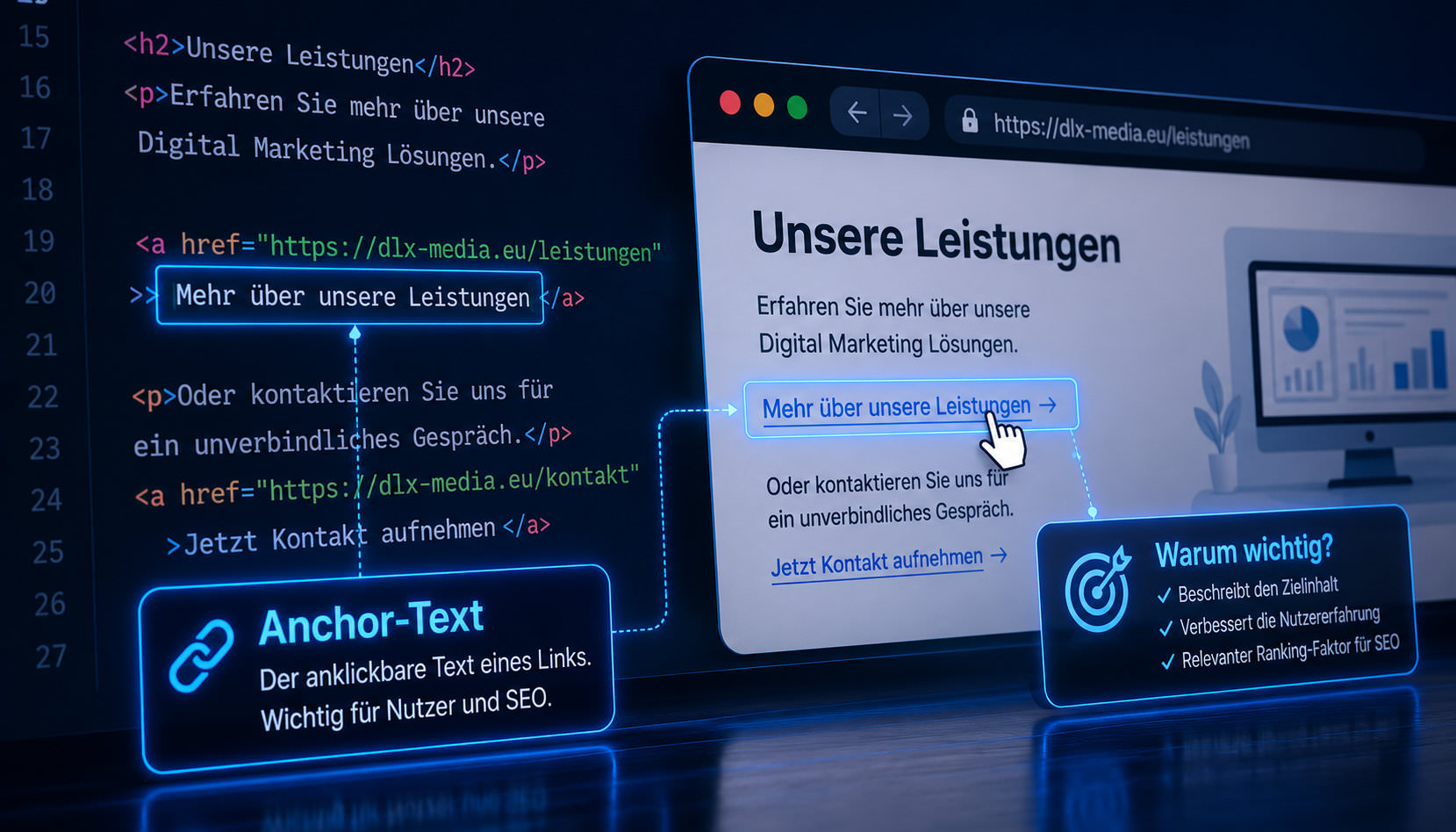
Anchor Text
Anchor texts are clickable link texts that optimize SEO and user guidance—key for rankings and user experience.
Navigation Tool for Websites
What Is an Anchor Text?
The anchor text (also known as link text or clickable text) is the visible, clickable text of a hyperlink. It creates the connection between two web pages and is a central element of search engine optimization (SEO) as well as user guidance. By choosing precise anchor texts, users and search engines can better understand and classify the content of the target page.
The Importance of Anchor Texts
Anchor texts serve several important functions:
- Content Description: They provide users and search engines with an indication of what content to expect on the linked page.
- Contextualization: They help search engines understand the thematic relationship between the linking and linked pages.
- User Guidance: Clear and descriptive anchor texts improve the user experience by setting and fulfilling expectations.
- SEO Signals: Search engines use anchor texts as a ranking signal to assess the relevance of a page for specific search terms.
Types of Anchor Texts
There are various types of anchor texts, each with different advantages and disadvantages:
Exact Match
The anchor text contains exactly the keyword for which the target page should rank.
- Example: "SEO agency" links to a page about SEO agencies.
- Advantages: Strong ranking signal for the specific keyword.
- Disadvantages: Can be considered spam if overused.
Partial Match
The anchor text contains the keyword along with other words.
- Example: "Tips from an SEO agency" links to a page about SEO agencies.
- Advantages: Appears more natural and less manipulative.
- Disadvantages: Weaker ranking signal than exact match.
Branded
The anchor text contains the brand name.
- Example: "DLx-Media" links to the DLx-Media homepage.
- Advantages: Strengthens brand awareness and appears natural.
- Disadvantages: No direct ranking signal for generic keywords.
Generic
The anchor text is very general.
- Example: "Click here" or "More information".
- Advantages: Simple and universally applicable.
- Disadvantages: No SEO value as it does not convey thematic relevance.
Naked URL
The anchor text is the URL itself.
- Example:
https://www.dlx-media.com/seo - Advantages: Transparent and builds trust.
- Disadvantages: No SEO value as it contains no keywords.
Image Links
The anchor text is part of an image (Alt attribute).
- Example: A logo with alt text "DLx-Media SEO Agency".
- Advantages: Visually appealing, can provide SEO signals through the alt text.
- Disadvantages: Search engines may understand the context less well than with text links.
Best Practices for Effective Anchor Texts
Basic Rules for Creation:
- Natural and Readable: Anchor texts should fit naturally into the flow of text and make sense for users.
- Precise and Descriptive: The text should clearly indicate what content to expect on the target page.
- Diverse: Use a mix of different anchor text types to create a natural link profile.
- Avoid Keyword Stuffing: Avoid excessive use of exact keyword matches.
- Short and Concise: Ideally, 2-5 words that precisely describe the content of the target page.
Examples of Good Anchor Texts:
| Context | Poor Anchor Text | Good Anchor Text |
|---|---|---|
| Link to an SEO guide | Click here | Comprehensive guide to search engine optimization |
| Link to a product | More info | Technical specifications of the SEO tool |
| Link to a blog post about content marketing | Article | 10 tips for successful content marketing |
| Link to the homepage | Home | DLx-Media - SEO Agency Berlin |
Anchor Texts and SEO
How Anchor Texts Influence Ranking:
- Relevance Signal: Search engines use anchor texts to determine the thematic relevance of a page for specific search terms.
- Link Juice Distribution: Anchor texts help distribute "link power" (link juice) thematically appropriately to a page.
- Contextual Understanding: They help search engines better understand the context and meaning of pages.
- User Behavior: Good anchor texts lead to higher click-through rates and better user behavior, which can positively impact ranking.
Common SEO Mistakes with Anchor Texts:
| Mistake | Problem | Solution |
|---|---|---|
| Over-optimization with exact match | Too many exact keyword matches appear unnatural | Vary anchor texts with synonyms and related terms |
| Generic anchor texts | "Click here" provides no context | Use descriptive texts that indicate the content of the target page |
| Anchor texts that are too long | Long sentences are hard to read and unwieldy | Keep anchor texts short and concise (2-5 words) |
| Misleading anchor texts | The text promises different content than what is on the target page | Ensure the anchor text reflects the actual content of the target page |
| Excessive use of brand names | Too many branded links can limit thematic diversity | Combine brand names with descriptive texts |
Anchor Texts in Practice
Internal Linking:
For internal links (links within your own website), anchor texts should:
- Guide the user through the website and facilitate navigation.
- Link thematically appropriate subpages to strengthen relevance.
- Reflect the hierarchy and structure of the website.
External Linking:
For external links (links to other websites), anchor texts should:
- Clearly indicate to the user that they are leaving the website.
- Precisely describe the content of the external page.
- Be appropriately labeled for affiliate links or paid links.
Anchor Texts in Content Strategies:
- Blog Posts: Use anchor texts to link to related articles and increase dwell time.
- Product Pages: Link to related products or category pages with descriptive texts.
- Service Pages: Use anchor texts to refer to case studies or customer references.
- FAQ Pages: Link to detailed explanations or guides.
Tools for Analysis and Optimization
There are various tools that can help with the analysis and optimization of anchor texts:
- Google Search Console: Shows the anchor texts that other websites use to link to your page.
- Ahrefs: Analyzes the anchor text profile of your backlinks and identifies optimization potential.
- SEMrush: Provides insights into the anchor text distribution of your backlinks and competitors.
- Screaming Frog: Crawls your website and analyzes internal anchor texts.
- Moz Link Explorer: Shows the anchor text profile of your backlinks with a quality assessment.
FAQ: Frequently Asked Questions About Anchor Texts
General Questions:
Why are anchor texts important for SEO?
Anchor texts are important because they help search engines understand the content and context of the linked page. They serve as a ranking signal and influence how a page is ranked for specific search terms. At the same time, they improve the user experience by clearly indicating what content to expect after clicking.
How many different anchor texts should I use?
There is no fixed rule, but a healthy mix of different anchor text types (exact match, partial match, branded, generic) appears most natural. As a rule of thumb: No more than 20-30% of your anchor texts should be exact match. The rest should consist of partial match, branded, and other variations.
Can I use the same anchor text multiple times?
Yes, you can use the same anchor text multiple times, especially if it is natural and thematically appropriate. However, you should ensure not to use too many identical anchor texts, as this can appear unnatural. Vary the texts wherever it makes sense.
Technical Questions:
How do I change an anchor text in HTML?
In HTML, you change the anchor text by adjusting the text between the <a> and </a> tags: <a href="targetpage.html">New Anchor Text</a>
How do anchor texts affect user behavior?
Good anchor texts improve the user experience by setting clear expectations. Users are more likely to click on links that describe what they will find on the target page. This leads to a higher click-through rate (CTR) and a lower bounce rate, which can positively impact SEO ranking.
Best Practices:
Should I use keywords in anchor texts?
Yes, keywords can be used in anchor texts, but with caution. Use keywords only if they fit naturally into the context and accurately describe the content of the target page. Avoid keyword stuffing, as this can be considered spam by search engines.
How long should an anchor text be?
Ideally, an anchor text should be between 2 and 5 words long. It should be short enough to be easily readable but long enough to precisely describe the content of the target page. In rare cases, longer descriptive texts can also be useful.
Can anchor texts contain special characters?
Yes, anchor texts can contain special characters if they make sense in the context. However, you should ensure that the characters are displayed correctly in all browsers and devices. Avoid excessive use of special characters, as this can impair readability.
Conclusion: Anchor Texts as a Strategic SEO Element
Anchor texts are a powerful but often underestimated tool in search engine optimization. They not only connect web pages but also convey valuable signals to search engines and users. By strategically using anchor texts, you can:
- Increase the relevance of your pages for specific search terms.
- Improve the user experience through clear and descriptive links.
- Optimize the link structure of your website and facilitate crawlability for search engines.
- Boost the authority and ranking of your website in search results.
A natural, diverse, and thematically appropriate anchor text profile is crucial for long-term SEO success. Take the time to carefully plan and optimize your anchor texts—your users and search engines will thank you.